Practical decision first: if you value ease of moving quickly through airports and minimizing uncertainty, pick a simpler itinerary with one carrier and clear baggage rules; if you value the freedom to change dates at short notice, choose a fare class or carrier that explicitly allows flexible changes even if it costs more or adds connections. For solo travelers between Seoul and Osaka that tradeoff—schedule flexibility versus convenience—matters more than marginal savings because single travelers absorb all connection risk and often need reliable arrival and baggage handling. Before checking live options, decide how fixed your travel dates are, whether you’ll carry checked luggage, and how tight your onward plans in Osaka must be. This article explains how to compare routing, connection and baggage risk, schedule fit, and fare terms so you can make a one-shot booking with confidence.
See live routes for your exact travel day
Compare direct and connecting choices with the same baggage and traveler details.
Routing: direct versus connecting options
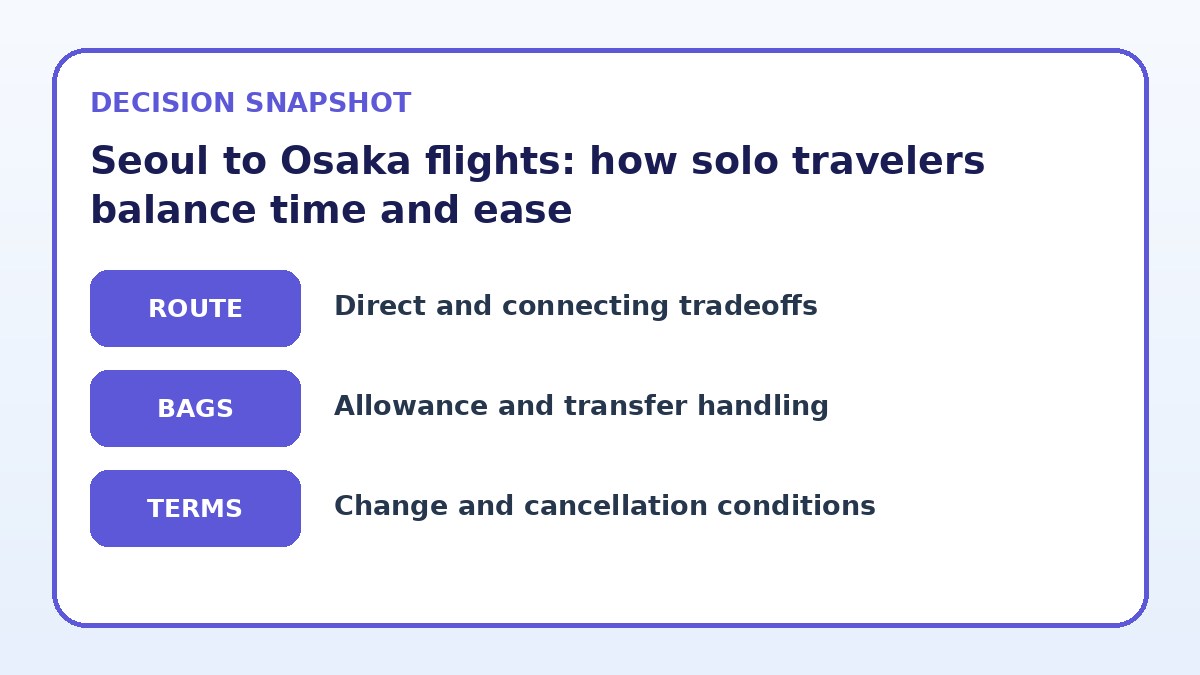
On the Seoul to Osaka corridor you’ll typically see both direct flights and itineraries that route through another airport. For a solo traveler focused on convenience, direct or single-stop itineraries operated by one carrier simplify connections, reduce transfer distance, and limit the number of operators whose rules you must follow. When comparing listings, explicitly check the total elapsed travel time, the number of carrier changes, and whether an itinerary is marked as a codeshare—codeshares can look convenient but may complicate baggage transfer and irregularity handling.
If schedule flexibility is the priority, connecting itineraries can sometimes offer more date options or lower change penalties, because different carriers and markets price changeability differently. However, more connections raise the chance of missed onward flights or baggage delays, and solo travelers bear those risks alone. When you find a connecting route you like, examine the minimum connection time displayed and verify transfer airport layout and whether the connection requires changing terminals or re-clearing security or immigration—details you must confirm on provider pages before booking.
Baggage and connection risk for solo travelers
Checked baggage policies and how carriers handle transfers are central to comfort for a solo traveler. A single-carrier itinerary usually provides through-checked baggage from origin to final destination, which greatly reduces the chance you need to collect and re-check luggage during a connection. Low-cost or mixed-carrier itineraries may require you to claim and re-check bags, which adds time, complexity, and risk if you need to move between terminals or pass immigration. Always verify baggage transfer promises on the booking page and in the carrier’s contract of carriage.
If you plan to travel light with only carry-on luggage, you can accept tighter connections and potentially mix carriers for greater schedule flexibility. But consider airline size limits for cabin bags and gate-check practices, and confirm whether connections are protected by the carrier(s). For solo travelers who must arrive with checked luggage, prioritize itineraries that guarantee through-checked service or provide realistic transfer buffers to reduce the chance of lost bags or overnight delays.
Compare flight-selection strategies
| Flight strategy | Best for | Risk to check |
|---|---|---|
| Direct, single-carrier full-fare | Solo travelers prioritizing convenience and low connection risk | Usually less flexible on date changes and often more costly than restricted fares |
| Direct, change-friendly fare | Travelers who want a simple itinerary but may need to change dates | Higher fare than basic tickets; still limited if carrier restricts same-day swaps |
| Connecting mixed-carrier itinerary | Travelers seeking lower fares or broader schedule options | Increases baggage and missed-connection risk; check transfer rules carefully |
| Low-cost carrier with add-ons | Very flexible solo travelers traveling light who prioritize price over convenience | Add-on fees for baggage, seats, and changes quickly reduce apparent savings |
Recheck the complete itinerary
Confirm airports, connection handling, baggage, and change conditions before deciding.
Schedule fit: departure times, layovers, and your tolerance
Match the timetable to your personal rhythm and onward plans in Osaka. If you have early check-ins, tours, or train connections after arrival, favor flights that arrive with sufficient buffer to account for immigration, baggage, and airport transfers. Solo travellers should be conservative when estimating transfer times—allow extra slack if you'll need to pick up a SIM, exchange money, or navigate a new airport. Use scheduled block times and expected arrival windows to plan ground transfers rather than relying on gate arrival times.
When flexibility matters more than precise arrival time, choose fares that allow date or time swaps without heavy penalties and avoid itineraries with very short connection windows. If your trip is open-ended or you want to keep the option to extend, check whether the fare supports same-day or near-term rebooking online. Confirm on the carrier or booking page what counts as a same-day change and whether standby options exist; these operational details differ across airlines and fare buckets and can only be trusted after you verify them before purchase.
Flight details to verify
- Confirm your exact travel dates, passport name, and preferred airports in Seoul (ICN/GMP) and Osaka (KIX/ITM) before searching live fares.
- Note whether you need checked baggage and search fares that explicitly include through-checked service for connecting itineraries.
- Open and read the fare rules on the airline’s booking page: record change fees, eligible change window, and refundability before you add to cart.
- Check minimum connection times, terminal changes, and whether transfers require immigration or re-checking luggage at the transfer airport.
- Estimate buffer time for arrival activities (immigration, baggage, currency, transport) and choose arrival times that match your onward schedule in Osaka.
- If booking through an aggregator, copy the flight details and verify identical fare conditions on the carrier’s official site before final payment.
Fare conditions and what to verify before booking
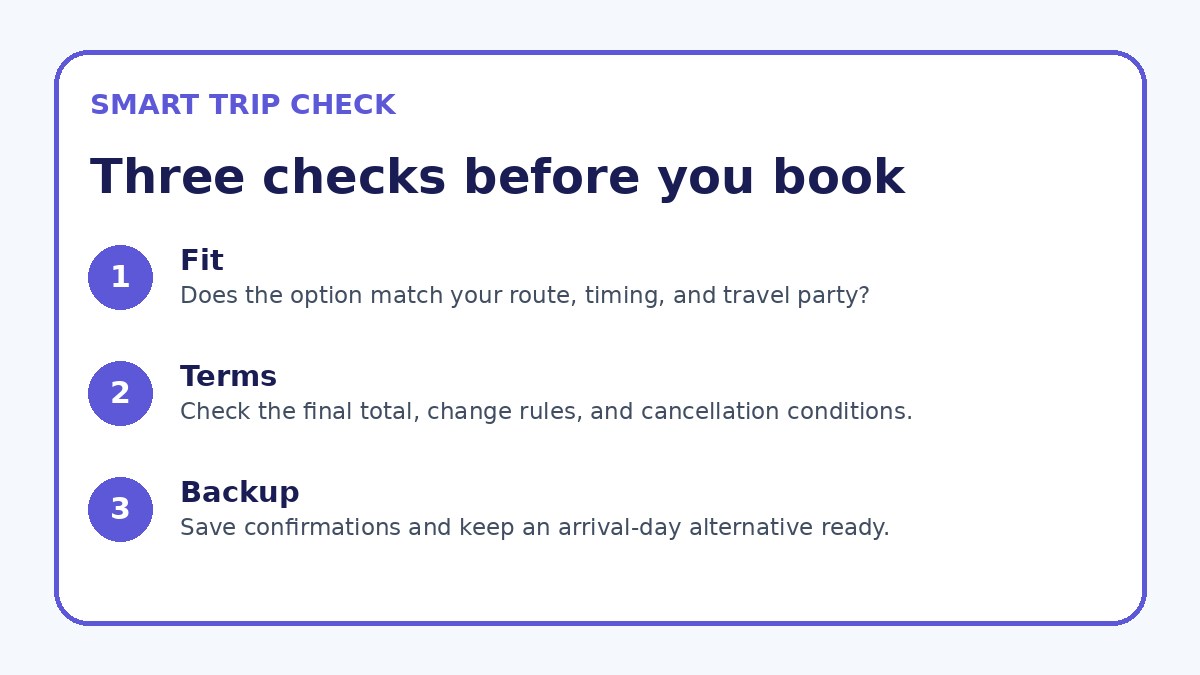
Fare rules are the operational reality behind any flexibility claim. Before you click buy, expand the fare rules on the booking page and note change fees, the window for free changes, refundability, and whether taxes or carrier surcharges apply on reissued tickets. For solo travelers, the biggest practical questions are whether you can change either your date or route without paying the full fare difference, and whether you can obtain a partial refund if plans collapse. Don’t assume the price shown is final until you review the full conditions and the carrier’s published change workflow.
Also confirm seat assignment policies, baggage allowances associated with the selected fare, and how loyalty benefits (if any) apply. If you use a travel aggregator, double-check these same details on the airline’s final booking page; aggregator displays can omit surcharges or limited conditions. Trip.com can be useful to compare live availability and conditions, but always verify fare rules, change fees, and cancellation procedures on the carrier’s official page before committing to a purchase.
Flight Guide questions travelers ask
Should I pick a direct flight or a cheaper connecting option for a solo trip?
If minimizing hassle, choose a direct or single-carrier itinerary that reduces transfer steps and usually gives through-checked luggage. If your dates are flexible and you’re prepared to handle potential transfer tasks (collecting bags, moving between terminals), a connecting option can be cheaper or offer more departure times. For solo travelers, weigh the time and stress of transfers against any savings, and verify that connection protection or baggage transfer is explicitly provided in the fare rules before booking.
How do I ensure my checked baggage transfers automatically on a connection?
Automatic baggage transfer is more likely on itineraries issued on a single ticket by one carrier or closely partnered carriers. Before booking, confirm on the booking page or the carrier’s contract of carriage that luggage is checked through to your final destination. If the trip mixes unrelated carriers or requires re-entry into immigration at the transfer airport, assume you will need to reclaim and re-check bags. When in doubt, contact the carrier directly and get written confirmation of through-check handling for your itinerary.
What fare details should I verify if I need the ability to change dates?
Look for explicit statements about change fees, whether changes are permitted online, and if a fare difference must be paid on top of any fee. Identify the exact window when free or reduced-fee changes are allowed (for example, within 24 hours of booking or up to a day before departure) and verify whether taxes and surcharges are refundable or credited toward rebooking. Always confirm these points on the carrier’s booking or fare rules page; aggregator summaries can omit important exclusions or processes.
Final decision note
Balancing schedule flexibility and convenience on Seoul to Osaka flights comes down to three practical choices: accept a simpler, single-carrier route with clearer baggage and connection handling; buy a more flexible fare that lets you change dates with lower friction; or accept mixed routing and light packing to gain more schedule options at the cost of transfer risk. For solo travelers the right decision depends on how fixed your dates are, whether checked luggage is essential, and how much transfer complexity you can handle alone. Prepare exact dates, passenger details, and baggage needs before you search. Then verify fare rules, baggage transfer promises, and connection protections on the airline’s final booking page so you know exactly what you’re buying.
Continue planning
Check current options and final conditions
Use the provider page to confirm live availability, the final total, cancellation terms, and every condition that matters to your trip.
This evergreen planning guide was created with AI-assisted drafting and a structured quality review. It does not display live prices, schedules, availability, visa guidance, or provider rankings. Verify current details before booking. Some links are affiliate links; we may earn a commission at no additional cost to you.