If you’re arriving in Sydney with more suitcases than you want to carry, the immediate question is whether renting a car will actually simplify your trip. Practically speaking, driving helps when you need door-to-door flexibility, heavy or bulky items, or onward travel outside the urban area; it creates friction when traffic, parking, or pickup logistics cost more time than they save. This guide gives the direct answer up front—rent a car if your itinerary includes multiple suburban stops, early starts, or bulky gear; otherwise favor public transport combined with a targeted paid transfer—and then explains the tradeoffs, what to check in insurance wording, pickup and return friction, and a reliable non-driving fallback you can use instead.
Decide whether driving genuinely improves your itinerary
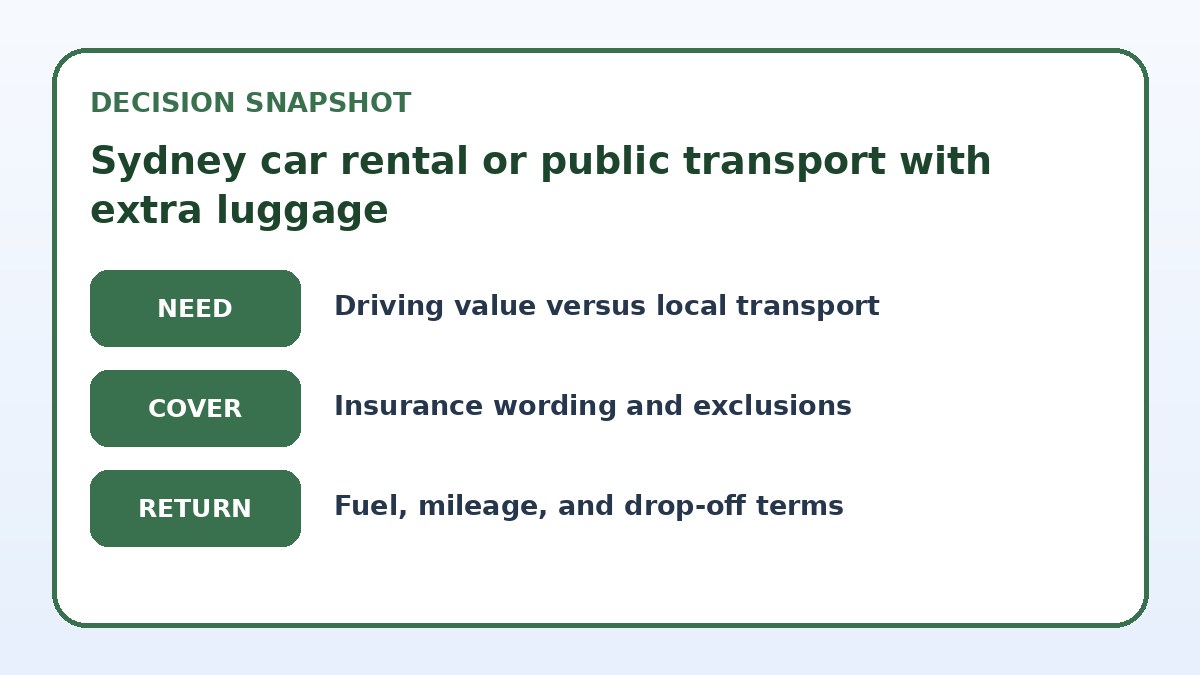
Start by mapping exactly where you need to go: airport arrival, hotel, meetings, day trips, and final departure. A rental car is worth the effort if your stops are widely spaced, include suburbs or beaches without frequent direct public transit, or if you’ll carry large items such as surfboards, photography gear, or trade-show boxes. If your schedule has many short, central-city activities or relies on peak-hour travel into the CBD, driving will often add delay and stress due to congestion and slow parking searches.
Also weigh the frequency and timing of your movements. Early-morning departures or late-night returns can favor a rental to avoid limited transport options, while daytime-only plans usually match train and bus services. Account for return logistics: will you be dropping the car back at the airport or city office, and how much time will that require? If the time and money spent on parking, fuel, and drop-off coordination exceed the practical benefits of door-to-door movement, public transit or mixed mobility will usually be the better choice.
Decide whether driving earns its place
| Mobility strategy | Best for | Cost or friction to check |
|---|---|---|
| Rent a car (self-drive rental) | Multiple suburban stops, bulky gear, early/late travel | Parking, fuel, and pickup/return steps add time and cost; verify insurance excess and exclusions |
| Public transport only (trains, buses, ferries) | Central Sydney stays with manageable luggage | Can be slow with heavy bags and requires station access with lifts; check luggage policies and station accessibility |
| Public transport plus single paid transfer (taxi or rideshare) | Central stay with heavy arrival/departure luggage | Higher per-leg cost but lower overall complexity; confirm pickup points and luggage capacity in vehicles |
| Private transfer or chauffeur service | Door-to-door service with heavy or awkward items | More expensive than self-serve options; confirm baggage rules, waiting time policies, and cancellation terms |
Check live rental choices only after the route test
Use the exact driver, dates, pickup point, and return plan to compare current conditions.
Insurance wording: what to verify before you book
Rental insurance phrasing affects your cost and liability more than headline coverage names. Look for the collision damage waiver (CDW) or loss-damage waiver and read the fine print: find the excess (the amount you’d pay after a claim), whether CDW excludes certain damage types (glass, undercarriage, tyres, roof), and how claims are handled. Confirm whether damage caused by improper loading or unsecured luggage is excluded; heavy or shifting cargo can cause damage that some policies don’t cover.
Also check whether third-party liability limits meet your expectations and if roadside assistance is included or optional. If you plan to add additional drivers, verify whether they are covered automatically or require a paid extra and what ID or licenses they must present. Finally, if you book through a broker or aggregator, review the rental company’s own final booking page to confirm coverage details rather than relying on summary claims in comparison tools.
Compare the full rental conditions
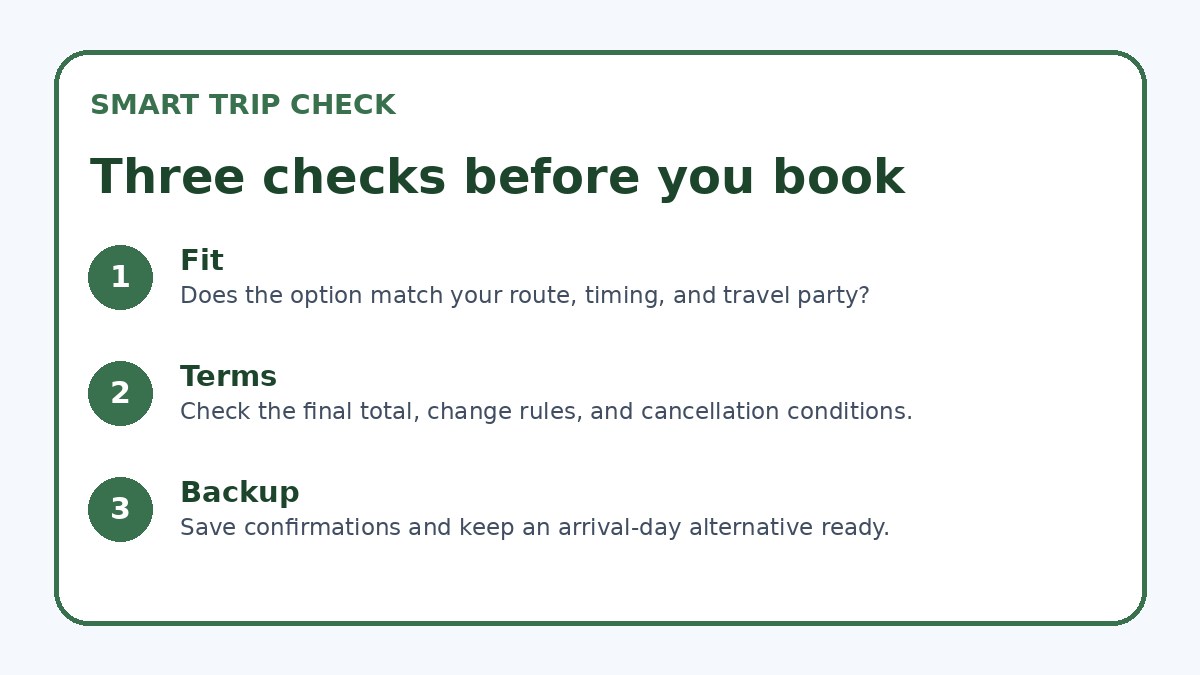
Confirm insurance wording, exclusions, deposit, fuel, mileage, and return terms on the final page.
Pickup and return friction: practical steps to minimize headaches
Airport pickups can be quick when you prepay or pre-complete forms, but they can also be time sinks when long queues, shuttle transfers, or desk paperwork intervene. Check whether the renter offers an on-airport counter versus an off-airport shuttle, and whether the vehicle handover includes a full walkaround with recorded damage photos. To reduce friction, arrive with digital confirmations, the right driving license (including any required international permit), and a credit card in the main driver’s name for the security hold.
Returning the vehicle often brings unexpected delays: refueling requirements, drop-off location differences, and final inspections. Decide in advance whether you will top up fuel or accept the company’s refuel charge, and allocate buffer time at the airport for the inspector’s final check. When possible, choose a provider whose return desk is near your departure terminal or arrange to return the car to a city location with easy onward transit to your flight; verify these details on the rental company’s final booking page before committing.
Car rental terms to verify
- Map every planned stop and note whether each address is on a direct train, bus, or ferry line with lifts or ramps.
- On the rental company’s final booking page, verify collision damage excess, exclusions for luggage-related damage, and whether roadside assistance is included.
- Confirm pickup logistics: on-airport counter versus off-airport shuttle, required documentation, and typical queue or handover times.
- Plan car return by locating the exact drop-off point, fuel return requirements, and whether an inspector will be present for a final walkaround.
- If not driving, prebook at least one paid transfer for arrival or departure to avoid juggling heavy luggage on public transport.
- Pack a compact wheeled day bag and test luggage wheels and handles to ensure they’ll survive pavement and station surfaces.
A reliable non-driving fallback for travelers with luggage
If you decide driving isn’t worth it, build a fallback plan that minimizes heavy-lifting while keeping arrivals and departures predictable. For arrivals, consider a pre-booked airport transfer for the first leg if you need help getting to a hotel with multiple large bags; otherwise, trains and light luggage trolleys are efficient for central areas. Use a single taxi or rideshare to bridge the station-to-hotel gap when stations aren’t conveniently sited for your accommodation.
For intercity or regional day trips, join small-group coach tours or book a private transfer if public services are sparse and your luggage would be a burden. When staying in central Sydney, learn the locations of staffed stations with lifts and plan your hotel choice around accessible public transport nodes. Keep a compact, wheeled day bag for short hops and leave bulk items in secure hotel storage if you’ll only need them for one or two out-of-town days.
Car Rental & Road Trip questions travelers ask
Will renting a car in Sydney always be faster than taking public transport with luggage?
Not always. Speed depends on where you’re going and when. Driving can be faster for multiple suburban stops or late-night schedules, but peak-hour traffic and the time needed for parking and drop-off often negate any time saved. For central-city itineraries with nearby train or ferry stations, public transport plus a single taxi at each end can be more predictable. Before you book, compare door-to-door travel time estimates for each leg, include parking search and walking times, and factor in the time it takes to collect and check in luggage.
What specific insurance wording should I look for on the rental confirmation page?
Look for the collision damage waiver (CDW) or loss-damage waiver details and the stated excess amount you’d be liable for after a claim. Check exclusions—some contracts exclude glass, undercarriage, tyres, roof, and damage from unsecured or overloaded luggage. Verify whether third-party liability limits meet your needs and whether roadside assistance and theft protection are included or optional. If you buy a damage-reduction add-on, confirm whether it replaces the excess or only reimburses you after you file a claim; always read the rental company’s own final booking page to confirm these terms.
How can I reduce pickup and return friction when I have extra suitcases?
Reduce friction by pre-completing renter details, choosing a provider with an on-airport counter if you value speed, and arriving with required documents and the credit card used for the reservation. Ask if the company documents vehicle condition with photos at handover to speed up disputes. For returns, know whether you must refuel and where the drop-off desk is relative to your departure terminal. If you’re tight on time, consider returning the car to a city location with a short, prebooked taxi to the airport; confirm exact drop-off instructions on the rental company’s final booking page.
Final decision note
The practical answer: rent a car in Sydney if your schedule requires multiple suburban stops, you’re carrying bulky or awkward items, or you need door-to-door flexibility outside regular public transport hours. If you’ll stay mostly in central Sydney and your luggage is manageable, combine trains, ferries and buses with a single paid transfer at arrival or departure to avoid parking and insurance headaches. Whatever you choose, check rental insurance excesses and exclusions, confirm pickup and return logistics on the provider’s final booking page, and prepare a non-driving fallback so unexpected delays don’t force last-minute decisions.
Continue planning
Check current options and final conditions
Use the provider page to confirm live availability, the final total, cancellation terms, and every condition that matters to your trip.
This evergreen planning guide was created with AI-assisted drafting and a structured quality review. It does not display live prices, schedules, availability, visa guidance, or provider rankings. Verify current details before booking. Some links are affiliate links; we may earn a commission at no additional cost to you.