If your Penang trip is work-first — meetings around George Town, client visits in Bayan Lepas, or supplier checks at local factories — deciding whether to rent a car hinges on fuel and mileage rules more than rental rates. The short answer: rent a car only if the routes you must cover make door-to-door time savings worth the extra admin of fuel clauses, mileage limits, and insurance wording. For many short, central business itineraries, taxis or ride-hailing can be cleaner. But if you have multiple stops across the island, frequent early starts, or equipment to move, a rental can be the more predictable option. Read the fine print on fuel policies, per-day or per-kilometre caps, and where refuelling is required, and verify insurance excesses and territorial limits before you book.
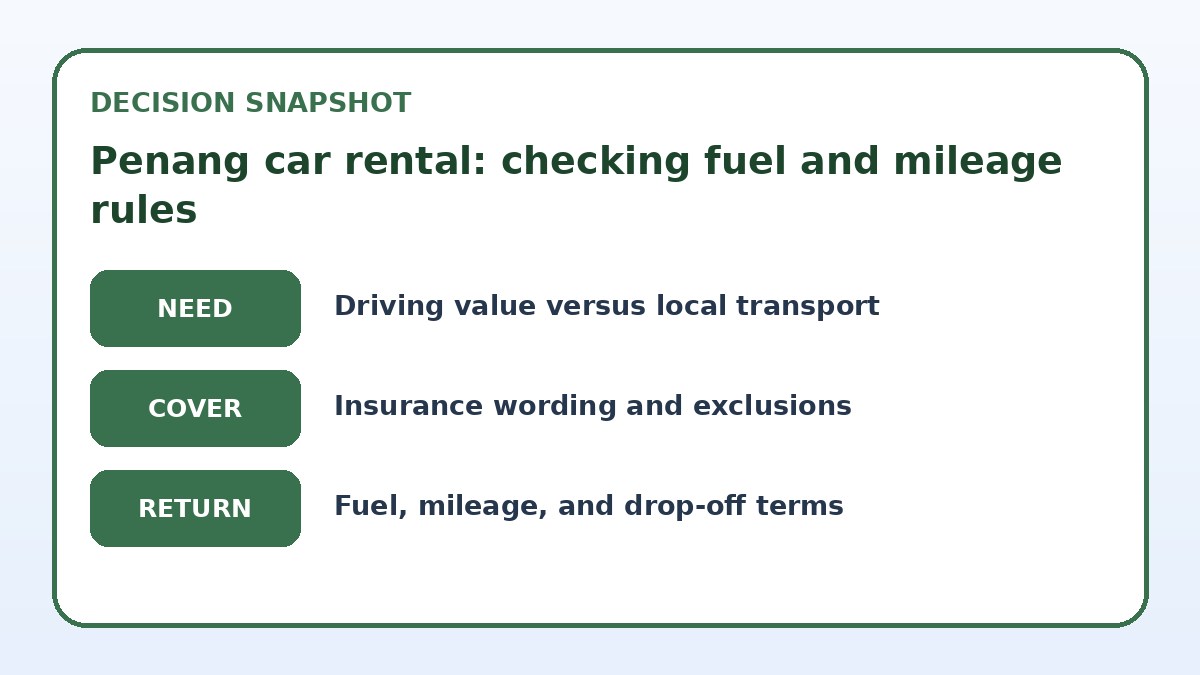
Decide whether driving improves your Penang business trip
Start by mapping your business appointments and the realistic sequence you’ll visit them in. Driving helps when you have back-to-back meetings in different parts of the island, need to transport samples or equipment, or expect late finishes outside reliable public-transport hours. If your schedule concentrates inside George Town’s core and you can rely on nearby hotels, the time saved by driving may be marginal once you add parking searches and congestion into the equation. Consider how predictable your start and end times are; rentals reward predictable, multi-stop itineraries more than sporadic single-meeting days.
Balance the operational benefits against administrative friction. Rentals mean contract signatures, fuel checks, and photographs at pickup and return. If your company prefers expense predictability, you must translate mileage and fuel rules into estimated outlays before booking. Also consider familiarity: if you or your company driver are comfortable with left-hand driving and Penang’s road patterns, a rental is less stressful. Otherwise, availability of reliable drivers or ride-hailing may outweigh the theoretical convenience of a hire car.
Decide whether driving earns its place
| Mobility strategy | Best for | Cost or friction to check |
|---|---|---|
| Rent a car (self-drive) | Multi-stop days, transporting samples or equipment across the island. | More admin (fuel rules, inspections, liability) and potential parking hassles in urban areas. |
| Ride-hailing and taxis | Single meetings or tightly scheduled downtown appointments where you want no vehicle responsibility. | Costs add up for many stops and you lose control over last-minute route changes or luggage handling. |
| Chauffeur or hotel-arranged car | Senior executives or when predictable door-to-door service and local driving expertise matter. | Higher hourly or daily cost and less control over pickup flexibility versus self-drive options. |
| Mixed approach (rental for heavy days, ride-hailing otherwise) | Schedules with a few days of heavy travel and other light, downtown days. | Requires coordination and potential extra administration for arranging two modes and expense reconciliation. |
Check live rental choices only after the route test
Use the exact driver, dates, pickup point, and return plan to compare current conditions.
What to check in the fuel and mileage clauses
Fuel policy wording varies and directly affects cost and convenience. Common models include full-to-full, full-to-empty, and prepaid fuel; each has different implications. For business clarity, full-to-full is simplest: you pick up a full tank and return full, avoiding the agency’s refuel-at-return markup. If the contract uses prepaid or full-to-empty terms, compare refill cost assumptions against local pump prices and the estimated fuel you’ll actually use. Always note how the company documents tank levels at handover—printed checklists and photos protect you from disputed charges.
Mileage terms can be per-day caps or unlimited usage; many contracts include a daily or total kilometre allowance with an overage fee. Convert your planned routes into estimated kilometres and check the per-kilometre charge in the contract. If you plan a mainland mainland-crossing trip or a long loop outside Penang, the overage fee can quickly outstrip any weekday saving from renting. Where mileage is unlimited, confirm whether there are territorial restrictions for crossing to nearby states or leaving the island, because some policies exclude certain areas or require prior notification.

Compare the full rental conditions
Confirm insurance wording, exclusions, deposit, fuel, mileage, and return terms on the final page.
Insurance wording and pickup/return friction to verify
Insurance language is where small words matter. Look for the excess amount — the sum you must pay before the insurer covers damage — and whether it applies per incident or per rental day. Confirm whether the quoted coverage includes third-party liability and whether business use is explicitly allowed; some standard personal policies exclude commercial or corporate errands. Also verify whether optional collision damage waivers (CDW) or theft protection are offered and whether accepting them reduces or eliminates the excess. Where you accept extra coverage, note the exact contract phrase that confirms reduced liability.
Pickup and return friction is an operational cost many travelers underestimate. Check whether airport pickups attract a premium, whether vehicle handover requires a long queue, and what documentation is needed to avoid delays. Inspect the vehicle jointly with the agent and record scratches or dents with timestamps and photos; get an agent’s signature or stamped copy of the condition report. On return, allow time for a final inspection rather than assuming the agent will process it immediately—discrepancies reported later often land on the renter. Before booking, note the provider’s stated processes for dispute resolution on the final booking page.
Car rental terms to verify
- Translate your full itinerary into estimated kilometres and compare that figure to the rental’s mileage allowance and overage rate on the provider’s final booking page.
- Confirm fuel policy wording (full-to-full, prepaid, or full-to-empty) and record how tank levels will be documented at pickup and return.
- Read insurance terms for excess amounts, whether business use is permitted, and whether optional waivers reduce your liability; save screenshots of the clauses.
- Photograph the vehicle exterior and interior with timestamps at pickup and get the agent’s signed condition report to avoid return disputes.
- Ask your company travel or finance team which receipts and logs they require for fuel and mileage reimbursement before incurring charges.
- Note pickup/return procedures and extra fees shown on the provider’s final booking page (airport fees, out-of-hours returns) and factor them into your decision.
Non-driving fallback and practical company-policy checks
Always prepare a non-driving fallback: a combination of ride-hailing apps, hotel-arranged cars, and short-term chauffeur services. For single or closely clustered meetings, door-to-door ride-hailing frequently beats rentals in speed and simplicity because you avoid fuel rules and mileage accounting. Hotels in Penang often arrange reliable transfers or can recommend vetted drivers knowledgeable about local parking and delivery procedures. If hauling sensitive equipment, consider a courier or local logistics provider for that single shipment rather than a long-term rental.
Before you finalize any booking, run the rental terms past your company’s travel or finance policy. Confirm whether the organization will reimburse fuel receipts, cover per-kilometre charges, or pay for additional insurance upgrades. Ask whether expense reporting requires specific receipts or mileage logs and whether corporate cards can be used for security deposits. If your company prefers consolidated invoicing or a corporate account, check whether the provider supports it and what identification or pre-authorizations are necessary on the provider’s final booking page.
Car Rental & Road Trip questions travelers ask
How do I estimate whether a rental’s mileage cap will be enough for my Penang schedule?
Start by plotting each meeting location, hotel, and planned site visit on a map and use a mapping tool to measure realistic driving distances between them, including likely parking detours. Add cushion for local driving such as transfers to restaurants, fuel stops, and routing deviations. Multiply daily totals by the number of rental days to compare with the supplier’s total allowance or daily cap. If the supplier charges a per-kilometre overage, multiply likely overage kilometres by that rate to estimate potential extra costs and decide if unlimited mileage or a longer rental day is more economical.
What exactly should I verify about insurance when renting for business in Penang?
Check that the contract explicitly allows business use or work-related driving, since some standard contracts exclude commercial activities. Note the excess (deductible) amount you’d pay per incident and whether it’s capped per rental. Confirm if collision damage waiver or theft protection is optional and whether purchasing them in advance or at the counter reduces your excess. Also verify third-party liability coverage limits and whether cover extends to driving outside the island if you plan mainland trips. Always save the precise policy wording and the insurer’s contact on the provider’s final booking page.
Can I avoid fuel refuelling disputes and extra charges?
Yes—prefer full-to-full policies and return the car with the same fuel level. At pickup, document the tank percentage with photos and ensure the agent annotates the condition and fuel level on the paperwork; keep copies. If you must take a prepaid or full-to-empty option, calculate whether estimated fuel consumption matches that arrangement to avoid overpaying. Keep all fuel receipts when refuelling during the rental if your company requires them for reimbursement, and check the provider’s stated refuelling charges on the booking page so you can contest any unexpected fees promptly.
Final decision note
For business travellers to Penang, the decision to rent a car comes down to predictable multi-stop routes versus the administrative hassle of fuel rules, mileage limits, and insurance wording. If your agenda requires moving equipment, early starts, or multiple out-of-core stops, a self-drive rental can be the more efficient choice — provided you verify fuel policy, mileage caps, and insurance excesses before booking. If your schedule is central and compact, rely on taxis, ride-hailing, or a chauffeur to avoid paperwork and potential return disputes. Whichever option you choose, check the provider’s final booking page for exact fuel, mileage, and insurance clauses, and keep photographic proof at hand to protect yourself from surprises.
Continue planning
Check current options and final conditions
Use the provider page to confirm live availability, the final total, cancellation terms, and every condition that matters to your trip.
This evergreen planning guide was created with AI-assisted drafting and a structured quality review. It does not display live prices, schedules, availability, visa guidance, or provider rankings. Verify current details before booking. Some links are affiliate links; we may earn a commission at no additional cost to you.