If you’re moving a family plus bags between Seoul and Busan, pick the option that manages the whole door-to-door chain, not only the seat on board. For most families the decision comes down to faster trains that simplify transfers, coaches that reduce transfers but need careful luggage handling, or driving for total control over stops and baggage. Consider terminal fit (how close the station or stop is to your accommodation), the physical effort of moving suitcases and children, and the ease of last-mile connections at each end. This article gives a practical short answer up front, then lays out tradeoffs, transfer friction, timing flexibility, and a disruption backup so you can choose what matters: speed, cost, convenience, or control. Verify specific baggage policies, station locker sizes, and reservation rules on providers’ booking pages — Trip.com can be a place to compare availability but always confirm final baggage details with the operator.
How to choose between rail, coach, car, or mixed options
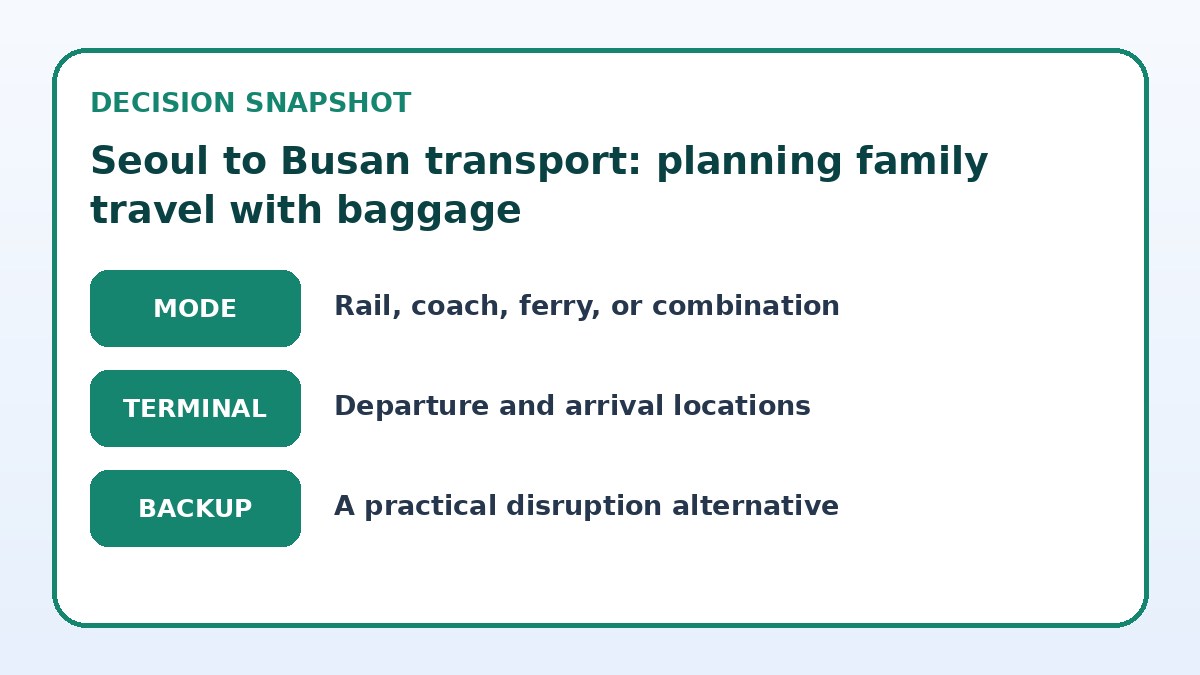
Start by ranking what you cannot compromise: minimizing time on the move, avoiding lift/stairs while juggling luggage, or keeping total cost low. High-speed rail typically shortens travel time between Seoul and Busan and reduces the period you need to keep children entertained, but station-to-hotel transfers matter. Coaches often let you check or store larger items under the vehicle and require only one handover at departure; however, they may stop at peripheral terminals and need a taxi or subway transfer to reach central hotels.
Driving yourself or hiring a van gives the most flexibility for luggage, strollers, and unscheduled stops but shifts all responsibility for navigation, parking, and fatigue to the driver. A mixed approach — for example a train for the long-distance leg plus a private transfer at either end — can combine speed with low baggage handling. When comparing options, factor in where your accommodation sits relative to each terminal, the number of suitcases and bulky items, and whether you’ll need child seats or stroller storage.
Choose the end-to-end journey plan
| Journey approach | Best for | Friction to check |
|---|---|---|
| High-speed rail (direct or with a single transfer) | Families who prioritize short travel time and fewer on-road hours with manageable luggage. | May require careful last-mile planning; luggage space on trains varies and station access can add walking. |
| Intercity coach (single-step luggage handling) | Families wanting a single luggage drop and simpler boarding when you have large or awkward bags. | Routes can stop away from central hotels, increasing taxi or transfer needs at each end. |
| Private car or self-drive | Families needing full control over stops, stroller storage, and timing with multiple bags. | Driver responsibility, parking and toll considerations, and fatigue on longer drives. |
| Mixed approach (train or coach plus short private transfer) | Travelers balancing speed with door-to-door ease, reducing carry time between steps. | Requires booking and coordinating two services; check luggage handover and pick-up details carefully. |
Check live intercity options
Look beyond the ride itself and compare terminals, transfers, luggage, and arrival fit.
Terminal fit and transfer friction: what to check
Terminal fit means how well the arrival and departure points match your actual door-to-door route. Check whether the station or coach terminal has elevators, escalators, or long platform walks; those add friction when you have babies, toddlers, and suitcases. Confirm where luggage is loaded and unloaded: some coaches handle large items under the bus while trains may require you to store bags in overhead racks, designated luggage areas, or station lockers. If you have a lot of bags, an extra taxi from the station may be the simplest option, so budget for that possibility.
Measure the walk from platform or bus bay to taxi stands, rideshare pickup points, and subway entrances if you expect to use those last-mile links. Also verify whether the arrival point is in a pedestrian zone or has limited vehicle access — this affects how close a car can drive to collect you. If you require child seats, confirm the provider’s policy and whether stations have staff to help; otherwise plan to bring portable harnesses or foldable carriers that are quick to deploy.
Timing flexibility and packing for convenience
Families benefit from scheduling buffers: choose connections and pick-up windows that let you move at your pace. Early or late departures may mean less crowded services but could complicate transfers if local public transit is reduced. Pack so that essential items (medication, snacks, diapers, a change of clothes, and entertainment) are in a small carry bag you can keep with you on board. Keep heavier suitcases to a minimum and use wheeled luggage rated for longer walks and irregular surfaces.
Consider packing smart to ease transfers: use soft-sided bags that can squeeze into tighter spaces, combine items into carry-on for quick retrieval, and attach colored tags for instant recognition. If you’ll be moving between multiple modes, distribute weight so at least one adult can manage a child and one piece of luggage at a time. For long days, include lightweight foldable seats or a compact travel stroller that can collapse quickly at security or when boarding.
Compare the practical alternatives
Use the final page to confirm what is actually offered on your dates and save a workable fallback.
Intercity travel checklist
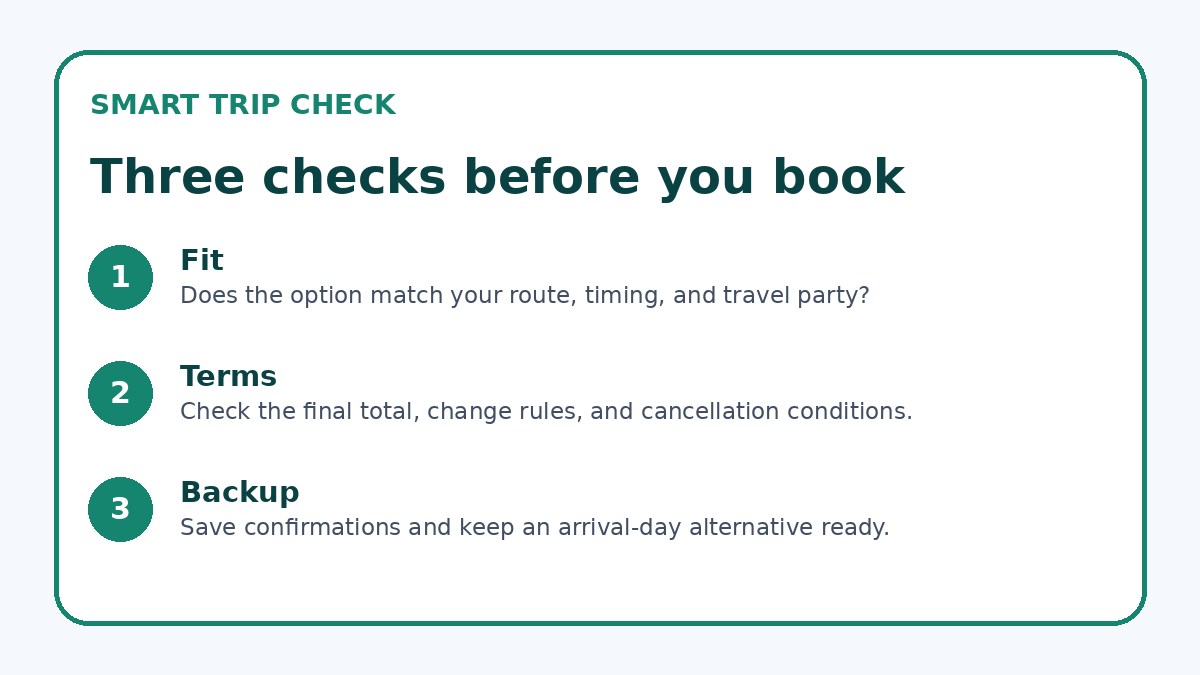
- Confirm luggage allowances, size limits, and storage rules on the operator’s official booking or policy page before purchase.
- Measure walking distances between platform/bay and curbside pickup at both your departure and arrival points using maps or station layouts.
- Pack a carry bag with essentials (medication, snacks, documents, chargers, and a change of clothes) for immediate access.
- Reserve child seats or request stroller support in advance where required; carry a compact travel stroller if allowed on board.
- Pre-book a private transfer for at least one leg if your accommodation is far from the main station to avoid heavy carries.
- Save emergency contact numbers and have a local payment method ready for unplanned taxis, storage, or alternative bookings.
Disruption backup: plans for delays, missed connections, and lost luggage
Build simple redundancy into your plan. Identify the nearest alternate stations or coach stops, and note taxi/rideshare pickup locations at each terminal so you can move if a scheduled service is canceled. Keep copies of booking confirmations and contact numbers in both paper and electronic form; have the family’s essential documents and a small emergency kit in your carry bag. If you rely on child seats or specific luggage handling, confirm what the operator will do if your service is canceled and whether they rebook you on the next available option.
For lost or delayed luggage, know how to file a claim with the transport operator and where to find station customer service. Photograph checked bags and contents before travel, especially valuable or unique items. If your trip cannot tolerate a long delay, plan an alternate route in advance — for example, drive to a different nearby station offering more frequent departures or switch to a coach that drops you closer to your final address. Make sure at least one adult keeps a charged phone, portable battery, and a local payment method to arrange emergency transfers quickly.
Rail & Intercity Transport questions travelers ask
How much luggage can I realistically bring from Seoul to Busan with children?
Realistic luggage depends on the mode you choose and your tolerance for carrying. Trains usually have limited dedicated luggage areas and overhead racks suitable for suitcases and smaller items; coaches often offer larger underfloor compartments for bulky items. If you plan to use public transport at either end or walk between hotel and the terminal, reduce suitcase count so one adult can handle a child plus a bag. Always check the operator’s baggage policy on their booking page and consider a private transfer for a large volume of bags or items like foldable strollers.
Is it better to bring a stroller or rely on station facilities when traveling with toddlers?
Bringing a lightweight, quickly foldable stroller usually beats relying on station facilities, especially with toddlers who nap or need containment during transfers. Compact strollers collapse for fast boarding and are easier to lift onto platforms or into baggage areas. Check whether your train or coach allows strollers on board, and whether lifts and ramps exist at your stations. If you plan to use a private car for part of the journey, a full-size stroller can be more practical, but account for trunk space and handling during transfers.
What immediate steps should I take if a booked service is canceled en route?
If a service is canceled, first contact the operator’s customer service to learn rebooking and refund options; keep booking confirmations ready. Locate station customer service or a staffed information desk to ask about alternate departures and official procedures. If immediate travel is necessary, arrange a taxi or rideshare to the nearest alternative terminal or your final address, and document receipts in case you seek reimbursement. For luggage, report missing or delayed items to the operator and follow their stated claims process; having photos and inventories of checked bags speeds resolution.
Final decision note
For families traveling Seoul to Busan with luggage, the practical choice depends on whether you want to minimize travel time, reduce the number of handovers, or control the entire door-to-door chain. High-speed rail reduces on-road hours but requires attention to station access and baggage policies; coaches simplify large-item handling but may increase transfers to reach central hotels. Driving offers the most control but adds responsibility for navigation and parking. A mixed plan — combining a fast main-leg service with a short private transfer — often gives the best balance for families. Before booking, verify baggage rules, station facilities, and pickup details on the provider’s official pages and consider Trip.com for comparing current availability, while treating operator pages as the final source for baggage and booking terms.
Continue planning
Check current options and final conditions
Use the provider page to confirm live availability, the final total, cancellation terms, and every condition that matters to your trip.
This evergreen planning guide was created with AI-assisted drafting and a structured quality review. It does not display live prices, schedules, availability, visa guidance, or provider rankings. Verify current details before booking. Some links are affiliate links; we may earn a commission at no additional cost to you.