For first-time visitors deciding between Hanoi airports, the central tradeoff is the route-versus-fare question: is a slightly lower ticket price worth a longer commute, increased connection risk, or stricter baggage rules? Most travelers on the Hanoi to Ho Chi Minh City route want a quick, predictable transfer and straightforward baggage handling, but low-fare options can shift the balance if you’re flexible with time and airport logistics. Start by locking in your travel dates and the number and type of travelers in your party—that affects fares, seat availability, and baggage allowances. Then compare available Hanoi departures by how direct they are, where the airport sits relative to your accommodations, what baggage policies apply, and whether flight times fit your daily plan. Below you’ll find the practical answer up front, followed by clear tradeoffs and checklists so you can book with confidence.

See live routes for your exact travel day
Compare direct and connecting choices with the same baggage and traveler details.
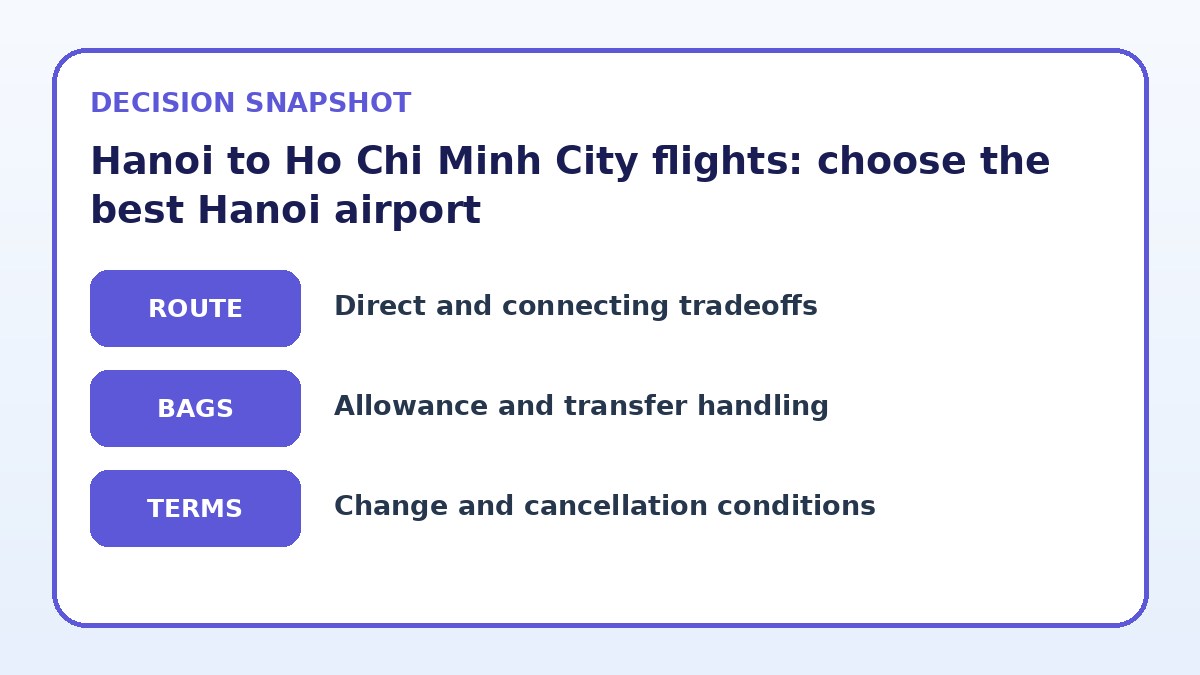
Routing and airport location: start with door-to-door time
The most practical choice often comes down to how long the full journey will take from your Hanoi lodging to your Ho Chi Minh City plans. Direct flights save time but may depart from different terminals or airports; if two Hanoi airports are available, compare travel time and transport reliability to each. Consider typical ground-transport options you plan to actually use—taxi, rideshare, or hotel transfer—and whether local traffic at your intended departure hour will add substantial delays. First-time visitors should prioritize predictable, easily navigable departures over small fare savings when overall travel time matters.
To compare routing, map out the complete trip: hotel to airport, estimated check-in and security time, flight duration, and arrival transfer in Ho Chi Minh City. Include buffer time for unfamiliar local processes like ticket counters, baggage drop, and language-related delays. If you’re connecting through another city, treat the connection like a mini-trip: ensure minimum connection times are realistic and that the booking shows both legs on one ticket to protect your journey if delays occur. This approach gives a practical door-to-door view rather than focusing solely on the flight time printed on the schedule.
Baggage and connection risk: what to verify before booking
Baggage rules and how carriers handle checked luggage can change the practical winner. Low-fare tickets sometimes exclude checked bags or apply strict weight and size limits; if you need a checked suitcase, compare total fare-plus-baggage costs across departure options. For connecting itineraries, confirm whether your baggage will be checked through to your final destination or if you are required to collect and recheck it during a transfer. For first-time visitors, simpler is better: one-ticket itineraries with through-checked bags and clear baggage allowances reduce stress and the risk of missed connections.
When a provider-specific detail matters, go to the airline’s final booking page and verify carry-on and checked baggage allowances, fees, and transfer rules. If the booking mixes different carriers, check each carrier’s policy because they may not honor the same allowances. Also verify transfer rules at any intermediate airports: some connections require immigration clearance and baggage reclaims that lengthen the layover. If you find a cheap fare that looks convenient but the baggage rules are unclear, either contact the carrier directly or opt for a fare class that clearly meets your baggage needs.
Compare flight-selection strategies
| Flight strategy | Best for | Risk to check |
|---|---|---|
| Choose the closest Hanoi airport with slightly higher fares | First-time visitors prioritizing simplicity and short ground transfers | Paying a bit more for lower commute time and fewer logistical unknowns |
| Pick the lowest fare regardless of airport or transfer complexity | Budget travelers who are flexible with time and comfortable navigating local transport | Higher risk of long transfers, baggage fees, and complicated connections |
| Select a one-ticket connecting itinerary to protect transfers | Travelers wanting baggage protection and rebooking assistance if delays occur | May involve longer total travel time or less convenient departure hours |
| Pay for a flexible fare class with free changes | Travelers who anticipate schedule changes or need peace of mind | Higher upfront cost in exchange for refund or change flexibility |
Recheck the complete itinerary
Confirm airports, connection handling, baggage, and change conditions before deciding.
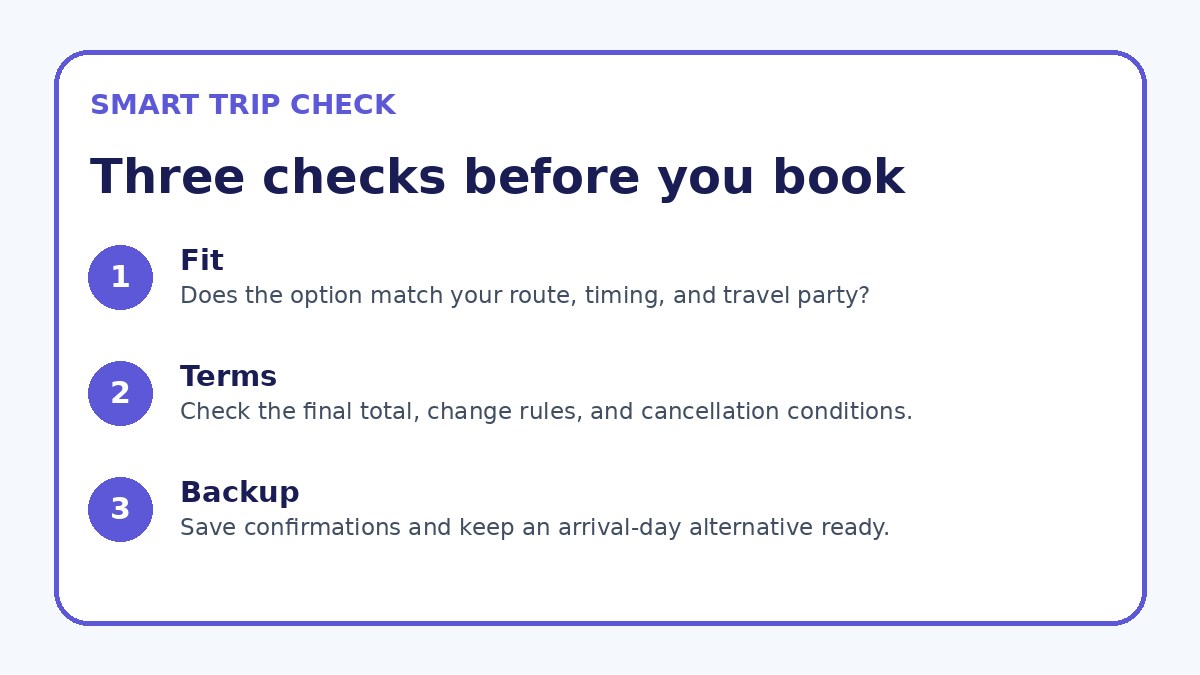
Schedule fit and daily logistics: align flights with your plans
Flight times should match your preferred rhythm—do you want to arrive in Ho Chi Minh City with most of the day left, or prefer an overnight option? Early departures may force an inconvenient pre-dawn transfer in Hanoi; late arrivals reduce ground-transport choices in Ho Chi Minh City. First-time visitors should favor flight times that avoid rushed connections to hotels or tours and that align with familiar transport options. Think about the local traffic patterns, your tolerance for early wake-ups, and whether you’ll need to check into accommodation immediately after arrival.
Also factor in the time needed for potential delays and immigration queues, particularly if you’re arriving into Ho Chi Minh City from another country beforehand. If your Hanoi flight must connect to an international leg, prefer schedules that preserve comfortable buffers between flights. When comparing departures, use your exact travel dates and traveler details to see realistic schedule availability, and watch for flights that share a single booking reference—these are easier to manage if changes happen. Practical scheduling reduces stress and leaves time for your first impressions of the city.
Flight details to verify
- Confirm your exact travel dates and full traveler names before searching fares to get accurate price and seat availability.
- Compare door-to-door travel time for each Hanoi departure including airport transfer time, check-in, and security buffers.
- Verify baggage allowances and fees on the final airline booking page; don’t rely solely on third-party summaries.
- If booking connecting flights, ensure both legs are on the same ticket or clarify recheck requirements with the airline.
- Match flight times to local ground-transport availability at arrival in Ho Chi Minh City to avoid late-night logistical issues.
- Check fare change and cancellation rules on the airline’s site so you understand penalties or allowances before payment.
Fare conditions and penalties: what affects flexibility
Fare rules determine how flexible your booking will be if plans shift. Lower fares often carry strict change and cancellation conditions, while slightly higher fare classes may include free changes or more generous credit policies. For first-time visitors who might adjust plans after arrival, weigh the cost of flexibility against the savings. Look specifically for change fees, refundability, and whether name or date changes are permitted; these conditions are commonly spelled out on the carrier’s final booking page and should guide your selection.
Remember to examine ancillary fees that can turn a cheap ticket into an expensive one—seat selection, checked baggage, and payment surcharges all add up. If you need to compare options side-by-side, calculate a total door-to-door cost that includes realistic baggage fees and transport to and from each airport. If the booking is through a third-party site, verify fare conditions on the airline’s official page or call the airline if anything is unclear. Trip.com can be useful to view availability, but always confirm fare conditions directly with the carrier before finalizing.
Flight Guide questions travelers ask
How do I decide whether a cheaper Hanoi departure is worth the extra travel time?
Start by calculating the full travel time from your Hanoi lodging to final arrival in Ho Chi Minh City, including transfers, check-in, and baggage handling. Assign a value to your time—how many hours of extra ground travel are acceptable? Then add any added costs such as taxi fares, extra night stays, or higher baggage fees that may apply at the cheaper departure. If the total inconvenience and added costs outweigh the ticket savings, choose the more convenient airport or departure.
What should I check about baggage and transfers for connecting itineraries?
Determine whether luggage is checked through to your final destination on the single booking or if you must collect and recheck it at the transfer airport. Verify carry-on limits and checked-bag allowances on each carrier’s booking page because different airlines on a mixed itinerary may apply different rules. Also check visa or immigration requirements at transfer points that could affect whether you need to reclaim luggage. When in doubt, contact the operating airline to confirm the handling of checked bags for your specific itinerary.
Can I rely on third-party sites to show accurate fare conditions and baggage rules?
Third-party sites are useful for comparing schedules and availability, but fare conditions and baggage policies can change and may differ between the aggregator and the carrier. Always confirm critical details—change fees, refundability, and baggage allowances—on the airline’s official booking page before you pay. If the itinerary combines carriers or includes codeshares, contact the airlines directly to resolve any inconsistencies and get a clear statement of responsibilities for delays, cancellations, and baggage handling.
Final decision note
For most first-time visitors, the most practical Hanoi departure is the one that minimizes total door-to-door time and simplifies baggage and connection handling—even if that means accepting a modestly higher fare. Begin by fixing your exact dates and traveler details, then compare full journey times, baggage rules, and fare conditions rather than looking only at the headline ticket price. If you value flexibility, a higher fare class with change privileges is worth considering; if you’re comfortable navigating local transport, a lower fare may save money. Always verify baggage allowances and change/cancellation policies on the carrier’s final booking page (or contact the airline) before completing your purchase.
Continue planning
Check current options and final conditions
Use the provider page to confirm live availability, the final total, cancellation terms, and every condition that matters to your trip.
This evergreen planning guide was created with AI-assisted drafting and a structured quality review. It does not display live prices, schedules, availability, visa guidance, or provider rankings. Verify current details before booking. Some links are affiliate links; we may earn a commission at no additional cost to you.