If your Vancouver itinerary centers on downtown meetings and short hops across the city, you may not need a rental. But if meetings spread to North Vancouver, Squamish, the airport zone, or multiple client sites beyond the core, driving often saves time and gives schedule control. For a busy business traveler the core question is simple: will the car reduce friction overall, or will pickup and return logistics add delay? This article gives a direct recommendation up front and then breaks down the tradeoffs—route value, insurance wording to check, practical pickup/return friction and a clear fallback when staying car-free. Use these checks to compare final booking pages and rental terms before you reserve, and consult the provider’s confirmation page for precise fees, operating hours, and mileage rules.

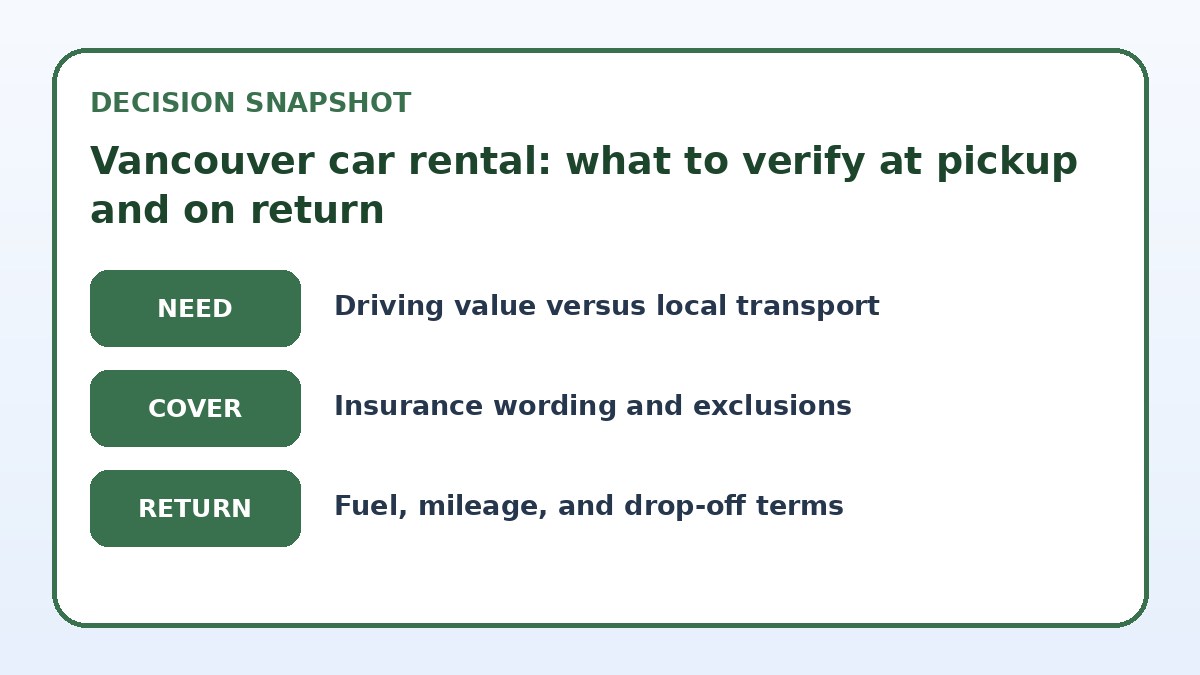
Deciding whether driving improves your Vancouver business schedule
Start with an itinerary map and mark where and when your appointments occur. Driving delivers clear value when your meetings hop between neighborhoods separated by bridges or long transit routes—examples include trips between downtown, Richmond, Richmond Airport area, the North Shore, or industrial parks. Driving also helps when you must transport materials, samples, or client displays that are bulky or time-sensitive. If your meetings cluster inside the downtown peninsula bounded by Burrard Inlet and False Creek, surface transit, walking and short rides often match or beat driving once you account for parking search time and peak-hour congestion.
Quantify door-to-door time rather than distance: include walking to a lot, payment or shuttle waits, and the time needed to find loading zones at client buildings. Consider meeting flexibility—if an appointment runs late, can you pause a car rental or extend the return window without large penalties? If your schedule includes early starts or late finishes that public transit doesn't comfortably serve, a rental can preserve independence. Use these criteria to make a binary decision before searching rental inventory: is driving a schedule enabler or an added operational task?
Decide whether driving earns its place
| Mobility strategy | Best for | Cost or friction to check |
|---|---|---|
| Full rental car for entire trip | Travelers with multi-site agendas, equipment to move, or unpredictable late finishes | Higher parking, fuel and hold deposit exposure plus pickup/return time and inspection responsibilities |
| Short-term hourly rental or car-share | Urban meetings with occasional need for a vehicle without full-day commitment | Potential availability gaps, variable pricing, and liability differences compared with standard rentals |
| Ride-hailing and taxis on demand | Downtown-centric schedules prioritizing time savings without parking hassles | Costs can spike during peak demand; repeated trips may become more expensive than a rental |
| Public transit plus arranged airport transfer | Predictable downtown itineraries and travelers who prioritize cost and avoiding driving stress | Longer door-to-door times for dispersed meetings and less flexibility for off-hour movements |
Check live rental choices only after the route test
Use the exact driver, dates, pickup point, and return plan to compare current conditions.
Insurance wording and liability: what business travelers must verify
Business travelers must read insurance wording carefully: identify whether the quoted rate includes third-party liability and collision coverage or only supplemental options. Verify policy limits, deductibles, and whether the renter or the company card covers damage. Many corporate credit cards offer primary or secondary rental coverage—but coverage terms vary by card and vehicle class. When you rely on corporate insurance or a personal policy, confirm that it applies in British Columbia and that it covers loss-of-use charges and administrative fees the rental company may claim after damage.
On the rental provider’s final booking page and the signed agreement at pickup, look for three specific items: the deductible amount on collision damage waivers, the scope of third-party liability coverage, and whether roadside assistance and theft protection are included or optional. If in doubt, request written confirmation via email showing exact coverage phrases. Do not assume verbal assurances at the counter; they are helpful, but your protection rests on the contract language and any corporate insurance certificate you can present at pickup.
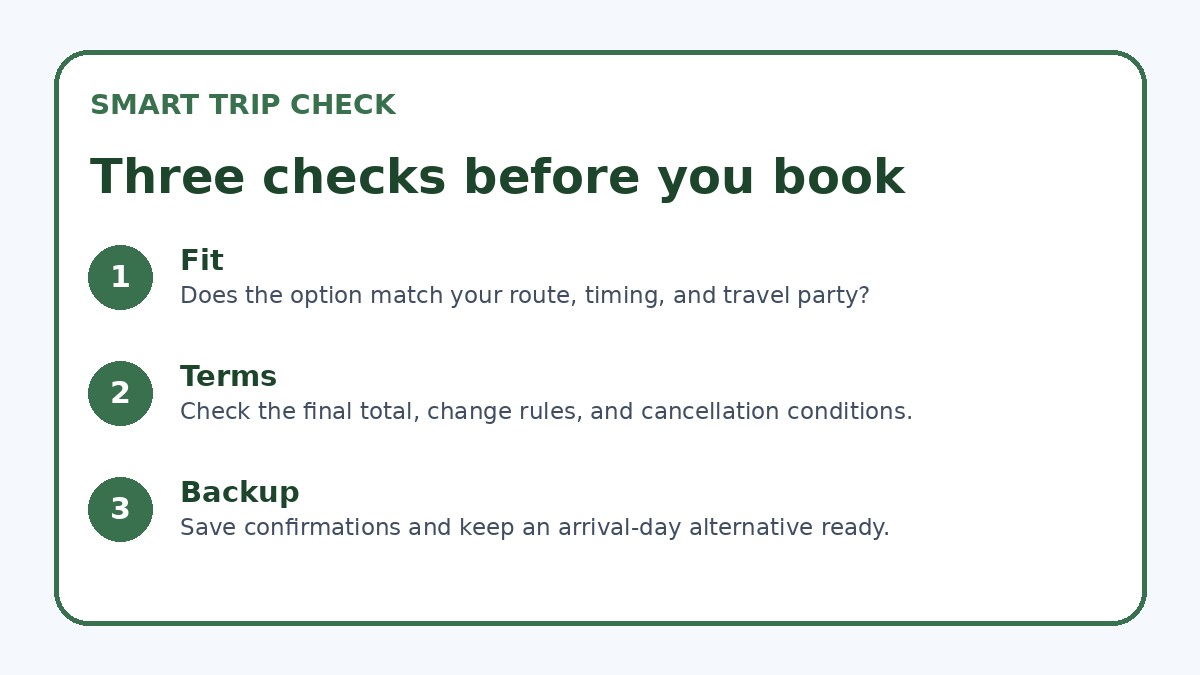
Compare the full rental conditions
Confirm insurance wording, exclusions, deposit, fuel, mileage, and return terms on the final page.
Pickup and return friction: practical steps to minimize lost time
Pickup friction costs more than minutes: it can derail a morning meeting if you face long queues, paperwork issues, or mismatch between the reserved vehicle and the actual fleet. Before you travel, confirm the rental location’s operating hours and whether airport pickups require shuttles—these transfers add hidden time. At pickup, have your driver’s license, corporate card, any rental authorization forms, and the renter’s printed or mobile confirmation ready. Check the vehicle for pre-existing damage with photos, note fuel level, and confirm the expected return location and any after-hours drop process to avoid disputes.
Return friction commonly arises from missed return windows, incorrect fuel refills, or failing to obtain a documented drop-off signature. Map the return route including peak traffic windows and allow buffer time for cleaning, refueling, and inspection. If your itinerary requires an early-morning return, verify whether the location accepts after-hours keys and whether they process final charges immediately or later. On the provider’s final page confirm the late-return fee policy, refueling rules (fuel charge versus full-to-full), and how they evidence vehicle condition at drop-off to prevent post-rental claims.
Car rental terms to verify
- Map all meeting addresses and estimate door-to-door travel time for driving versus transit to determine real time savings.
- On the rental provider’s final booking page, read the exact rental agreement wording for deductible amounts and liability limits.
- Confirm pickup location hours, whether airport pickup needs a shuttle, and whether the counter accepts your company card and authorization letter.
- Photograph the vehicle’s exterior and interior at pickup with timestamps and email the images to yourself or your travel manager.
- Plan your return with a time buffer for refueling, inspection, and traffic; note after-hours drop instructions and obtain a written return receipt.
- If avoiding a rental, prebook an airport transfer or reliable ride-hailing option and save the driver/provider contact in case of last-minute changes.
Non-driving fallback: efficient alternatives for business travelers
If driving doesn’t clearly improve your agenda, plan a fallback that matches reliability and door-to-door time. For downtown-centered schedules, a mix of rapid transit (SkyTrain and SeaBus), scheduled airport shuttles, and ride-hailing for the last mile usually gives predictable timing without parking headaches. For frequent cross-harbour trips, factor in SeaBus frequencies and connections to buses or rapid transit. Build contingency time between meetings to accommodate potential transit delays or ride-hailing surge pricing, and consider booking an airport transfer for fixed costs when heading to YVR to avoid scramble at the end of a trip.
If you prefer on-demand flexibility without a full rental, reserve a chauffeur service or corporate car for critical transfers—these come at higher cost but reduce handoffs and time risk. Use mobility apps for live comparisons on route time during your trip; Trip.com can be one place to check current options and provider availability but always confirm details on the operator’s booking page. Finally, have a local contact number for logistics help—hotel concierges and corporate travel desks can arrange last-minute transport if plans change.
Car Rental & Road Trip questions travelers ask
Do I need extra insurance on a Vancouver rental if my company issues a corporate card?
Corporate cards often provide rental coverage but terms vary widely. Before relying on it, ask your company’s travel or finance team for a written certificate describing coverage limits, deductible responsibilities, and whether loss-of-use or administrative fees are covered. At pickup, present any corporate authorization and request the rental company to note the card on the contract. Finally, confirm on the provider’s final booking page and the signed agreement if additional waivers or coverage purchases are required at the counter to avoid personal exposure.
What are the easiest pickup and return locations for minimizing wasted time?
Airport counters offer long hours but often require shuttle transfers and longer processing queues; downtown stations are convenient but may have restricted hours and limited parking. Choose the location that aligns with your first appointment and departure timing. On the rental provider’s final page check operating hours, shuttle requirements, and whether the site supports quick electronic check-in or a fast-lane for corporate clients. Prioritize a site that minimizes cross-city travel at peak commute times to reduce the chance of delays.
How can I avoid disputes about vehicle damage after returning the car?
Document the vehicle condition on pickup and at return: take time-stamped photos of all sides, interior, and the odometer. Request the inspector to sign a return receipt or a damage-free checklist; if the location uses a digital drop box, keep the confirmation email or screenshot. Verify that the rental agreement explains the process for post-rental damage claims and how long the company may hold your card for alleged charges. If a dispute arises later, your dated photos and the signed/emailed return confirmation are your primary evidence.
Final decision note
For a business traveler in Vancouver, make the driving decision by mapping appointments and testing whether a car cuts door-to-door time or only shifts friction. If driving helps avoid multi-stop transit routes, renting gives schedule control—but only after you verify insurance wording, deductible exposures, pickup hours, and the return process on the provider’s final booking page. If downtown clusters dominate your itinerary, a thoughtful non-driving fallback of transit, ride-hailing, or a booked transfer will usually reduce stress and administrative overhead. Use the checklists above, capture vehicle condition at pickup and drop-off, and confirm all coverage and fee language in writing before you leave the counter.
Continue planning
Check current options and final conditions
Use the provider page to confirm live availability, the final total, cancellation terms, and every condition that matters to your trip.
This evergreen planning guide was created with AI-assisted drafting and a structured quality review. It does not display live prices, schedules, availability, visa guidance, or provider rankings. Verify current details before booking. Some links are affiliate links; we may earn a commission at no additional cost to you.