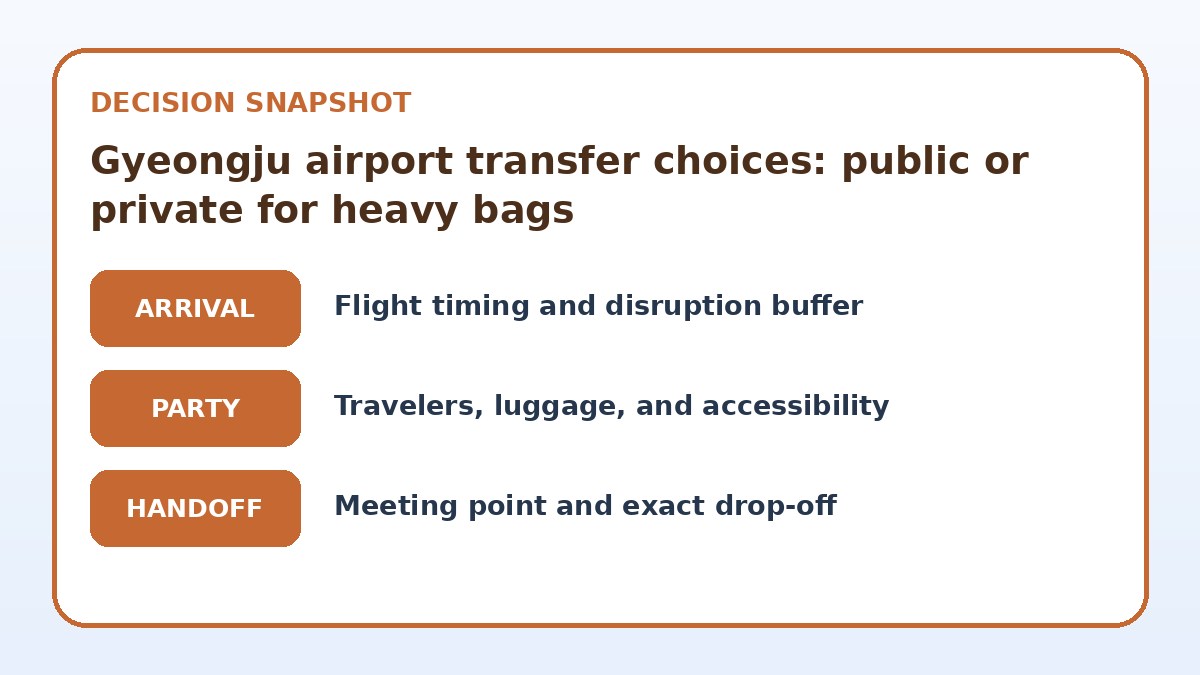
First hour after landing: decide whether to prioritize money, speed, or simplicity. If you’re arriving in Gyeongju with extra luggage the immediate choice is between managing bags on public transport—usually cheaper but more hands-on—or booking a private vehicle that carries everything to your door. Think about group size, the number of suitcases and awkward items, whether your flight could be delayed, and how easy it will be to meet a driver at the airport. This article gives the quick recommendation up front and then steps through the tradeoffs: when public options make sense, when private pickup is safer and easier, what to check in arrival instructions, and how to match drop-off fit to your accommodation’s access. Use it while you still have flight and hotel details open so you can make the right booking before you land.
Check options for your arrival details
Use your flight, luggage, party size, and accommodation address to compare current choices.
Luggage and party size: match vehicle to bags
Count bags and estimate bulk before deciding. Two people with one checked bag each plus a carry-on can often manage public buses or a shared van without stress, but families, groups of three or more, or travelers with oversized instrument cases, golf bags, or photographic equipment will find a private transfer dramatically simpler. Public options require lifting luggage onto buses, stowing items in overhead racks or under seats, and possibly moving between services, which becomes tiring after a long flight. Private vehicles remove those transfers and usually include trunk space and direct door-to-door handling by the driver.
Also think about luggage shape, not just count. Bulky items that don’t compress—tripods, bulky boxes, or a stroller—can consume trunk layouts and may not fit on small shuttle buses. If any member needs frequent access to a bag (medications, baby supplies), private transport keeps everything within reach. When booking private, state the exact number and size of items on the booking form and ask the provider to confirm vehicle type. For public travel, identify bus models and luggage policies where possible, and keep heavy items in a single manageable case to reduce handling.
Arrival details to have ready
- Count all bags including carry-ons, bulky items, and instruments; note dimensions before choosing transport.
- Confirm flight number and arrival terminal on your transfer booking so providers can monitor delays.
- Ask private transfer providers for clear meeting-point instructions, driver contact, and vehicle size confirmation.
- Check whether your accommodation’s entrance, stairs, or lane allow vehicle access and share photos or clear directions with the driver.
- If using public transport, look up the last scheduled departures and the official bus stop name or platform for Gyeongju connections.
- Pack a small accessible daypack with essentials (documents, medication, chargers) in case luggage is delayed or you transfer between services.
Late or disrupted arrival: reduce uncertainty
Arrivals late at night or after significant delays change the calculus. Public buses and trains often run less frequently late in the evening or may have suspended connections after a certain hour. Missed connections mean waiting in terminals or seeking costly local taxis at short notice. A pre-arranged private transfer can be more flexible: many providers expect flight delays, monitor arrival times, and hold a driver for a late flight, but you must confirm their delay policy before booking. If you do choose public options for a late arrival, research the last scheduled departures for your route and have a fallback taxi or rideshare number saved.
Disruption can also complicate meetups with drivers: airlines sometimes change gates and arrival airports within a region. When you book privately, give the driver your airline and flight number and reconfirm who will monitor ETA changes. If you plan to rely on public transport despite a risk of delay, factor in extra time for immigration and baggage collection, and identify a comfortable indoor waiting area in the terminal. Ready a small daypack with essentials to avoid retrieving checked luggage multiple times during rebooking or delays.
Match the transfer to your arrival
| Arrival approach | Best for | Detail to verify |
|---|---|---|
| Pre-booked private transfer (door-to-door) | Groups, heavy or bulky luggage, late arrivals, travelers who value convenience | Higher cost and must verify vehicle access at the drop-off address |
| Airport taxi on arrival | Single travelers or small groups with moderate luggage and uncertain arrival time | Quicker than public transit but fares vary and trunk space is limited for many large items |
| Scheduled airport shuttle or shared transfer | Budget-conscious travelers with standard luggage who want a reserved seat | May include stops and limited luggage space; coordination can add wait time |
| Public bus/train plus local taxi for last mile | Economy travelers comfortable handling luggage who want lower fares | Multiple transfers and heavier physical handling of bags; can be slow with tight connections |
Make the meeting plan clear
Check the final pickup instructions, waiting conditions, and exact drop-off coverage.
Meeting-point clarity: avoid waits and confusion
Clear meeting instructions are non-negotiable for private pickups. Airports often have multiple exits, parking levels, and designated staging areas for different services. When you book a private transfer, ask for the exact meeting point name, a description of nearby landmarks, and a mobile contact number for the driver. Confirm whether the driver will hold a sign with your name and whether they expect you to text when you pass immigration. For pick-ups that require crossing to an arrivals forecourt or moving to a separate pick-up lane, know if you must pass through customs or remain airside (some airports restrict access to certain areas).
Public transport benefits from being standardized: look up the official bus stop or shuttle zone name for the Gyeongju route and the platform number if available, then verify whether luggage space is limited or allocated on board. Allow extra time to walk from baggage claim to the bus stop, and identify covered waiting areas in case of weather. For shared shuttles or ride platforms, review payment methods accepted—cash, card, or mobile payments—and carry smaller bills for transfers or bus fares.
Destination drop-off: fit the vehicle to the final address
Not all Gyeongju addresses are equally vehicle-friendly. Historic districts and guesthouses in older neighborhoods can have narrow lanes, low-clearance entrances, or steps from the curb to the door. If your accommodation sits down a pedestrianized street or a small alley, a full-size private van might not reach the door; you could request a smaller car for easier access or ask whether the driver can unload at the nearest legal stopping point. When booking, send the exact address and, if possible, a photo of the building entrance so the provider can pick an appropriate vehicle.
For public transport, plan the last segment from the bus or train stop to your door. Some accommodations provide luggage assistance from the nearest stop for an extra fee or have staff who can collect you within a short walking distance. If you expect a long roll with heavy suitcases, prefer a drop-off that minimizes walking and steps. Always communicate with your lodging before booking—confirm where guests are typically dropped off, whether they can store luggage if you arrive early, and any suggested arrival instructions for drivers or public transport stops.
Airport Transfer & Local Mobility questions travelers ask
Can I bring oversized sports equipment or musical instruments to Gyeongju using public transport?
Public buses and trains near Gyeongju may accept oversized items, but space is limited and policies differ by operator. If your item is awkward—like a surfboard, large cello case, or golf bag—contact the bus company or railway operator in advance to confirm whether they allow such items and whether an extra fee or reservation is required. For peace of mind, consider a private transfer where you can state the exact dimensions and be sure the vehicle will accommodate the item on arrival, or ask your airline about special handling options.
What should I do if my flight is diverted or seriously delayed arriving to Gyeongju?
If your flight is diverted or delayed, first notify any pre-booked private transfer provider with your new ETA and confirm whether they monitor flight numbers. Private drivers often expect delays when told in advance, but you must verify their delay policy and any grace period. If you rely on public transport, check for the last bus or train departures for the day and have backup transport options saved—local taxis, rideshare apps, or an airport hotel. Keep essential items in your carry-on so you can wait comfortably or move between options without needing checked luggage.
How can I verify a private transfer provider before I book?
When comparing private transfer providers, ask for the vehicle type and passenger capacity, read recent user reviews on booking platforms, and confirm insurance and licensing details where those are displayed. Request a written confirmation with the driver’s contact number, the meeting point at the airport, and the cancellation or delay policy. If the booking site does not show these details, contact the provider directly. Trip.com can be used as one option to compare current availability and terms, but always verify policies on the provider’s final booking page before you commit.
Final decision note
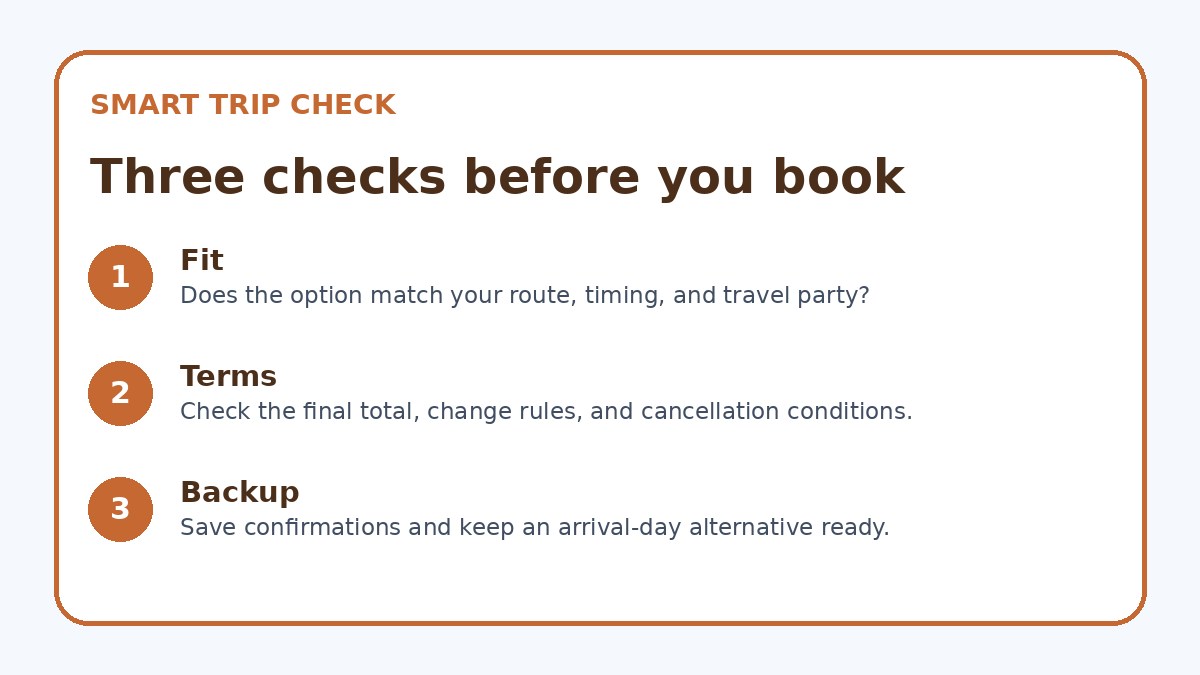
For most travelers with extra luggage, the practical choice is to match transport to the size and awkwardness of your bags, group size, and arrival certainty. Private transfers reduce physical handling, simplify late or disrupted arrivals, and get you closer to your door, but require you to confirm vehicle size and drop-off access ahead of time. Public transport and shared shuttles are cheaper and fine when luggage is limited and schedules fit, but expect transfers and more lifting. Decide now while you still have flight and hotel details: count your baggage, check your accommodation’s access, confirm meeting-point instructions, and choose the option that minimizes transfers and stress for your specific trip to Gyeongju.
Continue planning
Check current options and final conditions
Use the provider page to confirm live availability, the final total, cancellation terms, and every condition that matters to your trip.
This evergreen planning guide was created with AI-assisted drafting and a structured quality review. It does not display live prices, schedules, availability, visa guidance, or provider rankings. Verify current details before booking. Some links are affiliate links; we may earn a commission at no additional cost to you.