If you have back-to-back meetings in Barcelona’s outer districts, client sites near the port, or day trips to Maresme or Tarragona, driving can save time and provide flexible timing. For many central-city itineraries — hotels in Eixample or near Plaça Catalunya — the combination of short distances, limited parking, and low-emission zones often makes driving more hassle than benefit. This article gives the practical answer first: choose a rental only if your meetings require direct access to suburbs, airport-side logistics, or heavy door-to-door luggage movement. Otherwise, plan on rail, taxis, or a mix of on-demand cars for airport legs. Below you’ll find the decision criteria that matter for business travelers: route value, insurance wording to inspect, pickup and return friction at Barcelona pick-up locations, and a clear non-driving fallback plan.
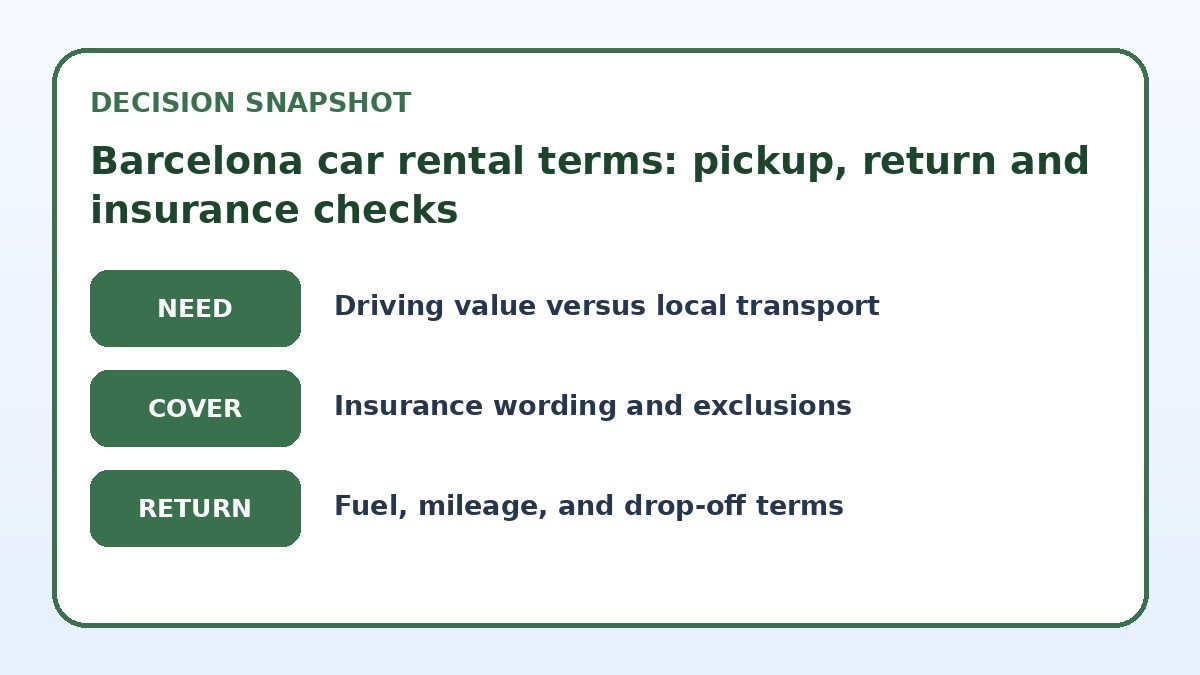
Deciding whether driving improves your Barcelona business itinerary
Start by mapping your meetings by district and time windows. Driving adds clear value when you must reach destinations outside the central grid — for example, industrial parks, conference venues near the Port of Barcelona, or meetings in Tarragona province where rail schedules are sparse. Account for the cost and time of scheduled parking, potential low-emission zone restrictions (you must verify vehicle compatibility), and rush-hour surface street congestion. For a tightly routed day inside the central districts, the door-to-door time advantage often evaporates once you add walking to/from parking and searching for spaces.
Also weigh suitcase and equipment needs: a car matters if you’re transporting bulky samples, demo units, or a team with multiple small cases. Consider meeting unpredictability; if locations shift or you must pivot between venues, driving provides flexibility. Finally, calculate opportunity cost: if driving means you’ll waste time on pickups and returns, that lost meeting preparation or email time could be more costly than a taxi or train. Use this assessment to decide whether to proceed to vendor comparisons or plan a public-transport fallback.
Decide whether driving earns its place
| Mobility strategy | Best for | Cost or friction to check |
|---|---|---|
| Rent a car for the full trip | Multi-site suburban schedules where timing and equipment control are essential | Higher administrative friction, parking costs, and need to verify insurance and zone rules |
| Airport-only rental, return at airport | Single outward site visits or remote meetings near the airport where a car simplifies first/last mile | Limited flexibility inside the city and potential city-zone driving restrictions |
| Public transport plus occasional app rides | Central-city meeting blocks with short distances and unpredictable timing | May be slower for outer-district appointments and incurs variable taxi costs |
| Pre-booked private transfers for key legs | High-stakes meetings needing guaranteed arrival times or group transfers with equipment | Higher per-trip cost but low pickup/return friction and predictable billing |
Check live rental choices only after the route test
Use the exact driver, dates, pickup point, and return plan to compare current conditions.
Insurance wording and coverage: what to inspect on the rental page
Read the contract wording for Collision Damage Waiver (CDW), Theft Protection, and liability limits. CDW often reduces your financial exposure but rarely eliminates administrative fees or excess amounts; the fine print will state the maximum charge you can face after a claim. Check if glass, tires, and undercarriage are included — some contracts exclude those items or require separate products. For business travelers, confirm whether additional drivers are covered and whether company credit cards or corporate policies impose different rules.
Look for phrasing about deductible or excess amounts, and whether an extra paid waiver reduces that excess to zero. Verify cross-border restrictions if you plan a day trip outside Spain — many policies forbid taking the car into certain countries or require a permit. Confirm which documentation the rental company will ask for at pickup: corporate authorisation letters, driver’s licence held for a minimum time, credit card in the renter’s name, and any special corporate rates that need internal codes. Always save screenshots and the confirmation page, and compare them with the provider’s final booking page before you complete payment.
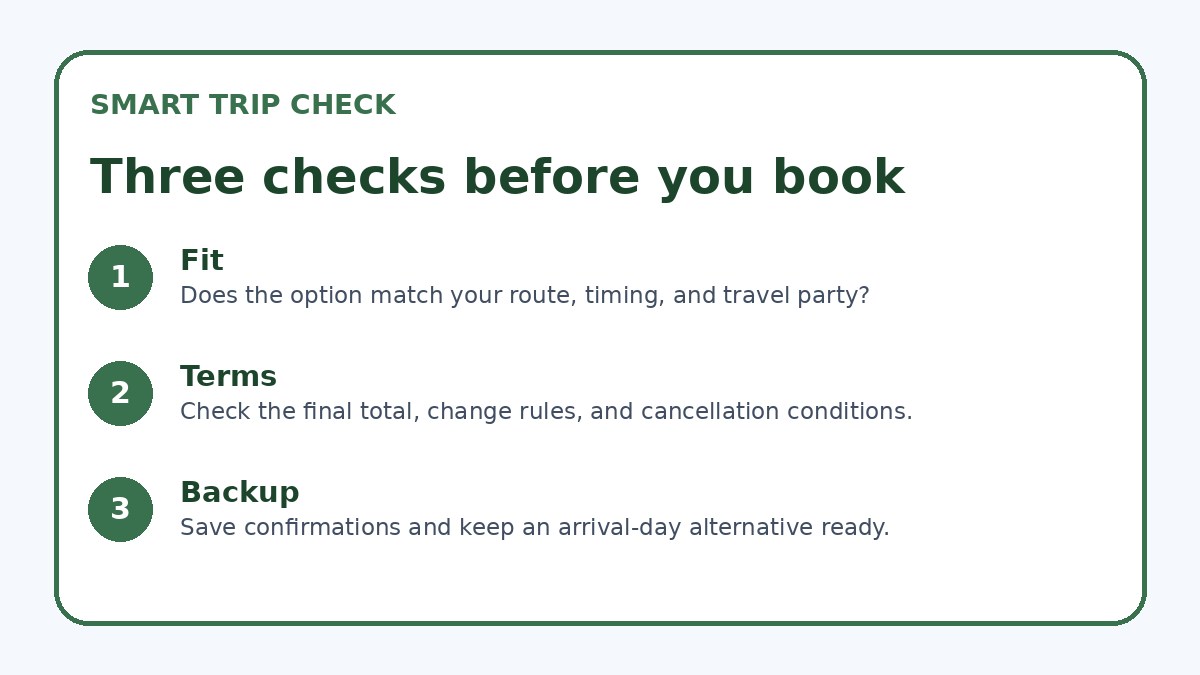
Compare the full rental conditions
Confirm insurance wording, exclusions, deposit, fuel, mileage, and return terms on the final page.
Pickup and return friction: timing, locations, and airport vs city counters
Pickup friction varies by location. Airport counters may offer longer hours and shuttle services but also longer queues and stricter inspections; city offices sometimes open later and close earlier on weekends. Confirm counter opening hours, whether the provider requires a shuttle from the terminal, and if after-hours pickup is available. Ask about administrative hold amounts on the credit card and how long the hold will remain. Business travelers should budget extra time for desk formalities, vehicle inspection and photographing damage, and getting any necessary permits or stickers for city driving.
Return friction is as important as pickup. Verify the provider’s after-hours drop-off process, whether you must refuel to a specified level, and whether they require the same parking spot or counter return. Note where the inspection takes place and whether you’ll receive immediate confirmation that the vehicle was accepted without charge or if there’s a pending hold that will release later. If you might finish late, choose a supplier with a clearly documented after-hours key-drop and ensure your corporate card can absorb pending holds until they clear.
Car rental terms to verify
- Map all meeting locations and mark which lie outside central transit corridors before deciding to rent.
- Confirm CDW, liability excess, and whether glass, tires, and undercarriage are covered on the final booking page.
- Check counter hours, shuttle requirements, and after-hours key-drop procedures at your chosen pickup point.
- Verify the credit-card hold amount and how long the hold remains on corporate cards before authorising a booking.
- Ask explicitly about low-emission zone compliance and any required stickers or permits for the rental vehicle.
- Plan an alternative (train plus app rides or a private transfer) and pre-book key legs if your schedule is tight.
Non-driving fallback: fast alternatives that keep your business schedule intact
Plan a fallback before you book: identify rapid rail or regional train options to major meeting corridors, pre-book preferred taxis for airport transfers, and download ride-hailing apps. Barcelona has an extensive metro, tram, and commuter rail network that can be faster than surface driving during peak hours. For meetings outside public-transport corridors, arrange a reliable private transfer for the longest or earliest legs and use local taxis or app rides for last-mile movement. Keep receipts and note corporate expense rules for these alternatives.
Also arrange contingency for last-minute location changes: have a shortlist of nearby coworking spaces or hotel meeting rooms that can be rented by the hour, and share itinerary times with local contacts who can advise on traffic or transit disruptions. If you expect to rely on taxis or apps, set up your corporate account in advance so billing and receipts are streamlined. Finally, consider using Trip.com or another aggregator to compare current availability and terms, but always verify the supplier’s exact pickup and return wording on their final booking page before confirming.
Car Rental & Road Trip questions travelers ask
Will a corporate credit card cover the hold and possible excess on a Barcelona rental?
Corporates vary: many rental companies place a pre-authorisation hold on the renter’s card to cover potential excess and incidental charges. Confirm with the rental supplier how large the hold will be and how long it will remain; these details appear on the supplier’s final booking page or in the terms and conditions. Check your company’s credit policy for overseas holds and whether the corporate card issuer treats holds differently than settled charges. If the hold is likely to affect cashflow, ask if there’s an alternative deposit option or whether the excess can be reduced with an accepted waiver.
Can I pick up a rented car late at night or return it after hours in Barcelona?
Some locations offer after-hours key drop or staffed desks at airports, while many city counters close earlier. The supplier’s terms will state whether after-hours pickup is permitted and any additional fees involved. For after-hours returns, confirm the exact drop-box procedure, the address for returns, and how they document the vehicle’s condition to avoid disputes. Always photograph the odometer and multiple vehicle angles at return and keep timestamps. If late pickup or return is critical, secure that ability in writing on the final booking page before you arrive.
How do I verify low-emission zone and cross-border rules for my Barcelona rental?
Rental pages or confirmation documents should include low-emission zone (LEZ) compliance and whether certain vehicle types are restricted. If the supplier does not clearly state LEZ compatibility, contact them directly to confirm the vehicle’s emissions badge or permit. For cross-border travel, read the policy section that covers international travel limits and required paperwork — some rentals prohibit travel outside Spain or require explicit permission and additional insurance. Always save the supplier’s final terms and ask for written confirmation if you plan to cross regional borders.
Final decision note
For business travelers, the practical choice about Barcelona car rental boils down to route value and pickup/return friction. Rent when your meeting itinerary demands reliable door-to-door transport across outer districts, when you must move equipment, or when timing cannot tolerate public-transport variability. Before you click book, scrutinise insurance wording, credit-card hold sizes, pickup and after-hours return procedures, and any low-emission zone or cross-border limits on the supplier’s final booking page. If driving is marginally useful, adopt a hybrid approach: pre-book crucial transfers and rely on public transport and app rides for central-city legs. Doing this reduces administrative surprises and keeps your schedule—and invoices—clean.
Continue planning
Check current options and final conditions
Use the provider page to confirm live availability, the final total, cancellation terms, and every condition that matters to your trip.
This evergreen planning guide was created with AI-assisted drafting and a structured quality review. It does not display live prices, schedules, availability, visa guidance, or provider rankings. Verify current details before booking. Some links are affiliate links; we may earn a commission at no additional cost to you.