Practical answer up front: before searching Seoul to Busan flights for your family, gather exact travel dates, ages of each child, preferred airports, and luggage needs — then compare at least three flight options for routing, total door-to-door time, baggage allowances, and refundable/change policies. Families face a clear tradeoff: the fastest routing often costs more and may have tighter connection margins for young children, while lower fares frequently bring stricter baggage limits and fewer flexibility options. Use those constraints to set a non-negotiable list (departure window, maximum connections, stroller policy, acceptable layover length) and a flexible list (preferred seating, meal requests) to narrow choices quickly. Having passenger details and date flexibility ready will make live booking faster and reduce stress at check-out; verify final fare rules and baggage allowances directly on the carrier’s booking page before paying.
See live routes for your exact travel day
Compare direct and connecting choices with the same baggage and traveler details.
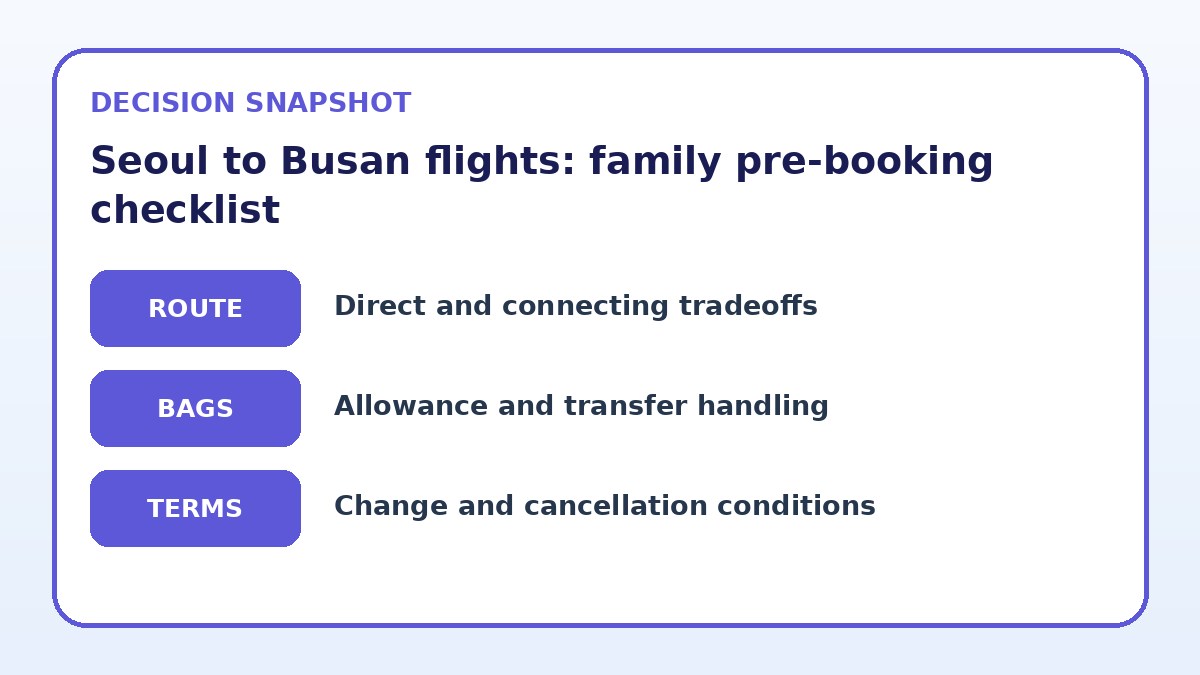
Routing: direct vs connecting, and airport choices
Families often assume the fastest flight is the obvious pick, but routing choices are a true tradeoff: direct flights reduce connection stress and time in transit, which is especially valuable with small children, while connecting itineraries can be cheaper or more widely available outside peak times. On the Seoul–Busan route consider both departure airports (Incheon ICN vs Gimpo GMP) and arrival airports or alternatives—each adds time for transfers. When comparing options, convert scheduled airtime into realistic door-to-door estimates by adding transfer times, security queues, and buffer minutes for family needs like diaper changes or restroom breaks.
When you evaluate a route, write down your acceptable maximum number of connections and minimum connection time for your family; short children or mobility needs may require longer layovers. If a connection is necessary, prefer single-airline itineraries or alliances where possible to reduce the risk of missed connections and simplify baggage recheck. Always verify connection times and whether the itinerary requires rechecking baggage or passing through security/immigration between legs — these practical details appear on the carrier’s booking page and can change depending on the carrier and airport.
Baggage and connection risk for families
Baggage allowances vary by fare class, route, and carrier; for families carrying strollers, car seats, or multiple checked bags, the cheapest fare could end up more expensive after add-on fees. Create an inventory of what you must bring versus what you can rent or buy at destination, then check standard included allowances for each fare before comparing total cost. Also confirm whether special items like car seats count as checked baggage or carry-on, and whether airlines allow gate-checking of strollers at no charge — these particulars show up on the airline’s baggage rules page during booking.
Connection risk rises with shorter layovers and multi-carrier itineraries because missed connections can leave families stranded or split up. If a tight connection is the only affordable option, assess whether the carrier provides minimum connecting times and protects missed connections under its contract of carriage; verify if interline agreements mean your bags transfer automatically. For peace of mind, consider purchasing refundable fares or travel protection that covers missed connections and emergency rebooking, and keep crucial items (medications, a change of clothes) in carry-on bags for every family member.
Compare flight-selection strategies
| Flight strategy | Best for | Risk to check |
|---|---|---|
| Pick the fastest direct flights | Families prioritizing minimal travel stress and quick transfers | Usually higher fares and potentially less schedule flexibility |
| Choose lowest-fare multiple-connection options | Families on tight budgets willing to accept longer travel time | Higher risk of missed connections and additional baggage charges |
| Use a single-airline connecting itinerary with flexible fare | Families wanting a balance of cost-control and protection | May cost more than bare-minimum fares but reduces rebooking hassles |
| Book refundable or changeable fares with added baggage | Families who value flexibility for unpredictable schedules or health concerns | Higher upfront cost but reduces stress and potential rebooking fees |
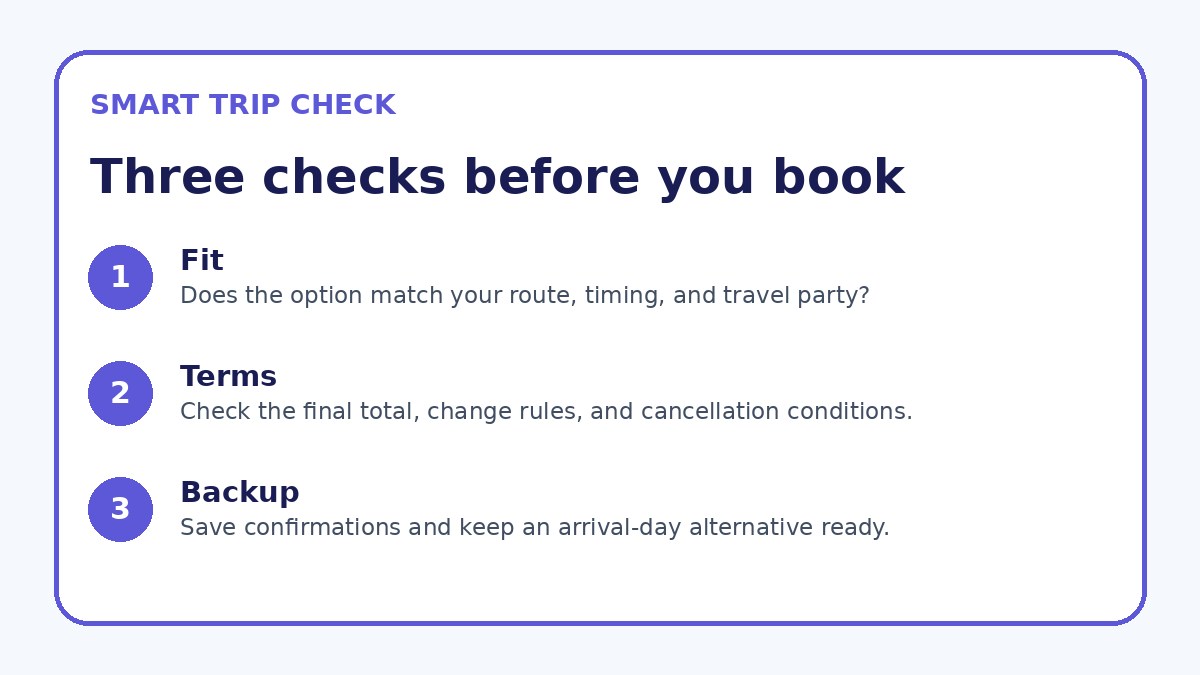
Recheck the complete itinerary
Confirm airports, connection handling, baggage, and change conditions before deciding.
Schedule fit and daily rhythm for kids
Pick flight times that align with your children’s sleep and meal schedule to reduce meltdowns. Early morning flights avoid traffic to the airport and often operate with fewer delays, but they may require very early wake-ups and complicated airport transfers; evening flights can coincide with kids’ bedtime if they’ll sleep on the plane, but arrivals late at night complicate ground transfers. Map out a realistic timeline around the scheduled departure: leave your home with at least twice your usual urban commute time for peak traffic, plus recommended airport arrival buffer for families.
Also consider the schedule at both ends of the trip: arrival time affects whether you’ll handle check-in at accommodation, childcare, or public transport in daylight. If you need to be at a specific time in Busan (an event, check-in window, or ferry), prioritize itinerary options that provide reliable arrival buffers. When comparing flights, filter for those that match your non-negotiable windows first, then weigh how baggage rules and fare conditions change your final choice.
Flight details to verify
- Confirm exact travel dates, full legal passenger names, ages of each child, and whether infants will occupy a seat before checking prices.
- Decide maximum acceptable connections and minimum connection time for your family; flag itineraries with transfers requiring rechecked baggage or border formalities.
- List required luggage items (stroller, car seat, medical supplies) and verify each fare’s included baggage, stroller, and special-item policies on the airline booking page.
- Choose preferred departure/arrival airports and calculate door-to-door travel time including transfers, airport check-in, and likely traffic for the chosen time of day.
- Read the fare conditions on the final carrier booking screen: change fees, refund rules, seat-assignment policy, and infant ticketing rules; screenshot or save the terms.
- Compare at least three live options (including price with required baggage and seats); consider travel insurance or refundable fares if the family needs flexibility.
Fare conditions and the fine print families should verify
Fare conditions determine how flexible your plan can be if someone falls ill, a flight is delayed, or travel dates shift. Before booking, read the airline’s final booking page to confirm change fees, refundability, and whether name corrections are allowed without penalty — these specifics vary by fare class and can significantly affect family travel. If you rely on priority boarding or pre-assigned seats to sit together, verify the seat-assignment policy for your fare type and whether seats are guaranteed during online check-in or only at the gate.
Also confirm any charges for infant or lap seating and whether infants require a separate ticket for certain fare types or routes. For complex itineraries, look for interline or codeshare protection when flights are on multiple carriers; these protections can make the carrier responsible for rebooking and baggage transfers if a disruption occurs. Always print or save the booking terms and the carrier’s contact details for quick access during disruptions.
Flight Guide questions travelers ask
Should families prefer direct flights or cheaper connecting options between Seoul and Busan?
There’s no single right answer — it depends on what your family values most. Direct flights minimize transfers and reduce the chance of missed connections, which helps with toddlers, lots of luggage, or members with limited mobility. Cheaper connecting options can lower cost but add transit time and increase the chance of disruption that could be hard to manage with young children. When deciding, quantify the value of reduced travel time versus potential savings and check whether connections require rechecking baggage or passing through additional formalities; these details affect the real-world convenience of each option.
How do I make sure we can sit together and manage baggage for a family?
Start by checking seat-assignment policies for the specific fare before purchase — some low-cost fare classes block advance seat selection or charge fees for adjacent seats. If sitting together is essential, factor seat selection fees into the total cost or choose a fare that includes seats. For baggage, list your must-bring items and verify whether strollers and car seats are free or counted as checked bags; if you expect to check multiple pieces, compare total trip cost after paying for required checked baggage. Save the carrier’s baggage rules page from the booking flow for reference at check-in.
What specifics should I verify on the airline’s booking page before final payment?
On the airline’s final booking page verify refund and change conditions (including how name corrections are handled), exact baggage allowances and fees, seat assignment availability and cost, rules for infant or lap tickets, and whether your itinerary is protected on a single ticket across all legs. Also confirm any required documentation for children and the carrier’s policy on gate-checked strollers and car seats. Don’t rely on summary screens — open the fare rules and baggage details linked on the booking page and save or screenshot them for quick reference if you need to change plans.
Final decision note
Booking Seoul to Busan flights for a family requires a short, focused checklist and a clear ranking of tradeoffs: time versus cost, baggage needs versus fare class restrictions, and schedule fit versus connection risk. Start by collecting exact passenger details and non-negotiable windows, then compare door-to-door times and the true cost of each option after baggage and seat fees. Verify fare rules and special-item policies on the airline’s final booking page and consider flexible fares or insurance when unpredictability matters. With those steps completed, you’ll be able to choose the itinerary that balances comfort, cost, and the family’s tolerance for transit-related stress.
Continue planning
Check current options and final conditions
Use the provider page to confirm live availability, the final total, cancellation terms, and every condition that matters to your trip.
This evergreen planning guide was created with AI-assisted drafting and a structured quality review. It does not display live prices, schedules, availability, visa guidance, or provider rankings. Verify current details before booking. Some links are affiliate links; we may earn a commission at no additional cost to you.