If you need a practical decision on Tokyo to Kyoto transport for your first trip, start by choosing the mode that fits the time you have, the luggage you carry, and where you need to end up in Kyoto. For many visitors the choice falls between rail (shinkansen and limited express combinations) and highway coach; a mixed approach or ruler-of-thumb transfers can also suit tight budgets or unusual itineraries. The fastest option may require more walking with luggage through large stations, while cheaper coach options trade comfort and schedule flexibility for longer door-to-door time. This article focuses on the travel day: matching terminals, handling baggage, building timing buffers, and preparing a realistic backup plan so you arrive where you want when you want.
Choosing between rail, coach, or a mixed route
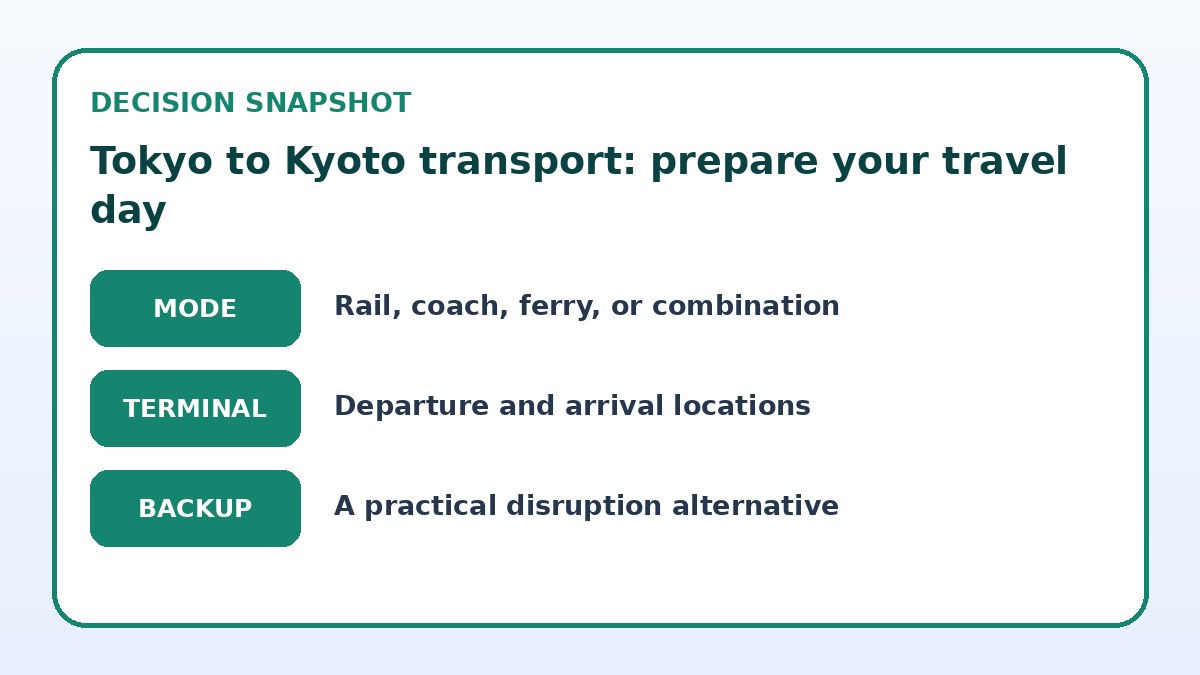
Decide primarily by door-to-door practicality. Rail (including high-speed and conventional trains) usually minimizes city-center to city-center time and is simplest when your Tokyo and Kyoto endpoints are near major stations. Coaches often depart from different terminals and may drop you off near transit hubs, but they can have longer travel times and fewer luggage limits. Mixed routes—train to a regional hub then coach, or coach to a smaller station then local train—can combine lower cost with acceptable total time. Examine how far your accommodation is from arrival points before picking a mode.
When comparing options on booking pages or schedules, add realistic transfer times: walking between platforms, navigating station concourses, and waiting for local transit or taxis. If you value predictability, choose reserved seats on trains or coaches and avoid connections that require tight transfers. If budget and late-night arrival are priorities, a coach or mixed option might fit. Whatever you choose, plan the entire chain: getting to the departure terminal in Tokyo, the main ride, and onward transport in Kyoto.
Choose the end-to-end journey plan
| Journey approach | Best for | Friction to check |
|---|---|---|
| Direct high-speed rail (reserved seats) | Travelers prioritizing consistent city-center arrival and shorter door-to-door time. | May require more walking inside major stations with luggage and typically costs more than coach alternatives. |
| Highway coach (single-seat booking) | Budget-conscious travelers with flexible schedules who prefer straight boarding and fewer transfers. | Longer door-to-door times and potential discomfort on longer road journeys during peak traffic. |
| Mixed route (coach + local train or regional rail) | Those optimizing cost versus convenience for specific origin or destination neighborhoods. | Requires careful timing and may increase transfer friction with luggage between modes. |
| Flexible-day plan with shipped luggage and reserveable seats | Visitors wanting minimal luggage hassle and a stress-minimized arrival at the hotel. | Adds coordination time before travel (arranging delivery) and depends on carrier pickup/delivery windows. |
Check live intercity options
Look beyond the ride itself and compare terminals, transfers, luggage, and arrival fit.
Terminal fit and end-point practicality
Not all terminals are equally convenient for your start or end points. Tokyo has multiple large rail hubs and coach terminals; Kyoto’s main station sits near many hotels and transit lines. Confirm which station or terminal your chosen service uses and estimate the onward travel time to your accommodation. A slightly longer ride that arrives at Kyoto Station can be faster overall than a shorter service that drops you off at a remote stop requiring taxis or complex transfers.
Check platform and terminal layout ahead of travel to avoid surprises. Large stations mean long corridors and moving between lines can take 10–20 minutes with baggage. If you have mobility needs or heavy luggage, pick services that advertise accessible platforms or allow easy curbside boarding. Look at station maps published by operators or the station authority, and verify exit directions so you leave toward the right side of the city.
Luggage, transfers and timing flexibility
Luggage size and how you handle it will shape your day. Reserve seats where possible to secure overhead or designated luggage space. If you plan to use luggage delivery (takkyubin) services between hotels, factor in the delivery window: you may not get same-day door-to-door service in all cases. If you choose not to ship luggage, test whether your bags are manageable on stairs, escalators, and crowded platforms. Allow extra time for baggage checks at the station entrance, ticket gates, and boarding.
Timing flexibility means building realistic buffers into your schedule: plan for 20–45 minutes extra around rush hours, station navigation, and public-transport delays. If your arrival ties to a hotel check-in deadline or an evening reservation, aim for an earlier service to reduce pressure. For same-day round trips or tight connections, prefer options with frequent departures or reserve a spot on the next available train or coach to avoid missing plans when small disruptions occur.
Compare the practical alternatives
Use the final page to confirm what is actually offered on your dates and save a workable fallback.
Intercity travel checklist
- Confirm exact departure terminal/station in Tokyo and the arrival station in Kyoto, then estimate door-to-door travel time to your accommodation.
- Reserve seats when available to secure luggage space and reduce standing or searching for room on busy services.
- Measure and weigh your luggage; if oversized, research baggage rules or schedule a luggage-delivery service and confirm pickup times.
- Build a timing buffer of at least 30–45 minutes for airport/train-station navigation, especially during rush hours or complex transfers.
- Save electronic and printed confirmations, station exit maps, and your Kyoto address in Japanese for taxis or directions.
- Identify at least one concrete disruption backup (later train, different terminal route, or taxi option) and note how to book or buy it quickly.
Disruption backup and what to verify before booking
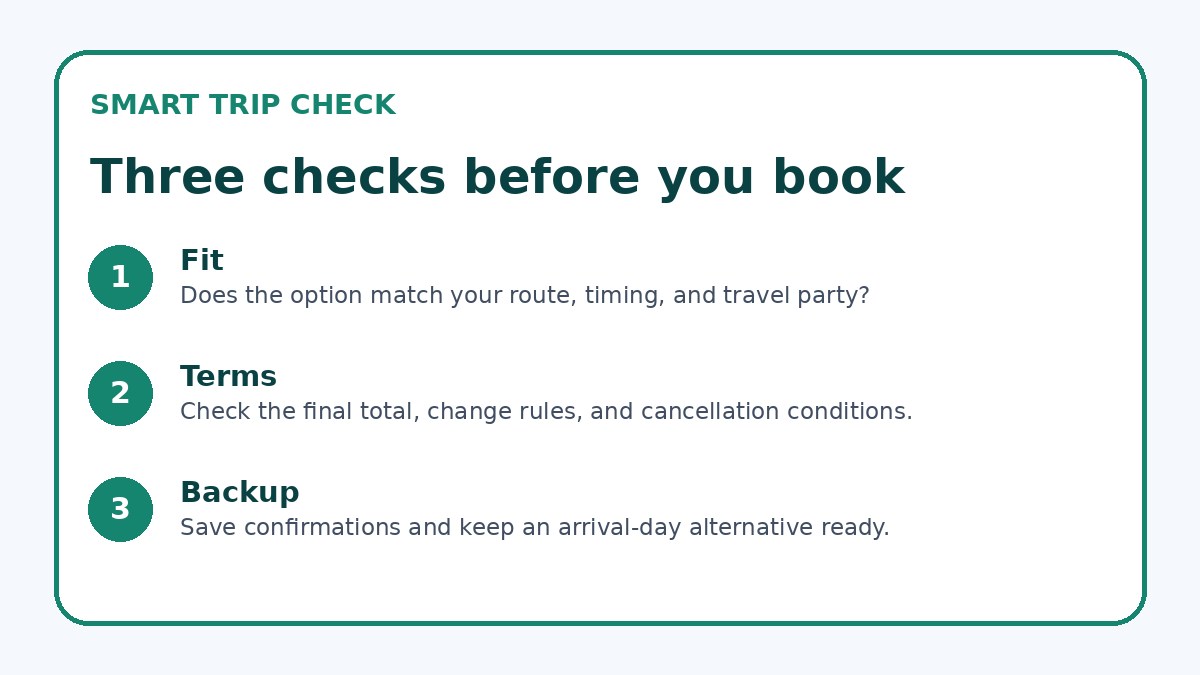
Before you book, choose a backup you can enact quickly: a later train or coach you can switch to, a different station you can reach by local transit, or a short taxi for last-mile coverage. Keep multiple ways to reach Kyoto in mind and know the refund or change rules on your chosen ticket—some reservations are flexible, others are not. If you use a third-party comparison site such as Trip.com, verify final availability and terms on the operator’s official page before relying on that option.
Prepare digital and physical copies of confirmations, station maps, and contact numbers for luggage services and your accommodation. Store an offline map and the address in Japanese for taxi drivers or if you need to ask for directions. Consider travel insurance that covers transport delays if that matters for connections or prepaid activities. On travel day, check real-time departure boards and operator notices shortly before leaving your lodging so you can switch to your backup if needed.
Rail & Intercity Transport questions travelers ask
Should I pick the fastest train or the cheapest coach from Tokyo to Kyoto?
Choose based on door-to-door needs rather than just vehicle speed. The fastest train may save travel time but could require long walks through stations with luggage; coaches often depart from different terminals and take longer but may be cheaper. Compare total time from your lodging in Tokyo to your Kyoto accommodation, include transfers and walking, and decide whether saving money is worth extra travel time or inconvenience. Also check seat reservations and luggage handling on both options before booking.
How much buffer time should I allow on the travel day for connections and station navigation?
A conservative buffer is typically 30–45 minutes for city station navigation and peak-hour congestion, with more time if you have heavy bags, mobility needs, or unfamiliarity with large stations. If your itinerary includes a tight connection—switching between different stations or modes—allow at least 45–90 minutes. If the rest of your day is fixed by appointments or reservations, choose an earlier service to avoid stress. Confirm departure platform info and check live-status updates shortly before you leave.
Can I rely on luggage delivery services to avoid carrying bags between Tokyo and Kyoto?
Luggage delivery (takkyubin) is commonly used, but it requires coordinating pickup windows and confirming delivery timing with the carrier and your hotels. It often reduces transfer friction and lets you travel light on the day, but same-day or next-day delivery depends on the service and your pickup/dropoff locations. Verify pickup availability, delivery estimates, and any size or weight restrictions on the carrier’s booking page before relying on it; keep a small, accessible bag with essentials for the travel day.
Final decision note
Planning the travel day from Tokyo to Kyoto is less about picking a single mode and more about matching the entire door-to-door chain to your priorities: speed, comfort, luggage handling, and schedule flexibility. Start by mapping your endpoints and comparing total time including transfers, then pick reserved seating where possible and build realistic timing buffers. Bring backup options—an alternative later service, a different station route, or a taxi plan—and verify critical details like terminal locations, luggage policies, and reservation change rules on provider pages. With these checks you’ll reduce day-of stress and reach Kyoto ready to explore.
Continue planning
Check current options and final conditions
Use the provider page to confirm live availability, the final total, cancellation terms, and every condition that matters to your trip.
This evergreen planning guide was created with AI-assisted drafting and a structured quality review. It does not display live prices, schedules, availability, visa guidance, or provider rankings. Verify current details before booking. Some links are affiliate links; we may earn a commission at no additional cost to you.