If you’re flying Sydney to Melbourne for the first time, the immediate decisions you need to make are straightforward: pick a flight routing that suits your schedule and baggage needs, decide how early to get to the airport, and plan for luggage handling both at check-in and on arrival. The simplest practical plan is to choose a flight whose schedule you can comfortably reach given your local travel time, buy a fare that includes the baggage you need, and allow buffer time for security, potential queues, and any connection procedures. This guide gives the direct answer first—aim to arrive at the airport 90–120 minutes before a domestic departure if you have hold luggage, or 60–90 minutes if you travel carry-on only—and then walks through the tradeoffs between fares, baggage limits, connections, and schedule fit. Before you search live fares, gather exact travel dates, full traveler names, and the number and size of bags so you can compare options accurately.
See live routes for your exact travel day
Compare direct and connecting choices with the same baggage and traveler details.
Routing: direct versus connecting options
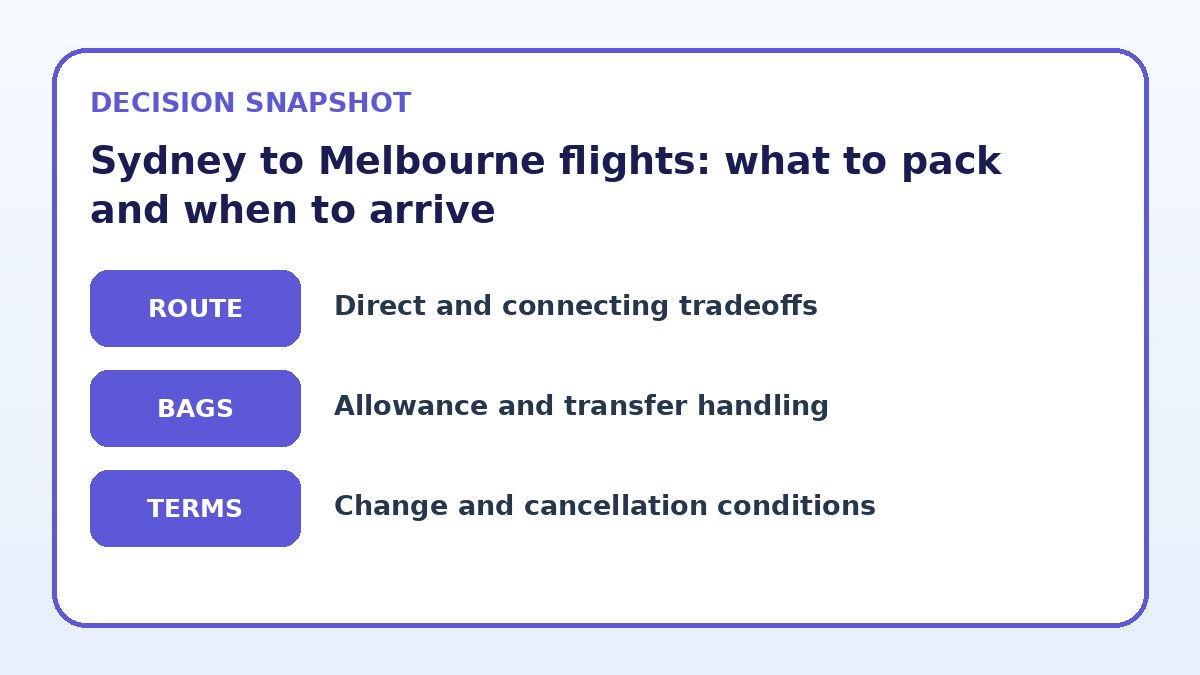
On the Sydney to Melbourne route, many travelers prioritize direct flights because they reduce overall complexity: no mid-journey transfers, lower chance of baggage mishandling, and usually shorter total travel time. When you compare direct and connecting options, read the fare conditions carefully—some lower-cost itineraries labeled as connecting may involve a separate ticket or require you to collect and re-check baggage at the connection airport. For first-time visitors, direct flights simplify timing and reduce stress, but a well-timed connection can be cheaper or provide better departure times.
When you evaluate routing, list your priorities: is minimizing total door-to-door time the goal, or is saving money worth an extra transfer? If you choose a connecting itinerary, verify whether the connection is protected by one booking reference and whether baggage will be checked through to Melbourne. On the booking page check connection minimum times, transfer terminals, and any notes about self-transfer. If a provider’s final booking page doesn’t clearly state baggage transfer rules or connection protection, contact them before buying.
Baggage and connection risk
Baggage is the practical limiter for airport arrival time and for routing choices: checked bags require drop-off time at the airline desk and add weight to missed-connection consequences. If your fare includes checked baggage, you still need to budget time to queue at the bag drop. Confirm size and weight allowances on the booking page and decide whether your bags fit carry-on rules; carry-on permits you to bypass the bag-drop queue and reduces your minimum airport arrival time.
For connections, baggage risk increases if you must re-check luggage between flights or change carriers. Always verify on the booking confirmation whether bags are tagged to your final destination. If bags are not checked through, build extra time for collection and check-in at the connecting airport. Consider travel insurance that covers missed connections for tight itineraries, and if you carry important items, place them in cabin baggage to avoid disruption if a checked bag is delayed.
Compare flight-selection strategies
| Flight strategy | Best for | Risk to check |
|---|---|---|
| Direct nonstop flight | Travelers who value simplicity and minimal connection risk | Often slightly higher fares or fewer departure times compared with connecting options |
| Connecting flight on a single-ticket itinerary | Those seeking lower fares while retaining baggage transfer protection | Longer total travel time and greater chance of delays affecting the arrival schedule |
| Separate tickets for legs (self-transfer) | Budget-focused travelers willing to manage their own transfers | Higher risk of missed connections and requirement to re-check baggage at transfer |
| Flexible/refundable fare | First-time visitors who want flexibility and lower stress about changes | Higher upfront cost compared with non-refundable or restricted tickets |
Recheck the complete itinerary
Confirm airports, connection handling, baggage, and change conditions before deciding.
Schedule fit: matching flight times to your plans
Match flight departure and arrival times to the wider logistics of your trip. For first-time visitors unfamiliar with city traffic, public transport schedules, or terminal layouts, allow extra ground time both before departure and after arrival. If you have morning commitments, a very early flight may save time overall, but it usually forces earlier check-in and potentially higher chances of queues. Late-day flights can be convenient but risk delays that cascade into missed onward plans.
When you choose a flight, check local transport connections at both ends and add realistic travel buffers. For example, if you need to catch a train or ferry after landing in Melbourne, factor in time to collect baggage, clear arrivals, and navigate to public transport. Make a simple timeline from your first pickup (hotel or home) to final arrival at your destination and build in at least 30 minutes of contingency for minor delays on top of the recommended airport arrival windows.
Flight details to verify
- Write down exact travel dates, full traveler names (as on ID), and the number and dimensions of all bags before searching fares.
- Decide whether you plan to travel carry-on only or need checked luggage and select fares that explicitly include the chosen allowance.
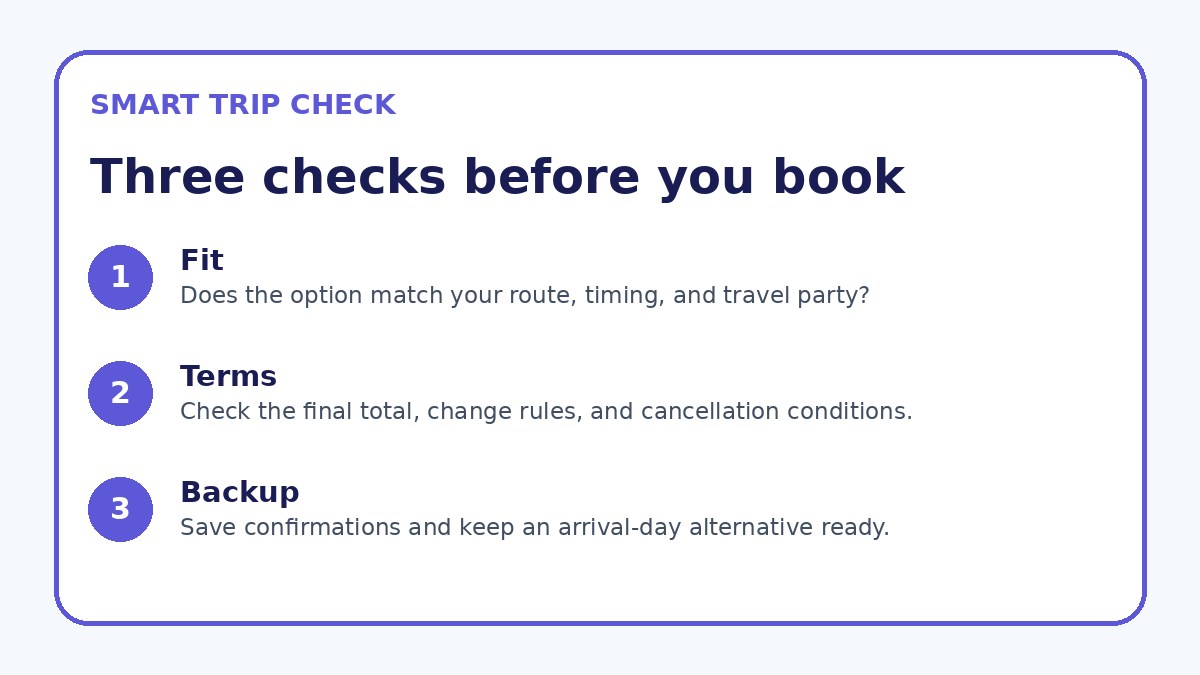
- Check the final booking page for baggage transfer rules, connection protections, and the total price including all possible fees.
- Plan to arrive at the Sydney terminal 90–120 minutes before departure if checking bags, or 60–90 minutes for carry-on only; add extra time at peak hours.
- If your itinerary includes a connection, verify whether luggage will be checked through to Melbourne or needs re-checking during the transfer.
- Take a photo of luggage tags and pack a small essentials bag in carry-on with chargers, medication, documents, and one change of clothes.
Fare conditions and what to verify before booking
Fare rules vary by ticket type: refundable, changeable with a fee, or non-changeable. Before you commit, check what the fare allows for cancellations, date changes, and name corrections. Crucially for this route, confirm whether the fare includes baggage allowance, whether seat assignments are included, and what the carry-on policy is. Many booking pages list baggage and change fees; read those sections closely and note any timing windows or fees for changes.
Also verify exactly what is promised on the provider’s final booking page: total price (including taxes and any baggage/seat fees), the permitted number and size of bags, transfer protections for connections, and contact information for airport check-in. If something is unclear—especially baggage transfer rules or minimum connection times—contact the airline or booking agent directly before payment. As an optional check, you may compare live options on Trip.com to see current availability and conditions, but always validate details on the airline’s or seller’s final booking confirmation.
Flight Guide questions travelers ask
How early should first-time flyers arrive at Sydney Airport for a domestic flight to Melbourne?
For first-time flyers, arriving early reduces stress and gives time to handle unfamiliar procedures. If you have checked baggage, arrive 90–120 minutes before departure to allow for check-in, bag drop, and security. If you only have carry-on luggage and know the terminal layout, 60–90 minutes is usually sufficient. Increase these buffers during peak travel times, public holidays, or if you need special assistance. Always verify check-in and bag-drop cut-off times on the airline’s final booking page so you’re not relying on general guidance alone.
Can I rely on my checked bags being transferred automatically during a connection?
Whether checked bags are transferred automatically depends on how your itinerary is booked. If both flights are on the same booking reference and the airline or code-share partner offers through-checked baggage, your bags are usually tagged to the final destination. If legs are booked separately or involve different carriers without an interline agreement, you may need to collect and re-check bags. Always confirm baggage transfer rules on the booking confirmation and contact the airline if the information is unclear before you travel.
What should I verify on the airline’s booking page before paying for a Sydney to Melbourne flight?
Before payment, verify the total price (fare plus taxes and any baggage or seat fees), exact baggage allowance including weight and size limits, change and cancellation conditions, whether seats are included, and any minimum connection times if applicable. Check whether baggage is checked through for connections and whether the fare is refundable or changeable. If you rely on services like priority boarding or check-in counters, confirm their availability. If details are ambiguous, contact the airline or agent directly for clarification.
Final decision note
Planning a first trip from Sydney to Melbourne becomes straightforward if you break the decision into three clear steps: pick the routing that fits your tolerance for connections, choose a fare that covers the baggage you actually need, and build realistic airport arrival buffers. Direct flights reduce handling and connection risk but evaluate whether a cheaper or better-timed connection genuinely saves you time after adding transfer steps. Before you hit purchase, have exact travel dates and bag counts ready, read the booking page for baggage transfer and change rules, and set a conservative airport arrival time. That preparation keeps the trip simple and reduces the chance of last-minute surprises.
Continue planning
Check current options and final conditions
Use the provider page to confirm live availability, the final total, cancellation terms, and every condition that matters to your trip.
This evergreen planning guide was created with AI-assisted drafting and a structured quality review. It does not display live prices, schedules, availability, visa guidance, or provider rankings. Verify current details before booking. Some links are affiliate links; we may earn a commission at no additional cost to you.