If you’re booking Seoul to Bali flights for work, the practical choice is often not the lowest headline fare but the one whose change and cancellation terms match your business risk tolerance. For short-notice meetings or itineraries that may shift after a contract signs, prioritize flexible change policies, refundable or partially refundable fares, or clear fee structures that keep rebooking predictable. If your trip is firm and cost-sensitive, a stricter fare with a low price point might make sense but accept higher replacement costs if plans change. This guide walks you through routing options, baggage and connection risks, schedule fit for typical business hours, and the exact fare conditions to check on the airline’s booking page before you commit. Prepare exact travel dates, traveler name spellings, loyalty numbers, and any corporate booking codes so you can compare live options with confidence.
See live routes for your exact travel day
Compare direct and connecting choices with the same baggage and traveler details.
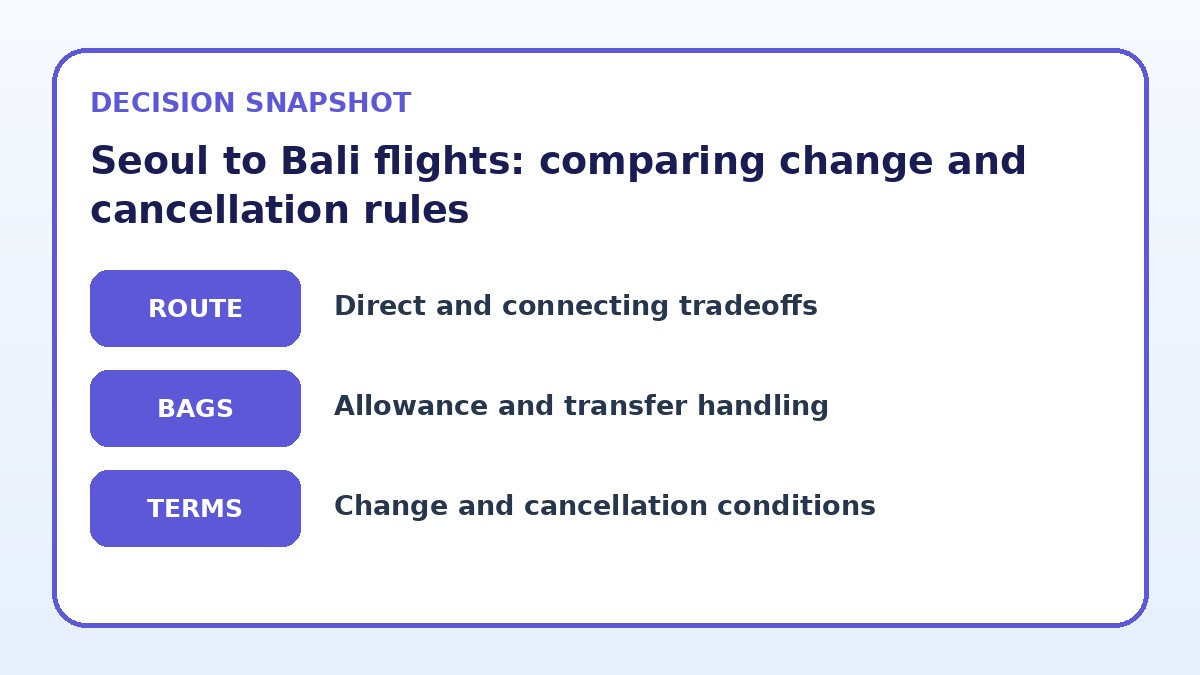
Routing: direct versus connecting choices
On the Seoul to Bali corridor you will typically find a mix of non-stop (where available) and one-stop connections; compare them on total travel time, connection padding, and the number of airports involved. For business travelers the priority is often predictable arrival time for meetings, so a slightly longer but well-timed connection can be preferable to a non-stop that arrives very early or very late. When evaluating options, check the earliest and latest possible arrival windows and pick the routing that minimizes the chance of missing the first business engagement.
Also consider where connections occur. A single connection with a comfortable minimum connection time reduces baggage and missed-connection risk compared with multiple short hops. If an itinerary involves an overnight connection, confirm if an airline provides hotel support or whether you must self-manage accommodation. On the booking page, verify which carrier operates each flight portion, whether the itinerary is through-ticketed (one ticket) or separate tickets, and how that affects rebooking and liability in case of missed connections.
Baggage and connection risk for business trips
Business travelers often travel with laptops, briefcases, and promotional materials; check the carry-on and checked baggage allowances attached to each fare class before booking. Low-cost or basic economy fares frequently restrict carry-on size or priority boarding and treat any schedule change as a higher fee event. For checked baggage, confirm whether the allowance is included or must be purchased separately; buying baggage as part of the fare can simplify changes since reissuing a ticket that added ancillaries sometimes requires separate steps.
Connections increase the chance of delayed baggage or misrouted items, so prefer through-checked itineraries where the carrier agrees to transfer luggage to the final destination. If your itinerary has short connection times, consider paid priority or guaranteed connection services if available. Verify on the airline’s final booking page whether baggage is through-checked for the whole journey, what happens to lost or delayed baggage, and any deadlines to report issues in order to preserve rights to compensation or support.
Compare flight-selection strategies
| Flight strategy | Best for | Risk to check |
|---|---|---|
| Book the most flexible refundable fare | Last-minute schedule changes and high-risk itineraries | Higher upfront cost; can still require minor fare differences on reissue |
| Buy a semi-flexible business fare with change fees waived | Frequent business travelers balancing cost and flexibility | Moderate price premium and potential limits on refundable value |
| Select a low-cost or basic fare and add flexibility as needed | Cost-conscious travelers with stable schedules | Ancillaries and change fees can be expensive and complicate reissues |
| Use a mixed-ticket routing to optimize schedule and price | Tailoring arrival/departure times when single-carrier options are poor | Higher connection and baggage risk; separate tickets may lack rebooking protection |
Recheck the complete itinerary
Confirm airports, connection handling, baggage, and change conditions before deciding.
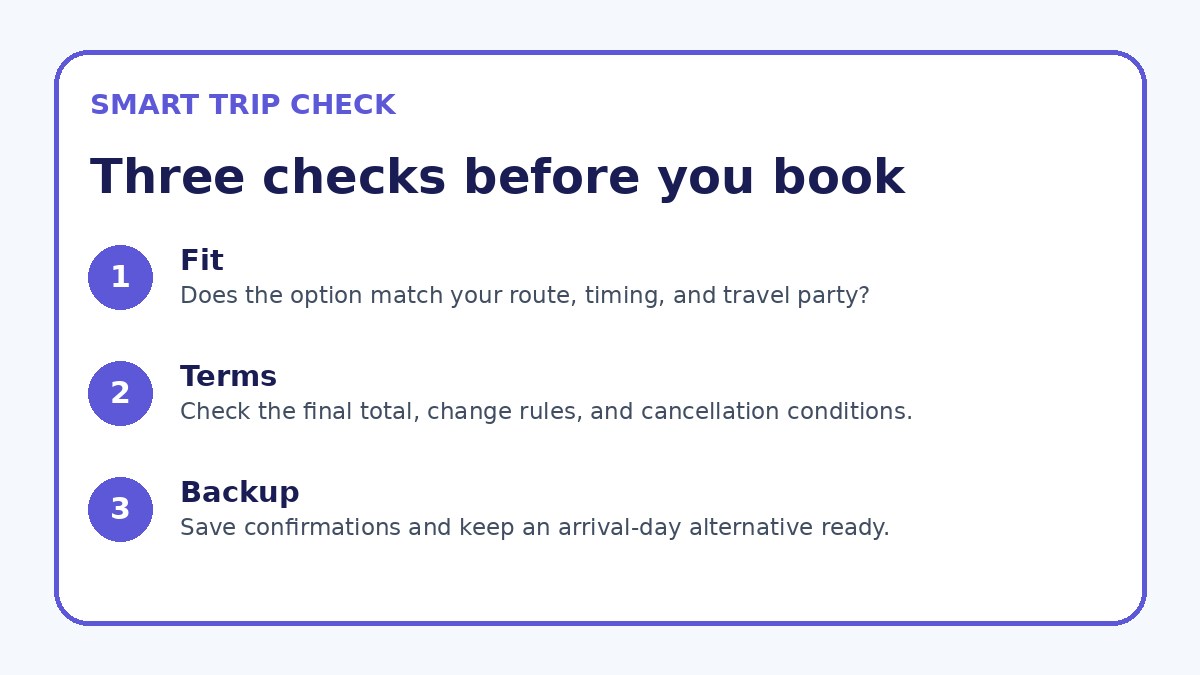
Schedule fit: optimizing arrival and departure times
Match flight times to your meeting schedule rather than simply choosing the earliest departure. Arriving the evening before important meetings reduces stress from delays but adds hotel cost; a same-day arrival can work if you build generous buffer time into your connections. Business travelers should also factor local transit time from the arrival airport to central business districts and potential evening curfews or traffic patterns that affect travel time in Bali.
When comparing flight options, look at both outbound and return schedules: a flexible return is often as valuable as a flexible outbound if meetings can extend. Pay attention to minimum connection times listed during booking and whether seats or meal service on the flight help you prepare for meetings en route. On the airline’s booking page, confirm exact departure and arrival local times for each segment, and verify whether schedule change notifications are sent via email, SMS, or app so you won’t miss last-minute adjustments.
Flight details to verify
- Have exact travel dates, full traveler names, passport numbers, and loyalty program details ready before shopping fares.
- Open the airline’s fare rules and copy the change and cancellation text into your booking notes for later verification.
- Confirm whether baggage is included and through-checked for all segments when you compare itineraries.
- Note which carrier issues the ticket and which carriers operate each segment to understand rebooking responsibility.
- Check how ancillaries (seats, lounge access, baggage) are handled if you change or cancel the base fare.
- If booking via a travel manager or agency, confirm who processes refunds or reissues and expected timelines for credits.
Fare conditions: what to check on the booking page
The core details to verify before you pay are: whether the fare is refundable, whether changes are permitted and under what fee structure, if reissues require paying fare differences, and any time windows that trigger different penalties. Clear corporate-friendly features to look for include free same-cabin changes within a set period, ticket credit instead of cash refunds, or flexibility to change names for crew or support staff. Don’t rely on summary labels; open the fare rules and read the change/cancellation section to see concrete fees, time limits, and whether taxes are refunded separately.
Also check if ancillary purchases—seat selection, baggage, lounge access—are refundable or transferable when you change the base ticket. If you are booking through a corporate travel tool or agency, verify which party (airline vs agency) handles refunds or reissues and how quickly credits are issued. For multi-carrier itineraries, confirm which carrier’s rules dominate rebooking responsibility, and always copy the exact policy language from the airline’s final booking page into your travel record for dispute resolution.
Flight Guide questions travelers ask
How do I decide between a refundable fare and a cheaper nonrefundable option?
Start with your risk tolerance: if your meeting date or attendee list can change, a refundable or highly flexible fare reduces stress and hidden costs. Compare the premium you pay for a refundable ticket to likely rebooking fees and fare differences you might face if you need to change a nonrefundable ticket. Also confirm whether your company’s travel policy reimburses cancelled trip costs and whether the airline issues a credit versus a cash refund. Finally, verify the exact refund mechanics and timeline on the airline’s booking page before purchasing.
What should I verify when an itinerary includes multiple airlines?
Check whether the ticket is issued as a single itinerary (through-ticketed) or as separate tickets; the former usually places rebooking responsibility with the issuing carrier or alliance, while the latter leaves you to manage missed connections. Verify which carrier’s conditions apply to changes and refunds for each segment and whether baggage will be transferred automatically. Also read the minimum connection time used by the booking system and confirm it’s realistic for immigration and baggage transfer at the connecting airport.
Can I rely on corporate travel policies to cover change fees or refunds?
Corporate travel policies may include special fare classes, negotiated change privileges, or a process to approve exceptions; however, you must verify what is available for the specific fare you book. When using a corporate code or negotiated rate, check whether change penalties are waived and how to document and request reimbursements. Always confirm, on both the airline’s booking page and with your travel manager, who issues refunds or reissues and the expected credit timelines so you know where to direct any disputes or urgent changes.
Final decision note
For business trips between Seoul and Bali, your best booking decision balances predictable arrival times with fare flexibility that matches your meeting risk. Prioritize routing that protects you from connection and baggage failure, and pick fare classes whose change and cancellation rules you can afford and administratively manage. Before you buy, prepare precise traveler details, read the full fare rules on the airline’s booking page, and note which carrier is responsible for reissues. Use that information to decide whether to pay more for refundable flexibility, add ancillaries for smoother transfers, or accept a strict fare with contingency plans. If you want live availability and to compare policies, Trip.com can be used to view current options, but always confirm the final rules on the airline’s confirmation screen.
Continue planning
Check current options and final conditions
Use the provider page to confirm live availability, the final total, cancellation terms, and every condition that matters to your trip.
This evergreen planning guide was created with AI-assisted drafting and a structured quality review. It does not display live prices, schedules, availability, visa guidance, or provider rankings. Verify current details before booking. Some links are affiliate links; we may earn a commission at no additional cost to you.