If you’re traveling to Singapore with bulky bags, sports equipment or family-sized luggage, deciding whether to rent a car hinges on fuel and mileage rules as much as cargo space. Practical driving can save door-to-door hauling time, but hidden mileage caps, refill policies and excess-luggage charges can erase the convenience. Start by asking three questions: how is fuel recorded and charged at pickup/return, what daily or total mileage limits apply, and how does the rental company handle oversized baggage or rooftop carriers? The right answers change packing and transport choices. This short guide gives the decisive yes/no on driving, explains the key contract terms to verify on the provider’s final booking page, compares four mobility approaches, and offers a fallback plan if driving isn’t the best match for your luggage-heavy trip.

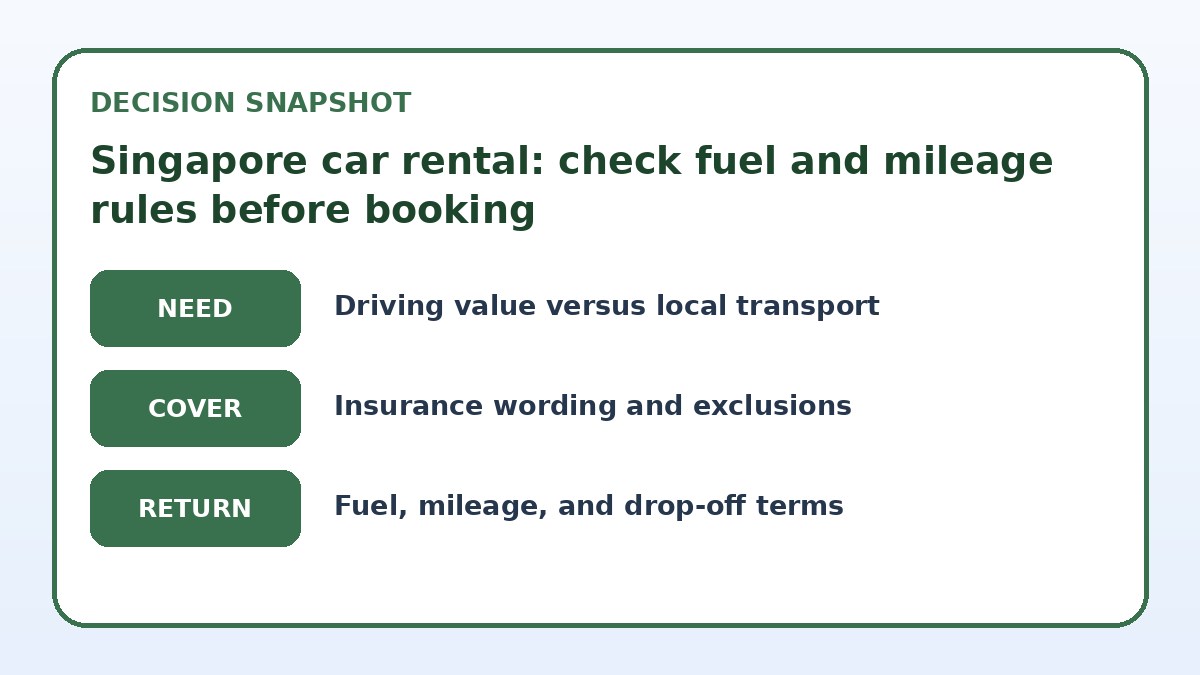
Decide whether driving improves your luggage-heavy itinerary
Start by comparing the net benefit of driving with your luggage load and trip plan. If your schedule includes several suburban stops, early starts or remote drop-offs where public transport would be slow or require multiple transfers, a rental can be worth the hassle. But if you’re staying inside the city center with short rides between attractions and you can manage larger bags in taxis or trunk space with one offload, the time and cost of dealing with fuel rules, congestion charges and parking may outweigh convenience.
When evaluating, treat fuel and mileage rules as opportunity costs: a low mileage allowance or an unfriendly fuel policy can add administrative friction and surprise charges. Consider door-to-door time savings, the number of onward transfers you’d avoid carrying baggage, and whether you’re comfortable lifting bags into trunks or rooftop carriers. If any of these factors are marginal, keep a non-driving fallback in mind—good taxi and delivery options exist in Singapore and can be simpler for city-centric itineraries.
Decide whether driving earns its place
| Mobility strategy | Best for | Cost or friction to check |
|---|---|---|
| Rent a car for the whole trip | Multi-stop suburban or cross-island itineraries with several large items to transport | Highest paperwork for fuel/mileage and potential luggage surcharges; must verify contract specifics closely |
| Short-term car hire just for airport transfers | Heavy arrivals or departures needing one large, direct transfer without repeated driving | Simpler mileage issues but may still incur fuel refuelling or airport handling fees |
| Taxis and ride-hailing for all legs | City-centric stays where trips are short and occasional larger trunks fit into cabs | Lower admin, but repeated fares can add up and larger items may require booking a bigger vehicle |
| Public transit plus luggage courier/hotel storage | Sightseeing where you want to avoid driving and offload bulky gear for specific legs | Lowest vehicle cost and hassle, but adds courier coordination and time for pickups/deliveries |
Check live rental choices only after the route test
Use the exact driver, dates, pickup point, and return plan to compare current conditions.
What to verify on the rental contract: fuel and mileage specifics
Inspect the final booking page and the contract for exact wording on fuel policy: full-to-full, pre-purchase of a tank, or charge-on-return. Full-to-full is easiest—pick up with a full tank and return full, documented by odometer and fuel gauge photos at both ends. If the provider offers a pre-purchase option, confirm the refund or top-up method and whether returns with unused fuel are credited. Also verify how fuel is measured (litres or internal percentage readings) and whether any refuelling fees or service charges apply.
For mileage, look for the daily allowance and any total cap across the rental, plus the charge per excess kilometre. Some contracts state a generous daily limit but impose a strict total cap for longer hires; others use an unlimited option at a premium. Carefully note whether mileage resets at midnight or is pro-rated per 24 hours, and whether additional drivers or one-way hires change allowed miles. If the contract mentions 'excess mileage' or 'unlimited option', check the exact numeric terms and where charges will appear on your final invoice.

Compare the full rental conditions
Confirm insurance wording, exclusions, deposit, fuel, mileage, and return terms on the final page.
Pickup, return friction and luggage handling provisions
Pickup and return logistics are where most disputes occur, especially with heavy luggage. At pickup, insist on a physical condition report with photos of the boot/trunk, roof and interior; have staff note existing scratches or dents and record the fuel reading. If you’ll be using a roof box or carrier, confirm whether the rental company supplies one, whether installation is allowed by policy, and if there is an extra charge or deposit. If pickup is at the airport, ask about shuttle wait times for oversized bags and whether airport handling incurs extra fees.
On return, verify how staff document fuel level and odometer and whether you receive a receipt showing final charges. If the vehicle needs cleaning because of sand, mud or odours from luggage, check for referenced cleaning fees and what constitutes normal versus excessive wear. Take timestamped photos of the interior and fuel reading at return to keep evidence in case of later billing. When in doubt, ask the agent to sign a handover note confirming the vehicle condition and fuel level before you leave the branch.
Car rental terms to verify
- Confirm fuel policy wording (full-to-full, pre-purchase, or charge-on-return) on the final booking page and screenshot it.
- Note the daily and total mileage limits, the excess-kilometre rate, and whether an unlimited option exists and its exact terms.
- Ask the provider in writing about rooftop boxes or carriers: availability, allowed weight, installation charges and insurance coverage.
- Get a written condition report with timestamped photos of trunk, roof and interior at pickup, signed by staff where possible.
- Check insurance exclusions for cargo-related damage and consider separate insurance for valuable equipment or instruments.
- Record the odometer and fuel reading (photos) at return and request a printed or emailed final receipt showing any fuel or mileage charges.
Insurance, damage liability and a non-driving fallback
Read insurance wording carefully: collision damage waivers (CDW) and supplementary liability cover often exclude damage caused by improperly secured rooftop loads or overloaded trunks. Confirm whether roof boxes are covered and whether there’s an increased excess or specific exclusions for cargo damage. If your equipment is valuable—musical instruments, professional gear, or sports kit—consider separate gear insurance and ask whether the rental company requires additional declarations or surcharges for valuable cargo.
If driving doesn’t look clean or cost-effective, have a fallback plan. Taxis and ride-hail apps in Singapore are typically reliable and can carry substantial luggage in larger vehicle categories; for very bulky items, pre-book a luggage courier or hotel transfer service. Public transport with a lighter load remains efficient, and many hotels offer luggage storage so you can use transit for sightseeing without dragging bags. Keep confirmation screenshots and the provider’s final booking page details so you can compare costs and terms before you commit to driving.
Car Rental & Road Trip questions travelers ask
How do fuel charges usually work when returning a rental car in Singapore?
Fuel policies vary: full-to-full is common—pick up with a full tank and return it full—while some providers offer pre-paid fuel or charge per missing litre at a higher rate. Verify which method applies on the provider’s final booking page and ask how fuel level is measured and recorded. At pickup and return, take dated photos of the fuel gauge and ask staff to confirm the reading in writing to avoid disputes. If pre-purchasing fuel, confirm if refunds are provided for unused volumes and how those refunds are calculated.
Will extra luggage affect my insurance or liability on a rental car?
Yes—many insurance and collision-damage waivers exclude damage caused by improper loading or payloads exceeding vehicle limits. Roof boxes or unsecured items that damage the car or obstruct driver view may void parts of cover and increase excess amounts. Always declare large or heavy equipment to the rental company, check the allowed cargo weight and whether roof-mounted gear is permitted, and get any special arrangements in writing. For valuable items, arrange separate equipment insurance regardless of the car policy.
If I exceed the mileage limit, how will charges appear and what should I check?
Excess mileage is billed per kilometre or as a flat daily penalty depending on the contract; the rate and calculation method must be spelled out on the booking page. Before signing, confirm whether mileage is tracked by odometer only, whether there’s a grace allowance and how rounding is handled. At return, request a printed breakdown of kilometres driven and the excess charge calculation. Keep pickup and return photos and timestamps as evidence in case the billed kilometres are disputed afterward.
Final decision note
For travelers with extra luggage, the right call on Singapore car rental comes down to clear answers on fuel, mileage and luggage rules before you book. Driving adds flexibility for multi-stop suburban trips and bulky items, but only when the rental terms align with your needs: a straightforward fuel policy, a sufficient mileage allowance, explicit permission for rooftop carriers and transparent insurance wording. Always verify these specifics on the provider’s final booking page and capture pickup/return evidence. If contract terms look restrictive, use taxis, ride-hailing or a luggage courier plus public transit as a simpler, lower-risk fallback.
Continue planning
Check current options and final conditions
Use the provider page to confirm live availability, the final total, cancellation terms, and every condition that matters to your trip.
This evergreen planning guide was created with AI-assisted drafting and a structured quality review. It does not display live prices, schedules, availability, visa guidance, or provider rankings. Verify current details before booking. Some links are affiliate links; we may earn a commission at no additional cost to you.