Practical answer up front: for most families, prioritize a flight itinerary that minimizes stress on travel day — look for options with departure and arrival times that match your child’s sleep and activity rhythms, a single connection if necessary, and clear transfer times at both airports. If convenience is paramount, direct flights (if available) or same-terminal connections reduce hassle; if flexibility is more important, search for tickets with flexible change policies and longer layovers you can use as buffer. Before booking, compare total door-to-door time, baggage rules, seat assignment options, and change/cancellation terms. Check the airline’s final booking page for exact seat maps, carry-on allowances, and any family-specific boarding benefits. You can also compare current availability and conditions on Trip.com as one of several tools.
Decide what convenience means for your family
Convenience can mean different things: the shortest elapsed travel time, the fewest transfers, or fewer decisions on travel day. For families with young children, convenience often translates to predictable routines — departing at times that align with naps or meals, minimizing time in unfamiliar spaces, and reducing the number of seat changes. Think beyond flight duration: convenience includes gate proximity, the availability of family or priority boarding, and whether airports at each end have straightforward ground transport to your accommodation. Write down the aspects that matter most to your group before you search so you can compare options against that list.
When evaluating convenience, also consider what you can’t control on the day: airport crowds, security lines, and delays. If you value minimizing those variables, prioritize direct flights or itineraries that keep you within one terminal for connections. But if scheduling constraints at home make certain departure times impossible, convenience might instead mean a flexible ticket that lets you swap flights without significant penalty. Knowing which convenience factors are negotiable will help you weigh tradeoffs between faster itineraries and ones designed to reduce stress for kids and caregivers.
When flexibility beats speed: who should choose changeable tickets
Flexible tickets are worth paying for when your plans are likely to change or when traveling with infants, toddlers, or multi-generational groups. Flexibility helps if you need to add or move a traveler, adjust departure times to accommodate delayed trains to the airport, or if you prefer the option to extend your stay in Japan without rebooking a new flight. Look for fares that clearly state change fees, fare difference rules, and whether name changes or same-day rebookings are permitted. Families often benefit from the peace of mind that comes with refundable or rebookable options even if it costs more upfront.
However, flexibility comes with tradeoffs. Flexible fares can be more expensive and sometimes have limitations such as blackout periods or specific rebooking windows. Before paying extra for flexibility, calculate realistic scenarios: how likely are you to change dates, and what would a typical change cost on a non-flexible fare? Also confirm on the airline’s booking page whether refunds are processed as credits or cash, and whether third-party booking platforms have different change policies. That exact wording will determine how useful the flexibility actually is on travel day.
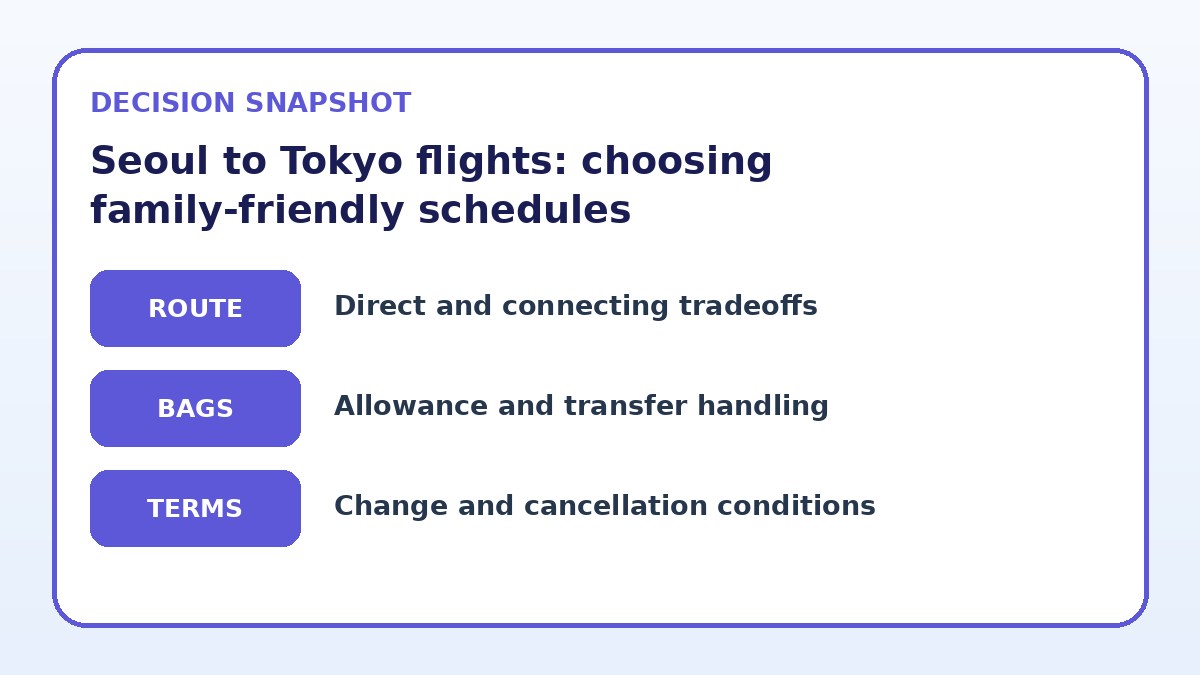
| Approach | Best for | Tradeoff to check |
|---|---|---|
| Direct flight (nonstop) | Families prioritizing the least travel disruption and simpler logistics | May be less flexible for timing and sometimes cost more than connecting fares |
| Single-connection itinerary with buffer | Families needing more departure/arrival time choices while limiting transfer complexity | Adds one transfer but reduces risk of missed flights when delays occur |
| Flexible/changeable fare | Travelers who need the option to change dates or passenger details | Often higher upfront cost and may have restrictions that limit value |
| Lowest-fare restrictive ticket | Families with fixed plans seeking the cheapest base fare | Limited or costly changes, tighter baggage limits, and possible seat-assignment restrictions |
Balancing connections: single layover vs direct options
If direct flights operate on the Seoul–Tokyo route, they simplify logistics and reduce the number of stress points. Direct flights often mean fewer chances for mishandled baggage, fewer security repeats, and simpler ground transfers. For families with small children, a single nonstop leg can make packing, boarding, and in-flight management much easier. But direct options may depart or arrive at times that don’t match family routines or may be more expensive for the flexibility you need.
A single well-timed connection can be a good compromise: choose an itinerary with a single layover that leaves a comfortable buffer for delays but isn’t so long that kids become overtired. When comparing connecting itineraries, check whether both segments are on the same ticket (which usually protects you if a missed connection is the airline’s responsibility), and verify if you’ll need to change terminals or re-clear security. Where there’s a choice, prefer connections that allow you to stay within the secure area and avoid extra transit steps with children and luggage.
Before you book
- Confirm departure and arrival airport terminals and whether transfers require leaving the secure area.
- Check the airline’s final booking page for exact baggage allowances and infant/child ticketing rules.
- Decide whether paid seat selection is necessary to keep your family together and verify seat-map details before purchase.
- Compare change and cancellation policies in writing — note fees, refund type (credit vs cash), and allowable rebooking windows.
- Plan door-to-door timings, adding extra buffer for security, passport control, and family restroom or feeding breaks.
- Pack an easily accessible travel kit with snacks, medications, chargers, entertainment, and travel documents in a carry-on.
Practical booking checks and day-of-travel tactics
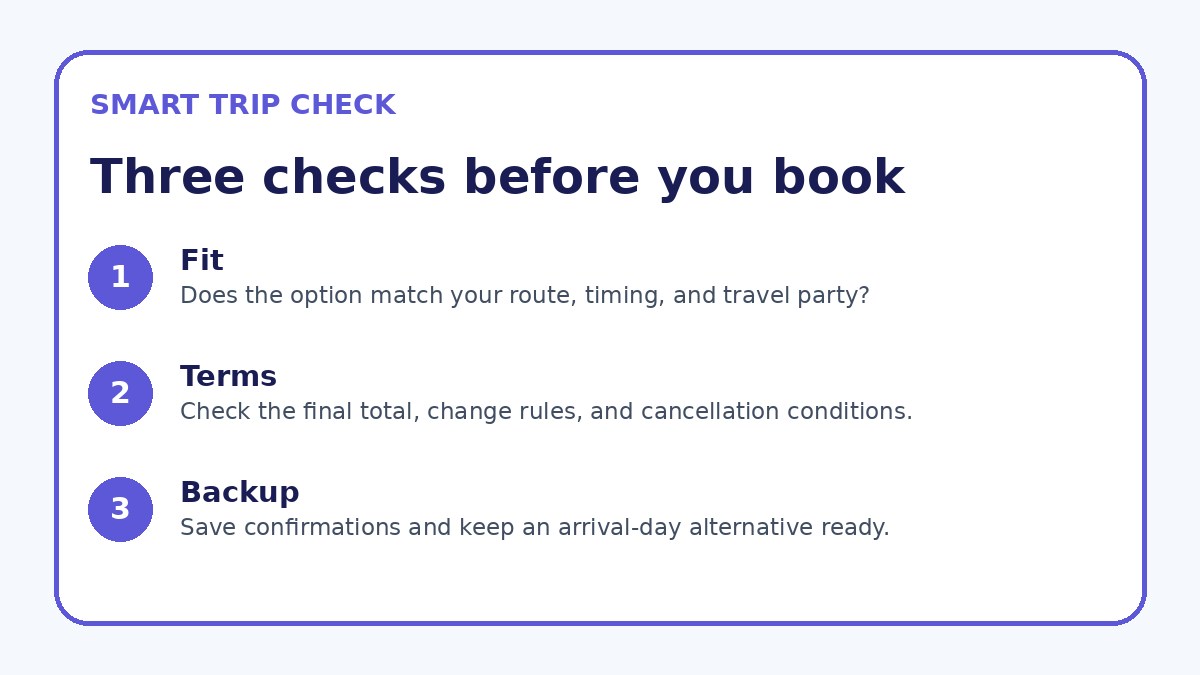
Before you book, create a short checklist of must-haves: acceptable departure/arrival windows, number of allowable carry-ons, seat selection options, and the exact change/cancellation terms. Confirm whether seats can be reserved free of charge, and if not, decide whether paid seat selection is worth it to keep the family together. Also verify baggage allowances and whether infants require a ticket or can travel on a lap; these details vary by carrier and fare class and must be confirmed on the booking page. Trip.com can be used to compare availability, but always read the airline’s final terms before purchase.
On travel day, arrive with time to spare, bring comfort items for the kids, and pre-load entertainment and snacks. If you have a connection, check airport maps in advance so you know gate locations and any planned terminal transfers. Use family or priority lanes if available, and ask staff about strollers or family assistance when you check in. Keep tickets, passports, and any documentation in an easily accessible place and have a charging plan for devices. Small preparation steps reduce friction and make even longer itineraries manageable.
Frequently asked questions
Should families always choose direct Seoul to Tokyo flights?
Not always. Direct flights reduce transfer points and are simpler on travel day, which is valuable with children. But direct departures may not align with your family’s schedule or could be at a premium. A carefully chosen single-connection flight with a comfortable layover can offer better timing and lower stress if direct times don’t fit. Compare door-to-door time, total airport hassle, and the airline’s protections for missed connections before deciding.
How much connection time should a family allow when transferring?
Aim for more buffer than solo travelers: plan extra time for restroom breaks, moving luggage, and calming or feeding children. If the connection is within the same terminal on a single ticket, a shorter buffer may suffice; if you must change terminals, collect and recheck baggage, or pass immigration, allow substantially more time. Exact minimums depend on the airports involved, so verify terminal transfer details and recommended minimum connection times on the airline’s booking page before you commit.
Are flexible fares worth the extra cost for family travel?
Flexible fares can be worth the cost if your itinerary is likely to change, if someone might need to cancel, or if travel to the airport depends on uncertain connections (trains, ferries). The value is in avoiding high change fees or losing an entire fare. But flexible fares are not always necessary for stable plans; sometimes buying a lower fare and adding separate protection (travel insurance that covers changes) is more cost-effective. Always check the exact change and refund rules on the airline’s site to understand what you’re buying.
Final planning note
Balancing schedule flexibility and convenience for families on Seoul to Tokyo flights comes down to prioritizing what reduces stress on travel day. If minimizing transfers and handling is most important, lean toward direct flights or same-terminal connections. If you need wiggle room for changing plans, opt for fares with clear, usable change terms or allow for longer layovers that function as a buffer. Before you click purchase, confirm baggage rules, seat-assignment options, infant policies, and the exact change/cancellation wording on the airline’s booking page. With those checks and a realistic plan for door-to-door timing, you’ll choose an itinerary that supports your family’s comfort and adaptability.
Continue planning
Check current options and final conditions
Use the provider page to confirm live availability, the final total, cancellation terms, and every condition that matters to your trip.
This evergreen planning guide was created with AI-assisted drafting and a structured quality review. It does not display live prices, schedules, availability, visa guidance, or provider rankings. Verify current details before booking. Some links are affiliate links; we may earn a commission at no additional cost to you.