Practical answer first: before you open any flight search, pick your exact dates, the number of travelers and the arrival district in Tokyo (Narita, Haneda, city center) — then compare direct versus connecting options, baggage allowances, and change/cancellation rules. For most first-time visitors, the main tradeoffs are time versus price and risk: direct flights save time and reduce connection risk but can be more expensive or depart from a less convenient airport; connecting itineraries sometimes lower fares but increase baggage transfer and missed-connection exposure. This article gives a focused pre-booking checklist and decision criteria so you can quickly narrow options and avoid common pitfalls. Follow the checklist items in order, verify fare conditions on the carrier or seller’s final booking page, and use a live search tool such as Trip.com only as a comparison point once you have exact traveler details ready.
See live routes for your exact travel day
Compare direct and connecting choices with the same baggage and traveler details.
Routing: direct versus connecting and arrival airports
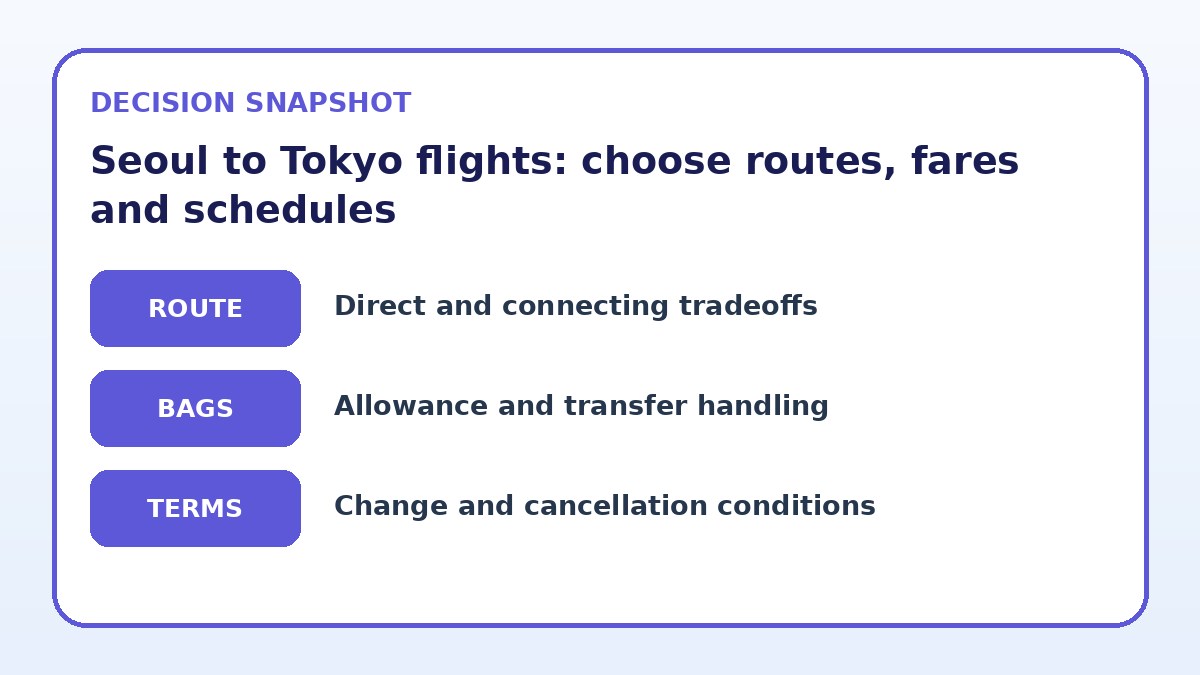
Start by mapping where in Tokyo you actually need to be: central Tokyo, southern wards, or near Narita or Haneda. Different arrival airports change your ground travel time and costs. Direct flights may arrive at Haneda (closer to central Tokyo) or Narita (farther east); connecting flights can route through regional hubs and may offer lower fares but typically increase total travel time. When searching, filter results by airport to see tradeoffs in arrival convenience and onward transit options. Remember the route choice affects not only flight time but also how late or early you arrive into the city, which matters for public transit connections and first-night logistics.
When comparing routes, evaluate the full door-to-door journey rather than clock hours alone. Add estimated transfer time from arrival airport to your hotel using the train, bus or airport taxi options; that total trip time is what you will feel. For connecting itineraries, look at minimum connection time and whether the connection is domestic or international; international-to-international transfers can have different processing and transfer paths. Do not assume the shortest scheduled air time is the fastest overall: long ground transfers or overnight layovers can flip your preference to a slightly slower but more convenient nonstop.
Baggage and connection risk: what to verify before you book
Baggage rules and how airlines handle transfers are crucial for first-time travelers. Before finalizing a fare, confirm whether checked bags are included, what size and weight limits apply, and whether fees are charged per segment. With connecting itineraries, determine whether your baggage is checked through to your final destination or must be reclaimed and checked again at the connection airport. If you must clear immigration and recheck luggage, that adds time and stress; for first-time visitors unfamiliar with Tokyo or the connecting hub, this may be a decisive factor.
Also consider liability for missed connections and delayed baggage. Cheaper connecting fares sometimes come with limited protections and tight connection windows. Check whether the carrier or ticketing agent offers rebook protection, how long the minimum connecting time is for the itinerary, and whether the itinerary mixes airlines on separate tickets — that increases your risk because each airline treats delays independently. On the booking page, explicitly verify baggage inclusion and the transfer policy for each segment, and write down the carrier’s stated responsibility for misconnected bags.
Compare flight-selection strategies
| Flight strategy | Best for | Risk to check |
|---|---|---|
| Direct nonstop flights | Travelers prioritizing speed and lower connection risk | Often higher base fare and potentially different airport arrival locations |
| One-stop connecting itineraries | Price-sensitive travelers willing to trade time for lower fares | Increased baggage transfer risk and longer total travel time |
| Mix-and-match separate tickets | Flexible planners searching for the lowest combined fares | Higher risk of missed connections and no interline protection |
| Flexible/refundable fares | Travelers who want changeability and lower financial risk | Usually higher upfront cost but fewer penalties for itinerary changes |
Recheck the complete itinerary
Confirm airports, connection handling, baggage, and change conditions before deciding.
Schedule fit: time of day, layovers and jet lag considerations
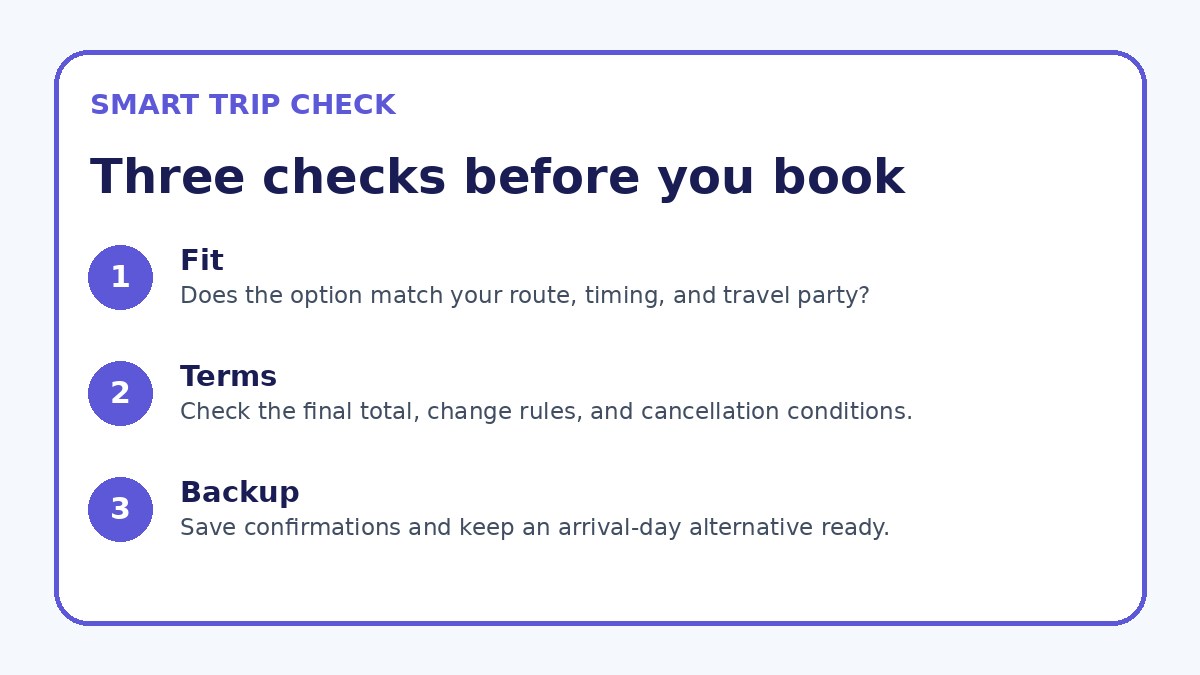
Think about when you want to arrive in Tokyo and how that fits your schedule on both ends. Early-morning arrivals give you a full first day but may require very early departures from Seoul or an overnight flight; late arrivals can mean fewer public transit options and higher taxi costs. For short trips, minimize travel-day disruption by favoring schedules that align with your preferred waking hours and planned activities. Consider whether you prefer flying overnight to sleep in transit or daytime flights that keep you on local time — this affects comfort, in-flight service availability, and how quickly you adjust to local time.
Layover length matters beyond just avoiding missed connections: it determines whether you have time to transfer between terminals, grab a meal, or rest. For first-time travelers, a cushion of longer layovers reduces stress but extends total travel time. If you are traveling on a single ticket with the same alliance, standard minimum connection times are often safe; if you are mixing carriers or tickets, add a generous buffer. On the booking page, check departure and arrival terminal information, scheduled layover duration, and whether the itinerary requires an overnight stop — then test the plan against your personal tolerance for layovers and jet lag.
Flight details to verify
- Confirm exact traveler names, passport numbers, and birthdates so your booking matches passport data and avoids name-change fees.
- Decide which Tokyo airport (Haneda or Narita) fits your ground transfer needs and filter search results by that airport before comparing fares.
- Check baggage allowance and whether checked baggage is included for each fare class and segment; note size, weight, and fee policies on the booking page.
- Compare total door-to-door travel time by adding estimated ground transit from arrival airport to your accommodation for each itinerary.
- Open the fare rules on the carrier’s or seller’s final booking page and record change, cancellation, and refund conditions before purchase.
- If using separate tickets or different carriers, plan at least double the airline minimum connection time and buy travel insurance that covers missed connections.
Fare conditions and booking logistics to confirm
When choosing a fare, the headline price is only part of the picture. Immediately check the fare conditions: refundability, change fees, name-change policies, and whether seat selection and checked bags are included or available for purchase. Lower
end of available text
Flight Guide questions travelers ask
Should I always pick the cheapest Seoul to Tokyo flight?
Not always. The cheapest headline fare can exclude checked baggage, seat selection and change protections, which add cost and risk. For short trips or if you must travel on a strict schedule, a slightly higher fare that includes baggage and flexible change terms can be more economical overall. Check what is included in the cheapest option and compare total expected costs — baggage fees, transfers, and potential rebooking expenses — before selecting a fare.
How do I decide between Haneda and Narita when booking flights from Seoul?
Choose the Tokyo airport based on your final destination and ground-transfer preferences. Haneda is generally closer to central Tokyo and may shorten travel time to downtown hotels, while Narita can be farther and involve longer train or bus rides. Also consider arrival time and local transit operating hours. Verify which airport the itinerary uses on the booking page and estimate the onward travel time and cost from that airport to your accommodation before confirming.
What should I verify about baggage and connections if my itinerary has a layover?
On the booking page, confirm whether your checked baggage is through-checked to the final destination or requires pickup and recheck at the connection point. Check minimum connection times, terminal change requirements and whether you must clear immigration during the transfer. If the segments are on different tickets, assume no interline baggage handling. Record the carrier’s stated responsibility for missed connections and delayed bags, and consider allowing extra layover time or choosing a single-ticket itinerary for lower risk.
Final decision note
Booking Seoul to Tokyo flights as a first-time visitor is mostly a matter of defining priorities: speed and convenience versus price and flexibility. Start by locking in exact travel dates, traveler details and preferred arrival airport, then run targeted searches comparing direct and connecting options. Use the checklist items to verify baggage rules, connection handling, schedule fit and fare conditions on the carrier or seller’s final booking page. If you need broader market visibility, check a comparison site such as Trip.com once you have exact details, but always confirm the critical rules shown at purchase. A little verification before you click buy will save time, money and stress once you arrive in Japan.
Continue planning
Check current options and final conditions
Use the provider page to confirm live availability, the final total, cancellation terms, and every condition that matters to your trip.
This evergreen planning guide was created with AI-assisted drafting and a structured quality review. It does not display live prices, schedules, availability, visa guidance, or provider rankings. Verify current details before booking. Some links are affiliate links; we may earn a commission at no additional cost to you.