Practical answer first: for most families the simplest Osaka to Kyoto transport plan is to pick a main rail corridor (Shinkansen or regular JR/Tokaido lines) that drops you at stations nearest your arrival and destination neighborhoods, then confirm how you will get to and from those stations — walking, subway, taxi, or a single shuttle — so you can avoid extra terminal hops. Focus on door-to-door time, number of luggage moves, and transfer complexity when you compare options. This article walks through how to choose modes, size up station layouts and terminal transfers, plan around luggage and strollers, and set realistic timing buffers. It also gives four clear decision approaches to match different family priorities and a simple disruption backup you can execute without scrambling the whole itinerary.
Choosing between rail, coach, or combined options
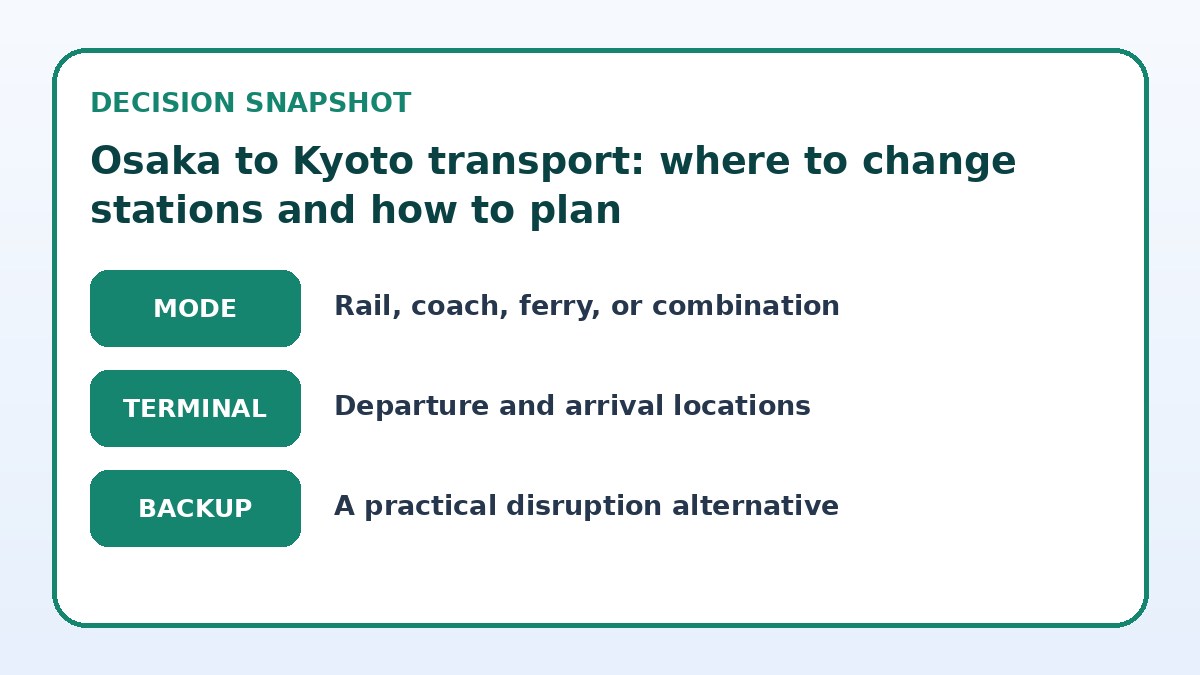
First decide on the main line: express rail (including Shinkansen where available), regional commuter trains, or highway coach. For families, prioritize options that reduce transfers and minimize platform-to-platform walking. Express rail offers predictability and simple station-to-station transfers, while regular commuter trains can drop you closer to neighborhood terminals but may require more walking or a local subway change. Coaches can be direct between terminals but often stop at motorway service areas and use coach terminals that are further from city centers, which matters when you have small children or lots of luggage.
When comparing mixed itineraries, map the entire door-to-door route rather than the ride time alone. Add walking time between platforms, time to collect and re-check luggage, subway or bus connections, and the time it takes to find a taxi rank or elevator. If a family member needs naps, choose departures and arrivals that align with those windows. Finally, when evaluating options online, check provider pages for baggage rules and platform transfer details; Trip.com can be used to compare current availability and conditions, but always verify the provider’s final booking page for exact station terminals and transfer instructions.
Choose the end-to-end journey plan
| Journey approach | Best for | Friction to check |
|---|---|---|
| Direct express rail with single terminal transfer | Families prioritizing simplicity and fewer platform changes | May require longer walk or connection at large terminals to reach neighborhood transport |
| Commuter rail with local subway or bus finish | Families wanting closer drop-off to specific neighborhoods | More transfers and possible stair-only interchanges; higher transfer friction with luggage |
| Coach or bus to city terminal then taxi to accommodation | Groups with limited mobility who prefer seated, direct boarding | Terminal-to-door time can increase due to coach terminals being outside central neighborhoods |
| Mixed approach: rail plus luggage forwarding and taxi finish | Families seeking minimal hands-on baggage during transfers | Requires coordination and confirmation of baggage pickup/delivery windows before booking |
Check live intercity options
Look beyond the ride itself and compare terminals, transfers, luggage, and arrival fit.
Terminal fit: stations, exits, and family-friendly facilities
Not all stations are equal for families. Large urban terminals often have many exits, long concourses, and multiple platforms, which can add several minutes or a longer walk to reach taxis or subway lines. Smaller stations may put you closer to your hotel or rental but have fewer facilities like coin lockers, changing rooms, or staffed information counters. Check station maps and look for information on elevator locations, stroller-friendly routes, and the presence of accessible restrooms. These practical details matter most when you are carrying luggage and supervising children at the same time.
If you need to change trains within a large terminal, plan which exit or transfer corridor you will use and save a screenshot of the station map on your phone for offline access. Confirm whether ticket gates are between platforms or on the concourse, because some transfers require exiting and re-entering through different gates. Also note station amenities that help families: quick cafés, convenience stores for last-minute supplies, and waiting areas where children can stretch without blocking thoroughfares. If in doubt, contact the station customer service through the official operator page to confirm elevator locations and the fastest transfer paths.
Luggage, strollers and transfer friction
Count how many luggage moves you will make from door to door, and aim to minimize them. Each additional transfer — step down from a train, a platform change, a subway descent, and a final short taxi ride — multiplies the time and effort. Consider using one medium suitcase per adult plus a small day pack to reduce bulk, or arrange a luggage-forwarding service if you prefer fewer hands on bags during transfers. If you use luggage shipping, verify pickup and delivery windows so bags don’t arrive after you do or sit unattended.
Strollers can be folded and carried on many services but require elevator access at stations. Confirm elevator availability and whether there is extra walking involved to reach accessible routes. If a family member must ride in a stroller because of naps, prioritize routes with short, step-free transfers. For taxis at busy terminals, know the location of the closest taxi rank and whether you’ll need to fold strollers before boarding. Practice a quick packing routine at origin so you can transition through transfers more smoothly.
Compare the practical alternatives
Use the final page to confirm what is actually offered on your dates and save a workable fallback.
Intercity travel checklist
- Map your door-to-door route: station exit to taxi rank or subway entrance to your accommodation and save offline screenshots.
- Confirm elevator and stroller-friendly routes at each station by checking official station maps or contacting customer service.
- Choose an itinerary with the fewest luggage transfers; consider luggage forwarding if you want hands-free moves.
- Schedule at least 20–30 minutes buffer for every planned transfer to account for restroom or snack breaks.
- Identify one clear backup: alternate station, later train, or taxi company phone number and save it in your phone.
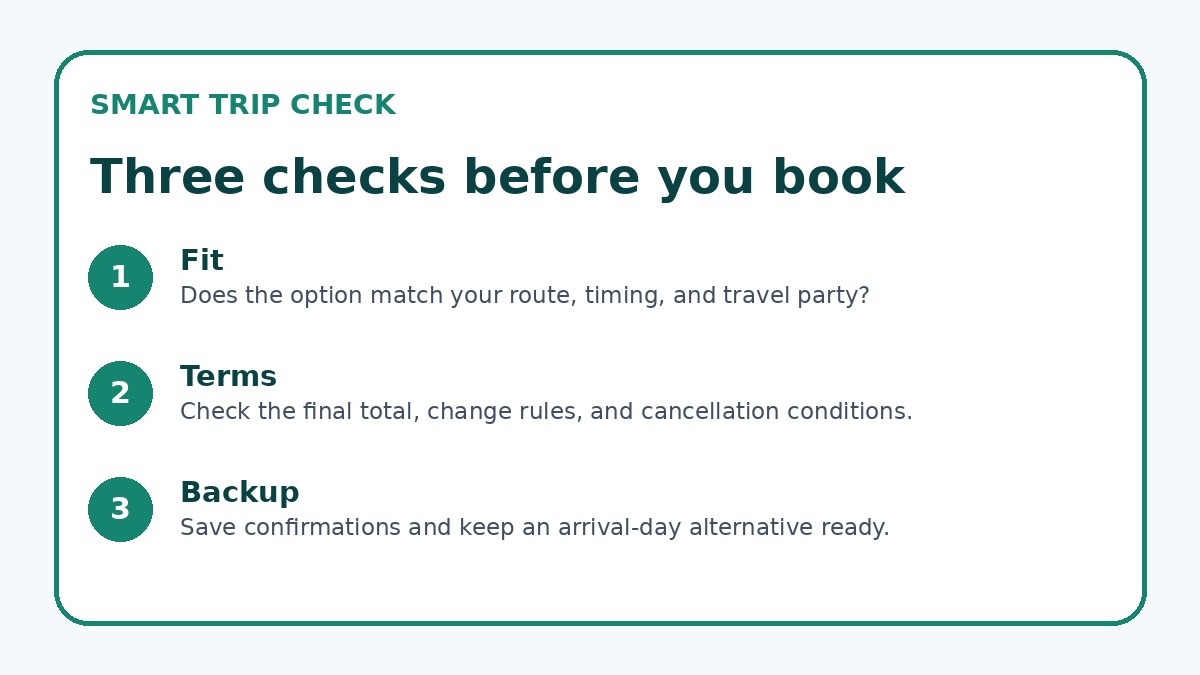
- Verify ticket change and refund policies on the provider’s final booking page before purchasing any non-flexible tickets.
Timing flexibility and a practical disruption backup
Build buffers into your schedule: plan departure windows instead of exact minutes, allow extra time for restroom breaks and food, and schedule longer transfer times when changing terminals within a city. Families move more slowly than solo travelers, so a 20–30 minute cushion at each transfer point is often sensible. When you buy tickets, note refund and change policies in case you need to shift to a later service; verify these terms on the provider’s booking pages. Keep physical and digital copies of reservations and station maps in case connectivity is limited.
Create a single backup plan that is simple to execute: identify an alternate nearby station that serves the same route, an accessible taxi rank, and a secondary rail service that runs on roughly the same corridor. If a primary train is delayed or a terminal area is unusually crowded, switch to the alternate and inform any hosts or pickup services of the change. Keep contact numbers for your accommodation and a local taxi company handy. Practicing the backup once mentally will reduce stress when small disruptions happen and let the family adapt without canceling the day.
Rail & Intercity Transport questions travelers ask
Which station in Osaka should families leave from to reach Kyoto with least hassle?
That depends on where you are staying in Osaka and where you need to arrive in Kyoto. Pick the station that reduces onward walking or subway changes: a central Osaka terminal can be fastest for express rail, while a local commuter station might drop you closer to a specific Kyoto neighborhood. Compare the full door-to-door route—walking to the station, transfer corridors, and final taxi or subway connections—and confirm elevator locations and platform access on the station’s official page before you go.
How much extra time should I allow for station transfers when traveling with young children?
Plan buffer windows rather than tight connections; for families a safe guideline is adding 20–30 minutes per transfer to allow for restroom breaks, ticket lines, stroller folding, and slower walking. If a transfer requires changing concourses or leaving and re-entering through ticket gates, add more time. If you’re purchasing time-sensitive tickets, review change options on the booking page so you can move to a later service without losing the entire fare if needed.
Are taxis a reliable backup for last-mile travel between terminals and accommodation?
Taxis are often the most straightforward last-mile option, especially with children or bulky luggage, but reliability depends on time of day and terminal layout. Confirm where the official taxi ranks are located at your arrival station and whether those ranks are accessible by elevator or require a long walk. Keep a local taxi company number and, if available, a rideshare app configured for Japan. If you plan to use taxis as backup, verify estimated travel times and have contact details for your accommodation ready to share with the driver.
Final decision note
When planning Osaka to Kyoto transport for a family, prioritize routes and terminals that reduce transfers and hands-on luggage moves. Decide early whether simplicity (fewer platform changes) or proximity (closer drop-off to your neighborhood) is more important, and then tailor station choices, stroller arrangements, and taxis around that priority. Build realistic timing buffers and keep one clear, easy-to-execute backup so small disruptions don’t derail your day. Verify elevator locations, luggage policies, and ticket change rules on providers’ final booking pages before you buy, and consider using Trip.com or the operator’s official site to compare current availability and terminal details.
Continue planning
Check current options and final conditions
Use the provider page to confirm live availability, the final total, cancellation terms, and every condition that matters to your trip.
This evergreen planning guide was created with AI-assisted drafting and a structured quality review. It does not display live prices, schedules, availability, visa guidance, or provider rankings. Verify current details before booking. Some links are affiliate links; we may earn a commission at no additional cost to you.