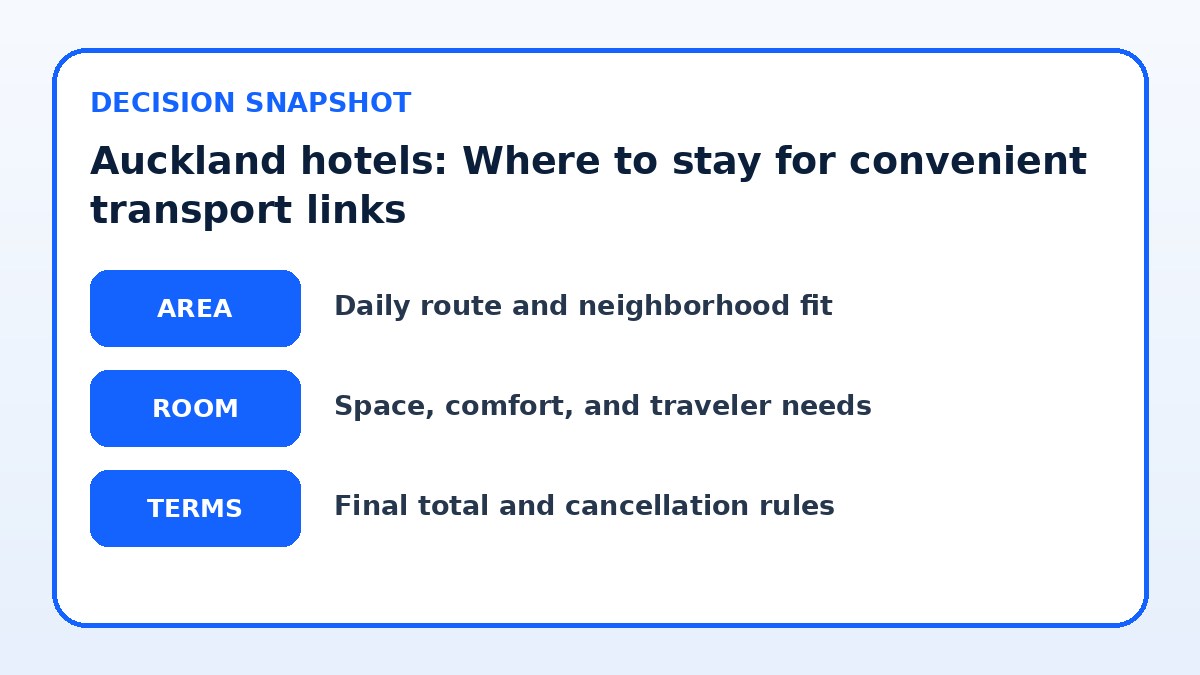
Practical answer first: choose your Auckland hotel by which transit node will save you the most time each day — ferry terminals for islands and waterfront attractions, Britomart or the CBD for quick access to city tram/bus routes, Parnell/Newmarket for museum and shopping links, or the airport-adjacent suburbs if you need easy arrivals and early departures. For first-time visitors, this focus cuts daily friction: you’ll spend less time changing transport modes and more time seeing sights. After you narrow to one of those stay-areas, refine by room size, noise profile, and whether you want on-site parking or frequent shuttle options. Later in the article I walk through how to evaluate neighborhood fit, plan typical daily routes, size up room and party needs, and check the booking terms and provider pages you must verify before confirming.
Check live stays in the areas that fit
Use your dates and party size to compare current rooms after you narrow the neighborhood fit.
Neighborhood fit: choose the stay-area that matches your plans
Start by listing the three types of activities that will dominate your trip: downtown dining and nightlife, island or harbour excursions, museums and markets, or early flights and airport logistics. Match each list to one of four practical stay-areas: the CBD and Viaduct for downtown access and ferries, Britomart for central train and bus connections, Parnell/Newmarket for museum and shopping convenience, and airport-side suburbs for arrival/departure ease. Choosing the right area first prevents you from selecting a cheap room that costs you hours each day in transfers and taxis.
Within a chosen area, identify the transit node that best supports your daily pattern — for example, a hotel a short walk from Britomart will offer more direct bus and train choices than one closer to a side street in the CBD. Also think about evening plans: some streets near busy bars and restaurants are noisier at night, while nearby residential pockets can be much calmer. Use a map to check walking distances from your shortlisted hotels to terminals, main bus stops, and ferry piers before you open live availability.
Choose an area-selection strategy
| Area approach | Best for | Tradeoff to check |
|---|---|---|
| Stay near ferry terminals (Viaduct/Wynyard) | Island visits, harbour cruises and waterfront dining | Higher evening activity and potential waterfront prices; may be less convenient for inland museums |
| Stay near Britomart/CBD train hub | Central train and bus connections for quick cross-city travel | Can be busy and noisier; some quieter neighbourhoods require a short walk |
| Stay in Parnell/Newmarket | Museum visits, boutique shopping and calmer residential streets | Slightly longer transfers to some waterfront ferries and nightlife spots |
| Stay near the airport or airport suburbs | Early flights, late arrivals, and large luggage or rental car needs | Less convenient for central sightseeing; you may need to use airport transfers or longer commutes |
Daily-route friction: how to test whether a hotel actually saves you time
A common trap is choosing a hotel near one attraction but far from the transit you’ll need later. To avoid this, sketch one typical day and one worst-case day for your itinerary and trace the route from the hotel to your first and last stops. Note the number of mode changes (walk to bus, bus to ferry, ferry to walk). Each change adds time and inconvenience, especially with luggage or after a long day. Prefer hotels that keep mode changes to one or zero for your regular routes.
When you’ve shortlisted properties in the right area, verify the specifics on providers’ booking pages: exact walking time to the nearest stop, whether lifts and steps are involved, and any required transfers. Check local transit maps for frequency rather than precise schedules, since frequencies can vary by day and season. If you have mobility needs or are travelling with young children, prioritise hotels with minimal on-the-ground friction — ground-floor or lift-access rooms and close, sheltered stops.
Now compare like with like
Keep the same dates, guests, room needs, and cancellation preferences while you compare the final choices.
Room and party needs: match accommodation layout to travel logistics
Decide the minimum room configuration you need before comparing nightly availability: double or twin beds, interconnecting rooms, sofa beds, or a small suite if you’ll be working or hosting visitors. Larger rooms can reduce the need to return to the hotel during the day, but they often occupy better locations. If you’re travelling as a pair and will be out most days, a compact city-room near transit may make more sense than a bigger unit located further out.
Consider luggage and storage needs. If you plan on day trips with the ferry or trains, you’ll appreciate a hotel with secure luggage hold or flexible check-in options. When booking, verify whether the provider lists exact room dimensions, storage facilities, and elevator access. If you need parking for a hire car, check the hotel’s parking arrangements on the booking page: is parking on-site, off-site, or only available through nearby commercial car parks? These are the kind of specifics that change frequently and must be confirmed with the property.

Hotel booking check before payment
- Map your top three daily activities and mark the closest transit nodes for each on a city map before searching hotels.
- Shortlist a single stay-area, then limit hotel comparisons to properties within a 10–20 minute walk of the main transit node.
- On each hotel booking page, verify exact walking time to the nearest ferry, train or bus stop and whether steps or lifts are involved.
- Confirm cancellation and change terms, whether the rate requires prepayment, and what ID or payment methods the property accepts.
- Check whether the hotel offers luggage storage or flexible check-in if you have an early arrival or late departure.
- If you need parking or airport shuttle service, confirm on the provider page whether these are on-site, require reservation, or carry extra rules.
Final booking terms: what to confirm on the hotel page before paying
Before you commit, confirm the cancellation and change policy, whether the rate requires prepayment, and what forms of ID and payment the property accepts. Look for explicit notes about arrival windows and late check-in — these matter if you’re arriving by late ferry or early flight. If you rely on airport shuttles or hotel-arranged transfers, verify pickup points and whether a reservation is needed. Remember: policies and operational details can change, so always re-check the provider’s final booking page.
Also confirm practical access details that affect your transit plans: the hotel’s stated walking time to the nearest ferry pier, bus stop names, nearest train station and whether lifts are present. If you plan to use rideshares frequently, verify if the hotel allows pickup/drop-off at its entrance or has designated spots. One optional place to compare live availability and current provider terms is Trip.com, but treat any listing as a starting point and verify policies on the hotel’s direct booking page before finalising.
Hotel Guide questions travelers ask
Which Auckland area is best if I only have two full days?
If you have two full days, prioritize a central location near Britomart or the CBD. From there you can reach ferry terminals, major museums, and key neighbourhoods with fewer transfers. A centrally located hotel reduces time spent changing modes and gives you flexible evening options. Before booking, check the exact walking distances from shortlisted hotels to Britomart and the main ferry piers on the provider pages, and confirm that the hotel’s neighborhood feels safe and walkable at night.
Is it better to stay near the ferry terminals or in Parnell for a family trip?
For families who plan multiple harbour trips, staying near the ferry terminals is practical because it cuts transfer time with children and luggage. If your itinerary focuses more on museums, parks and relaxed strolls, Parnell offers quieter, family-friendly streets and easier access to indoor attractions. Consider factors like stair-free routes, elevator access and luggage storage at the hotel; always verify those specifics on the booking page rather than assuming they’re standard.
How should I factor airport arrival or departure times into my hotel choice?
If you have early departures or late arrivals, give strong weight to airport-adjacent hotels or properties that offer dedicated airport shuttles to avoid long overnight transfers. Conversely, if your flights land at convenient daytime hours, staying closer to the CBD can be better for maximising sightseeing. Whatever you choose, confirm shuttle availability, pickup locations, and whether a reservation is needed on the hotel’s booking page; these service details can change and should be verified before you book.
Final decision note
For first-time visitors, the clearest way to pick Auckland hotels is to start with the transit node that matches your itinerary, then choose a hotel within easy walking distance of that node. Prioritise fewer mode changes on typical days, check room layouts and luggage policies to suit your party, and confirm access details and booking terms on provider pages before paying. Shortlisting by area first — ferries for harbour days, Britomart for central connectivity, Parnell/Newmarket for museums, or the airport for logistics — lets you compare actual rooms and rates with confidence. Use a mapping step and the checklist above to move from uncertainty to a tight shortlist before you open live availability; you’ll make a better booking that saves time and stress on the ground.
Continue planning
Check current options and final conditions
Use the provider page to confirm live availability, the final total, cancellation terms, and every condition that matters to your trip.
This evergreen planning guide was created with AI-assisted drafting and a structured quality review. It does not display live prices, schedules, availability, visa guidance, or provider rankings. Verify current details before booking. Some links are affiliate links; we may earn a commission at no additional cost to you.