If you’re travelling solo between Sydney and Melbourne, the practical choice comes down to how you value comfort, reliability, cost-effort and door-to-door convenience. For most solo travellers, a daytime or overnight train or an express coach will balance comfort and fewer transfers; driving or a combination with a short flight can make more sense when time or remote stops matter. There is no frequent ferry across that exact route, but coastal ferry segments combined with trains or coaches are possible for scenic alternatives. Start by deciding whether you prioritise minimal transfers, predictable timing, lower cost, or a scenic route. The rest of this guide compares terminal fit, luggage friction, timing flexibility and disruption backups so you can pick the option that matches your priorities and build a realistic door-to-door plan.
Terminal fit and door-to-door practicality
Assess where each mode drops you and how you get from there to your final address. Trains typically use central city stations linked to local transport, taxis and rideshares, which reduces onward transfer time for solo travellers without heavy luggage. Coaches usually use bus terminals that may be slightly outside the most convenient neighbourhoods, meaning either a short local transfer or a walk. When comparing options, map the terminal-to-accommodation journey and estimate time, cost and difficulty carrying your luggage alone.
If you choose a mixed route—such as a coastal ferry segment plus train—factor in transfer distances and timing buffers between services. Solo travellers should prioritise terminals with straightforward, visible counters and clear signage, especially if arriving late. If you have mobility needs or oversized luggage, verify accessibility and baggage handling at the terminal; do not assume every station or coach terminal offers the same level of assistance. Knowing exactly where each service leaves and arrives avoids unpleasant surprises on arrival.
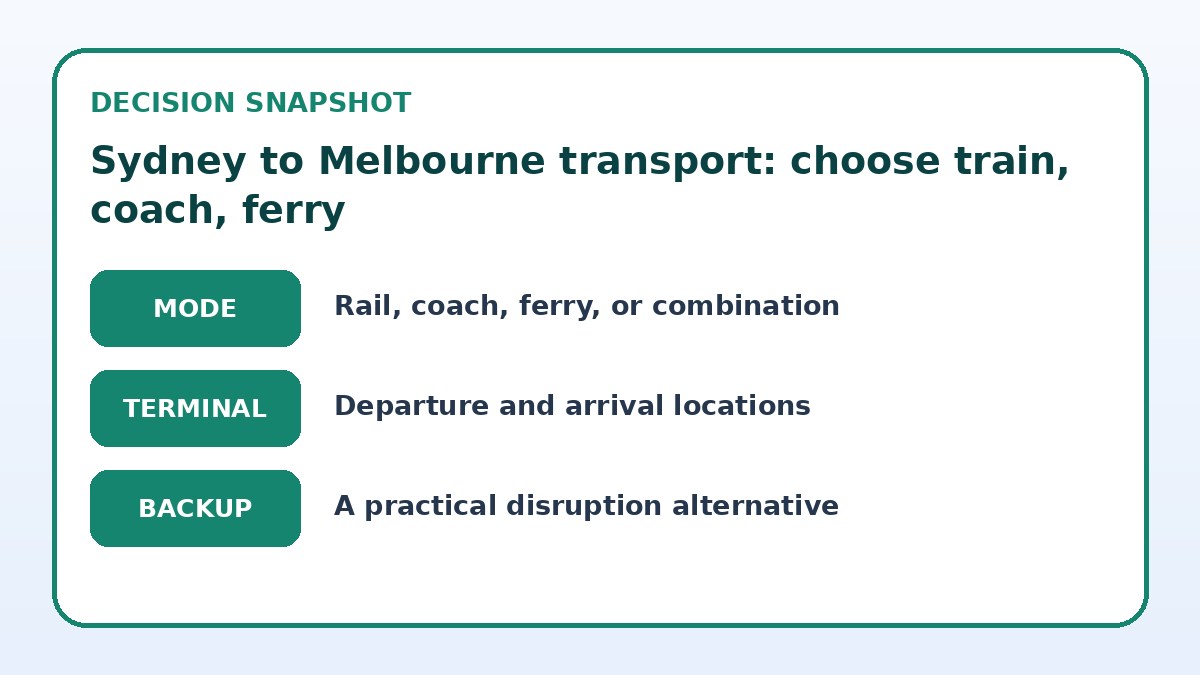
Choose the end-to-end journey plan
| Journey approach | Best for | Friction to check |
|---|---|---|
| Train-only (day or night) | Solo travellers wanting a comfortable ride with fewer transfers and easy station access | Can be slower than flying and schedules may be limited for overnight stretches; verify luggage rules and station transfer time |
| Coach-only (express services) | Solo travellers prioritising lower cost and straightforward, direct routing | Less onboard space and stricter luggage allowances; terminal location and local transfer costs may add time |
| Mixed ferry + land (scenic) | Solo travellers seeking a scenic route and a relaxed travel pace with coastal views | Adds transfers, more luggage handling and greater sensitivity to weather-related disruption |
| Drive or fly (time-focused) | Solo travellers who need the fastest door-to-door time or flexible stop patterns | Requires managing rentals, airport/garage transfers, or driving alone; often less straightforward door-to-door logistics |
Check live intercity options
Look beyond the ride itself and compare terminals, transfers, luggage, and arrival fit.
Luggage, transfers and solo-traveller friction
Compare luggage rules and the number of required transfers before you book. Trains often allow more flexible carry-on and checked luggage policies and give you space inside the carriage to keep belongings nearby. Coaches may have strict under-bus baggage allowances and separate storage, which is convenient but requires the driver to load and unload your bag—helpful for solo travellers but worth confirming. Ferry segments add more handling and sometimes more restrictive carry limits; pack to make transfers quick and manageable.
Think about the physical act of changing modes: how far are platforms or docks from ticket offices, and will you need to move your bags across stairs or long ramps? Solo travellers should avoid itineraries with tight connection windows or multiple short hops unless you can carry everything easily and are comfortable navigating unfamiliar terminals alone. Consider a simple wheeled bag and a daypack with essentials like documents, a charger and a small security pouch for peace of mind during transfers.
Timing flexibility and daily rhythms
Decide how flexible your schedule is. Daytime trains and coaches usually have many departures and let you choose a convenient start time, but availability varies by day and season; overnight trains or buses can save a night in a city but may restrict arrival times and leave you tired. Flights offer the most speed and frequent scheduling but add airport transfer time and pre-departure requirements. For scenic or slow travel, combine ferry legs with daytime rail to enjoy coastal views at a slower, less schedule-driven pace.
Solo travellers should prioritise options with clear, realistic total travel time from door to door rather than headline transit time. Calculate transfer wait times, check-in or boarding windows, and likely traffic or station crowding during peak periods. If you need to arrive by a specific time (meetings, tours or connections), prefer modes with more regular services and built-in cushion time. Conversely, if your trip is flexible, pick the mode that gives the best on-trip comfort and scenery.
Compare the practical alternatives
Use the final page to confirm what is actually offered on your dates and save a workable fallback.
Intercity travel checklist
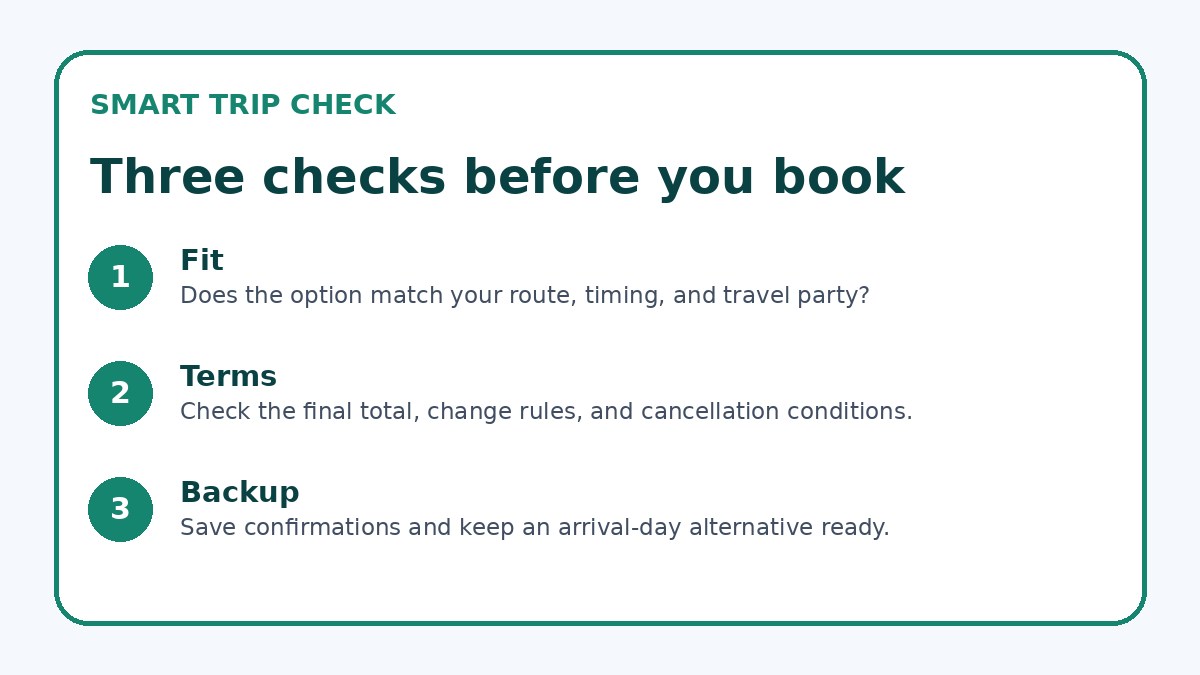
- Map the terminal-to-accommodation route and estimate transfer time, cost and walking distance before booking.
- Confirm luggage allowances and whether bags are stored separately or stay with you onboard.
- Build at least 60–90 minutes buffer between connecting segments to allow for delays and transfers.
- Save digital copies of tickets and ID, and make a screenshot in case of poor mobile reception.
- Check the provider’s change and cancellation policy on their official booking page before you pay.
- Identify an alternative same-day connection or local taxi/ride option as a disruption backup.
Disruption backups and practical checks before booking
Build a simple backup plan for delays or cancellations. For trains and coaches, identify the operator’s policy on rebooking and what local alternatives exist—another service that day, or a taxi/ride option from the nearest station. For mixed ferry-train itineraries, make sure there’s enough slack between segments because maritime services are more weather-sensitive. For flights, confirm the earliest and latest practical flights and how to reach alternate airports if needed.
Before you buy a ticket, verify exact terminal addresses, luggage allowances, onboard amenities, and change/cancellation policies on the provider’s official booking page. If you prefer comparison shopping, Trip.com can be used to check current availability and conditions but always confirm the final fare and rules on the provider’s site. If travelling solo, leave contact details with someone at your destination and store a digital copy of departure passes and identification for quick access during disruptions.
Rail & Intercity Transport questions travelers ask
Is taking the train from Sydney to Melbourne better than flying for a solo traveller?
Whether the train is better depends on your priorities. Trains usually mean larger central terminals, less time spent on security checks, and a more relaxed onboard environment where you can move around and keep luggage nearby. Flights are faster point-to-point but add airport transfers, check-in windows, and potential delays that affect door-to-door time. For solo travellers who value comfort and simpler station transfers, a train can be the better option; if you need to save many hours, compare total door-to-door time for a flight plus transfers.
Can I combine a ferry with trains or buses between Sydney and Melbourne safely and practically?
Yes, combining a coastal ferry with train or coach legs is practical if you plan transfer times and luggage handling in advance. Ferries can be scenic but tend to run on stricter timetables and may be weather-dependent, so allow extra buffer time to reach the next service. Make sure the departure and arrival docks are clearly located relative to the connecting station or bus terminal and that you can manage the physical transfer alone. Always verify the ferry operator’s baggage rules and recent service notices on their booking page.
What should I do if my booked train or coach is cancelled while I'm travelling alone?
First, check the operator’s official notice or app for rebooking options or posted instructions; many services allow same-day rebooking or refunds. If there’s no immediate alternative from the same operator, identify the next closest service (another train, coach, or a regional flight) and the cost and time to reach it. Keep a local taxi/ride-hailing app ready for quick transfers to alternate terminals, and have emergency contact details and payment methods accessible. If weather or large-scale disruption affects many services, confirm whether accommodation assistance or voucher support is offered by the carrier.
Final decision note
For solo travellers planning Sydney to Melbourne transport, the best choice depends on how you weigh door-to-door convenience, luggage ease, time and scenic preference. Trains reduce the hassle of airport procedures and centralise arrival in stations that are commonly well-linked to city transport. Coaches offer direct, often lower-effort routing but check where they arrive and how luggage is handled. Ferry-plus-land options deliver scenery at the cost of additional transfers, while flying or driving is sensible when time is critical. Use the checklist to verify terminals, luggage policies and change rules on provider pages, and pick the option that keeps your door-to-door stress low and backup plans simple.
Continue planning
Check current options and final conditions
Use the provider page to confirm live availability, the final total, cancellation terms, and every condition that matters to your trip.
This evergreen planning guide was created with AI-assisted drafting and a structured quality review. It does not display live prices, schedules, availability, visa guidance, or provider rankings. Verify current details before booking. Some links are affiliate links; we may earn a commission at no additional cost to you.