Practical answer up front: for most solo travelers prioritizing flexibility between Paris and Amsterdam, choose a fully refundable or changeable rail ticket where possible, or a flexible coach fare if your budget and willingness to accept longer journeys outweighs speed. If you need the cheapest non-changeable option, accept stricter terms and build a disruption backup plan. The decision hinges on how much time you can spare, how important guaranteed departure times are, and whether single-person luggage transfers and station-to-stay connections are easy. This article compares rail, coach, and mixed approaches with a focus on terminal fit, luggage friction, timing flexibility, and practical backups so you can pick the option that suits your trip style and risk tolerance.
Choosing between rail, coach, ferry, or mixed routes
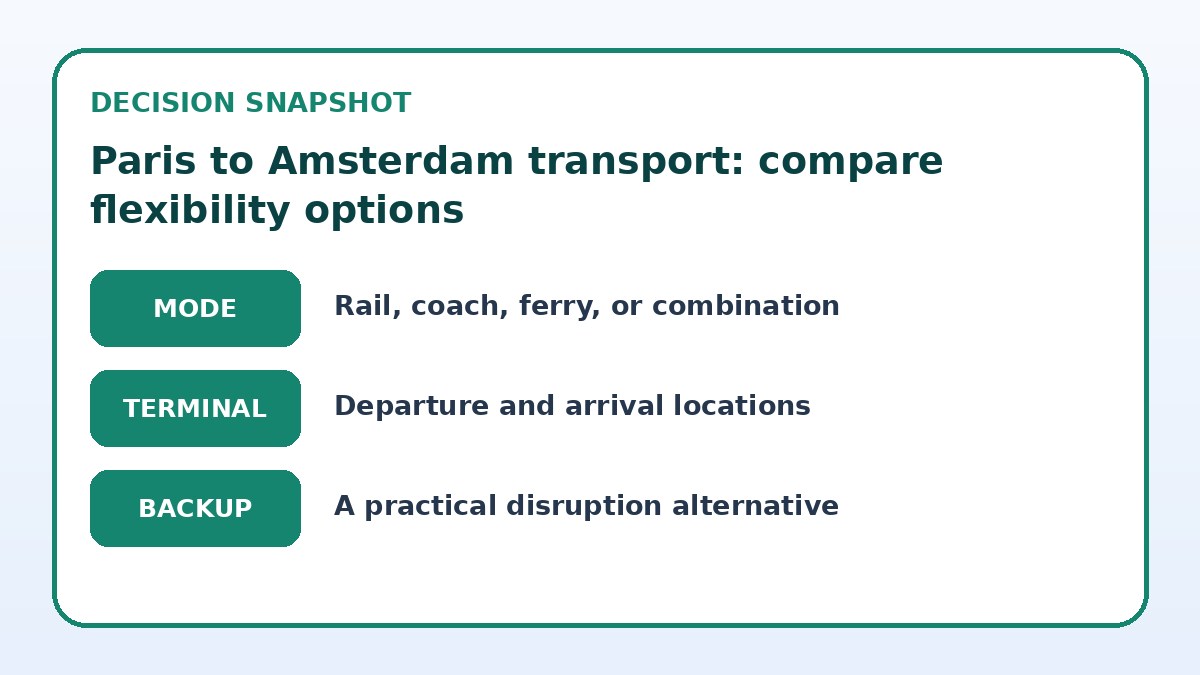
Start by matching your priorities: speed, flexibility, cost, or simplicity. Rail links between major cities tend to prioritize speed and minimize intermediate transfers, which reduces the number of places your plan can break; flexible rail tickets allow changes or refunds that cover the core leg. Coaches often have lower headline fares and sometimes offer forgiving change policies, but journeys are longer and transfers between terminals or coach parks and central locations add friction. Ferries rarely matter on this corridor unless you combine with a longer scenic route; they add distinct terminal handling and time margins that matter if you need tight onward connections.
Mixed routes — combining train for part of the trip and coach or regional rail for another — can open up more schedule choices and occasional savings, but they increase complexity. With mixed tickets you may need to manage separate change or refund rules for each segment, so the stage at which you require flexibility should guide which segment gets a flexible fare. Map out the door-to-door chain (home to departure, intercity leg, arrival to accommodation) and decide whether you need flexibility on every link or only the long intercity portion.
Choose the end-to-end journey plan
| Journey approach | Best for | Friction to check |
|---|---|---|
| Flexible rail ticket (changeable/refundable) | Solo travelers valuing predictable door-to-door ease and fewer transfers | Higher fare than strict advance tickets and depends on provider change rules |
| Flexible coach fare | Budget-focused solo travelers who can tolerate longer travel time and extra transfers | Longer journey, potential terminal-to-city friction, and comfort tradeoffs |
| Mixed route with flexibility on main leg only | Travelers balancing cost and resilience by protecting the longest segment | Multiple tickets to manage; secondary legs may remain inflexible |
| Strict advance ticket plus a disruption backup | Solo travelers prioritizing lowest upfront cost and willing to accept risk with a fallback | Risk of non-refundable loss; backup may add time or extra expense when used |
Check live intercity options
Look beyond the ride itself and compare terminals, transfers, luggage, and arrival fit.
Terminal fit and luggage/transfer friction
Terminal fit is about how stations and coach terminals plug into your ground plan. Major rail stations are often centrally located with straightforward last-mile options — metro, tram, taxi or rideshare — which reduces the hassle of luggage transfers and makes flexible arrival times practical. Coach terminals can be less central or require longer walks or additional transit, so factor that into whether a cheaper flexible coach ticket is truly practical for door-to-door convenience.
Consider your luggage situation honestly. Trains generally have larger storage areas and allow you to keep bags nearby; some coach services have strict hold-luggage rules and limited cabin space. If you travel with a single carry-on, you can be far more nimble switching modes or taking earlier/later departures. If you have bulky or multiple bags, prioritize options with clear luggage allowance and easy transfers so disruptions don’t balloon into long, uncomfortable waits or unexpected taxis.
Timing flexibility: change and refund tradeoffs
Ticket flexibility usually comes in tiers: restricted non-changeable fares, changeable-with-fee fares, and fully refundable fares. For solo travelers whose plans could shift—overnight layovers, meetings running late, or sudden personal changes—the difference between a cheap non-changeable ticket and a moderately more expensive flexible ticket can be the difference between a smooth reroute and a stressful scramble. When comparing options, calculate the value of being able to move to the next service that day versus the upfront extra cost.
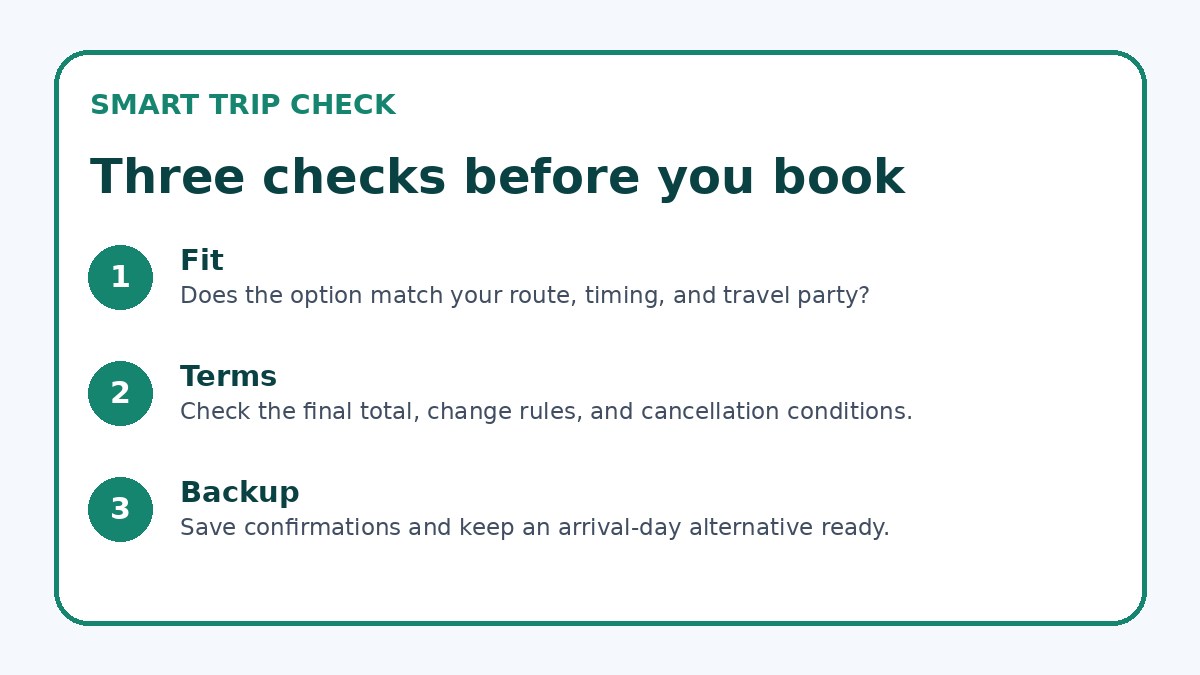
Look beyond headline flexibility and read the provider’s final booking page for exactly what is allowed: how late before departure you can change, whether you pay only the fare difference or a flat fee, and how refunds are processed (voucher versus money back). If you expect to arrive at the departure terminal with uncertain timing, prefer tickets that permit same-day exchange without heavy penalties or that explicitly allow boarding a later service on the same operator network.
Compare the practical alternatives
Use the final page to confirm what is actually offered on your dates and save a workable fallback.
Intercity travel checklist
- Decide how much flexibility you need: must-change, might-change, or no-change, and budget accordingly.
- Before booking, check the provider’s final booking page for exact change fees, refund rules, and how refunds are issued.
- Map door-to-door transfers from your accommodation to departure terminal and from arrival terminal to stay.
- Verify luggage allowances per ticket type and whether you must collect or label hold luggage between segments.
- Note alternative same-day departures and the process to rebook in person or online if you miss your connection.
- Pack a small emergency fund and have contact details for provider customer service and local onward transport.
Disruption backup: practical contingencies for solo travelers
A disruption backup plan turns a flexible ticket from theoretical protection into real peace of mind. Identify alternative departures on the same day and operator, and note where you could rebook in person if online self-service is limited. If a single ticket denies easy changes, prepare a fallback: a flexible coach option, a later train with flexible terms, or a short domestic flight only if it fits your door-to-door timeline and luggage rules. Keep digital copies of tickets and the provider contact details handy; being able to contact customer service quickly is often decisive.
Also think door-to-door contingencies: where will you go if a connection misses you—nearby station lounges, secure luggage storage, or a taxi rank with predictable fares? Solo travelers should have a small emergency fund for unexpected transfers or an overnight stay, and a clear final-step plan to reach accommodation from arrival points. Finally, when comparing options, check live-availability tools (Trip.com can be used to compare current options) but always confirm refund/change mechanics on the provider’s official booking page before you finalize.
Rail & Intercity Transport questions travelers ask
Should I always buy the most flexible rail ticket for Paris to Amsterdam transport?
Not always. A flexible rail ticket suits travelers who need freedom to change plans or who travel with significant luggage and want simple station transfers. If your dates are fixed, a less flexible advance ticket may save money, but you must accept the risk of change or cancellation fees. Consider how likely your plans are to change and whether the time you’d save or the stress you avoid is worth the extra fare. Always read the provider’s terms on the final booking page to confirm allowed changes and refund procedures.
Can I rely on a coach as a flexible backup if my train is cancelled?
A coach can be a practical backup because some coach networks have multiple daily departures and flexible rebooking policies, but it’s not a guaranteed substitute. Coaches take longer and often arrive at different terminals, which can complicate your last-mile plan. If you plan to use a coach only as a backup, make sure you understand ticket change procedures and whether you can purchase or board one at short notice, and factor in the extra travel time and terminal transfer when comparing overall door-to-door impact.
What practical checks should I do on the provider page before confirming a booking?
Check the exact change and refund policy, how a refund is returned (voucher versus payment to your card), deadlines for free changes, any required seat reservations, and the stated luggage allowance and rules. Also confirm whether tickets are e-tickets or need to be collected at a kiosk, and read any small-print notes about transfers or partner-operator segments. If a third-party site lists the option, use it for comparison but verify final terms on the operator’s own booking page before you commit.
Final decision note
For solo travelers on the Paris to Amsterdam corridor, the practical choice is a function of how much flexibility you need versus how much time and money you’re willing to spend. Flexible rail tickets usually give the best balance of simple station access, manageable luggage handling, and easy rebooking. Coaches or strict advance fares can work when time is available or budgets are constrained, but they increase door-to-door friction and the importance of a clear backup plan. Plan your entire chain — home to departure, intercity leg, and arrival to accommodation — verify the booking terms on the provider’s final page, and carry a straightforward disruption plan so you can adjust calmly if things change.
Continue planning
Check current options and final conditions
Use the provider page to confirm live availability, the final total, cancellation terms, and every condition that matters to your trip.
This evergreen planning guide was created with AI-assisted drafting and a structured quality review. It does not display live prices, schedules, availability, visa guidance, or provider rankings. Verify current details before booking. Some links are affiliate links; we may earn a commission at no additional cost to you.