If you’re landing in New York and want a clear, practical plan to reach Manhattan, start by matching time, luggage, budget, and comfort. The three main NYC-area airports—JFK, LaGuardia, and Newark—offer different public-transport, shuttle, and rideshare options that fit different priorities. For many first-time visitors the fastest reliable approach combines public transit for cost and predictability or a rideshare/airport taxi for door-to-door ease when traveling with lots of bags or tight schedules. Before you decide, check which airport you arrive at, how much luggage you have, whether you need a guaranteed car seat or wheelchair access, and if you value a simpler itinerary over saving money. Later sections explain tradeoffs, how to compare door-to-door time versus out-of-pocket cost, and the exact provider details you should verify on booking pages, including current schedules, pickup locations, and baggage rules.
Pick the right option by arrival airport and needs
Your choice often starts with which airport you use. JFK and Newark have rail links that connect to the city with one or more transfers; LaGuardia lacks a direct heavy-rail line and relies on buses and shuttle connections. If convenience is your priority—famously useful after a long flight—riding from the terminal straight to a taxi stand or requesting a rideshare pickup avoids carrying luggage between platforms. If you prioritize cost or want to experience local transport, combining airport buses and subways or regional rail can save money and avoid traffic congestion at peak times. Consider accessibility and how comfortable you are with stairs, elevators, or dragging wheeled suitcases through stations.
Also think about your schedule and party size. Solo travelers with minimal luggage often find public transit perfectly suitable, while families or groups may prefer a single vehicle to manage bags and minimize waiting. Late-night or very early arrivals change the calculus: some rail and bus services reduce frequency overnight, making a rideshare or airport taxi a safer option. Finally, check your hotel’s location—some neighborhoods have straightforward public-transit access, while others require an extra transfer or short taxi from the nearest station.
Public transit: predictable routes, more walking and transfers
Public transit combines regional trains, airport people-movers, buses, and the city subway. This is often the most economical and traffic-resistant choice for getting into Manhattan, especially during rush hours when dedicated rail or bus lanes can be faster than cars. However, expect some walking, stairs, or elevator use and the possibility of transferring between different operators or lines. If you’re traveling light and comfortable with steps or shifting between platforms, public transit can be efficient and gives a feel for the city’s daily pulse.
Before relying on a public-transit route, check the full door-to-door itinerary: how many transfers, whether station elevators are available for luggage, and whether rail or bus lines are operating on your arrival day and time. Verify current service alerts and planned work on the provider’s official pages or the booking app. If you have mobility needs, confirm accessible stations and platform access in advance; if traveling with a stroller or oversized luggage, a single-seat option or taxi might be far easier despite the higher cost.
| Approach | Best for | Tradeoff to check |
|---|---|---|
| Public transit (train + subway or bus) | Budget-minded solo travelers comfortable with transfers | More walking and potential transfers; check elevator access if you have heavy luggage |
| Rideshare or taxi | Groups, heavy luggage, late-night arrivals, or direct door-to-door travel | Subject to traffic and fare variability; verify pickup zones at the terminal |
| Prebooked private car or meet-and-greet | Passengers wanting guaranteed assistance and minimal fuss | Higher upfront cost and possible no-shows if booking details are incorrect; verify terms |
| Shared airport shuttle | Travelers seeking lower cost than private cars but more convenience than public transit | Longer door-to-door time due to multiple stops; confirm exact pickup arrangements |
Rideshares, taxis, and private cars: convenience versus variability
Taxis and rideshares give direct, door-to-door service from terminal curbs to your hotel, making them convenient when you want to minimize effort or arrive late at night. They’re especially practical for groups, heavy luggage, or travelers with limited mobility. The main drawbacks are potential traffic delays and surge pricing or peak rates with rideshare apps. To avoid surprises, compare the expected travel time in traffic windows similar to your arrival and note the designated pickup and drop-off areas at your terminal—providers may charge airport fees or have staging zones that require a short shuttle or walk.
If you opt for a prebooked private transfer, check what’s included—number of passengers, luggage allowances, meet-and-greet service, and cancellation terms—on the supplier’s booking page before you commit. For shared airport shuttles, remember they often add stops for other passengers, increasing travel time. Confirm how transfers are coordinated at your airport and whether the driver will meet you inside the terminal or at an external pickup point. Trip.com can be used as one place to compare current availability and options, but always verify specifics with the actual provider.
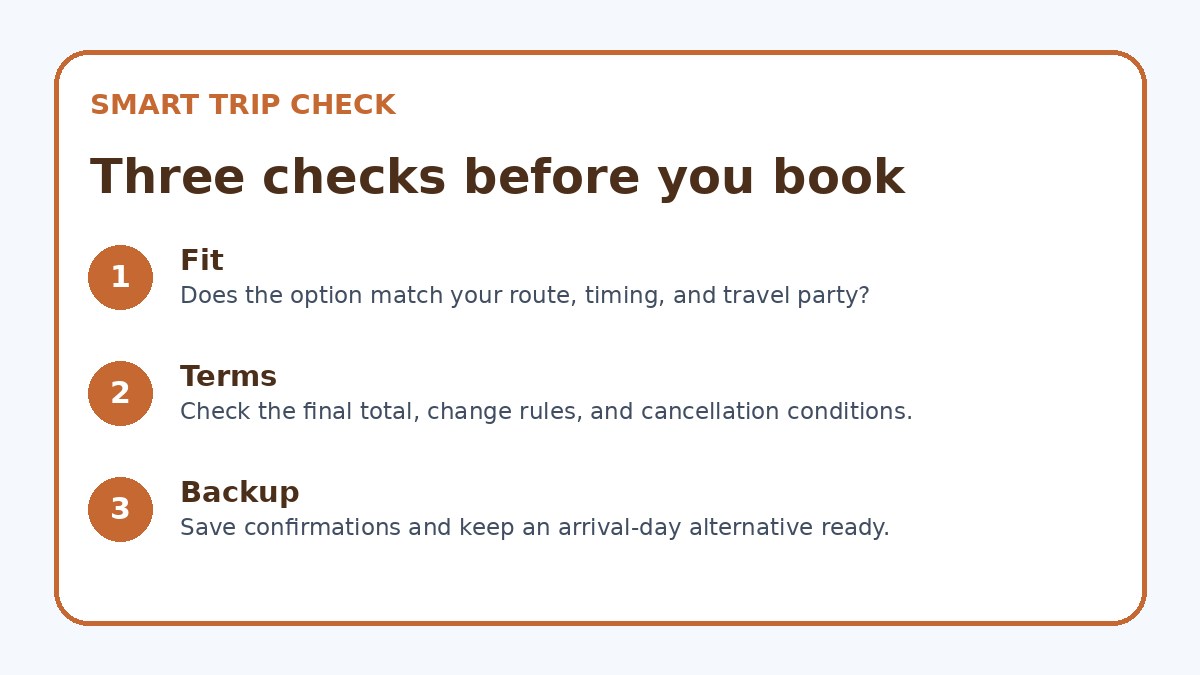
Before you book
- Confirm which airport you arrive at (JFK, LaGuardia, or Newark) and note the terminal on your booking confirmation.
- Estimate door-to-door travel time for each option, including walking, waiting, and transfers rather than just in-vehicle time.
- Check provider pickup locations and instructions on the official booking page before you leave for the airport.
- If you need accessibility or extra assistance, verify elevator access and accessible pickup procedures with the operator.
- Decide whether you want to prebook a private transfer or plan to use taxis/rideshares on arrival, and confirm cancellation policies.
- Have a backup plan (alternative transit route or contact number) in case of delays or last-minute service changes.
How to decide: checklist and comparison approach
Start by listing your priorities: speed, simplicity, cost, luggage handling, and accessibility. Estimate door-to-door time for each option rather than just in-vehicle time—include walking, waiting, transfers, and potential traffic. For example, a direct car may take less total time late at night, while a train plus short subway ride might beat surface traffic during a weekday morning. Compare how many times you’ll handle luggage and whether elevators or ramps are available for each transfer point.
When comparing choices, read the provider’s pickup instructions and cancellation policy carefully. Note pickup locations at your terminal, whether identification or flight details are required, and any extra charges for airport access or waiting time. If your schedule is tight, choose an option with predictable frequency and documented pickup points. If you’re undecided, a hybrid plan works: prebook the first leg with flexibility (for example, an option with free cancellation), and switch to a private ride on arrival if public transit looks impractical.
Frequently asked questions
Which NYC airport has the best public-transit access to Manhattan?
JFK and Newark both offer rail connections that link to regional and city lines, while LaGuardia relies primarily on bus and shuttle links. 'Best' depends on your endpoint in Manhattan and whether you prefer fewer transfers or less walking. Compare door-to-door time and the number of transfers for your specific hotel or neighborhood, and check for service advisories on the provider’s site. If you need elevator access or have lots of luggage, verify station facilities and whether the route requires carrying bags between platforms or terminals.
Is a rideshare or taxi faster than public transit from the airport?
It can be faster at off-peak hours or when public-transit connections are infrequent, especially for door-to-door trips with heavy luggage. During peak traffic, cars may be delayed by congestion, making trains or buses quicker and more predictable. To decide, estimate total door-to-door time for both options at your arrival hour, and factor in wait time for a rideshare or taxi pickup. For early-morning or late-night arrivals when public transit may run less often, a car can be the more reliable choice.
Should I prebook an airport transfer or wait until I arrive?
Prebooking offers certainty—especially useful for late arrivals, large groups, or when you need a meet-and-greet service—but reduces flexibility if plans change. Waiting to book on arrival allows you to assess real-time conditions and potentially use public transit if it’s running smoothly. If you prebook, carefully review pickup points, baggage allowances, and cancellation policies on the provider’s booking page. Using a comparison site such as Trip.com can show available options, but verify details directly with the transfer operator before finalizing.
Final planning note
Choosing the best New York City airport transfer is about matching your arrival airport, luggage, schedule, and comfort level with the pros and cons of public transit, rideshares, shuttles, and private cars. Public transit is often the most cost-effective and traffic-resistant choice, while taxis and rideshares offer convenience and simplicity—especially valuable for groups, heavy luggage, or odd-hour arrivals. Prebooked private transfers reduce uncertainty but require careful review of pickup and cancellation terms. Before you travel, confirm terminal pickup points, accessibility options, and any provider requirements on the official booking pages; keep a backup plan in case of service changes or unexpected delays.
Continue planning
Check current options and final conditions
Use the provider page to confirm live availability, the final total, cancellation terms, and every condition that matters to your trip.
This evergreen planning guide was created with AI-assisted drafting and a structured quality review. It does not display live prices, schedules, availability, visa guidance, or provider rankings. Verify current details before booking. Some links are affiliate links; we may earn a commission at no additional cost to you.