If you're traveling from Manila to Cebu with extra or bulky luggage, your most practical choice is the departure airport that minimizes handling complexity and connection risk while matching your schedule. For many travelers that will mean prioritizing direct flights from the primary Manila airport if you can find a schedule and fare that accept your baggage needs; otherwise, factor in the extra time, transfer logistics, and baggage recheck policies when using secondary airports or connecting itineraries. This article focuses on the tradeoffs that actually affect passengers with oversized bags: routing (direct vs. connecting), where baggage is checked and when you collect it, how tight schedules increase risk, and fare conditions that determine whether you can change plans without penalty. Before you search, have exact travel dates, number of bags, bag dimensions and weights, frequent-flier status, and preferred arrival window ready—it makes comparing options on airline sites or Trip.com far quicker and more reliable.

See live routes for your exact travel day
Compare direct and connecting choices with the same baggage and traveler details.
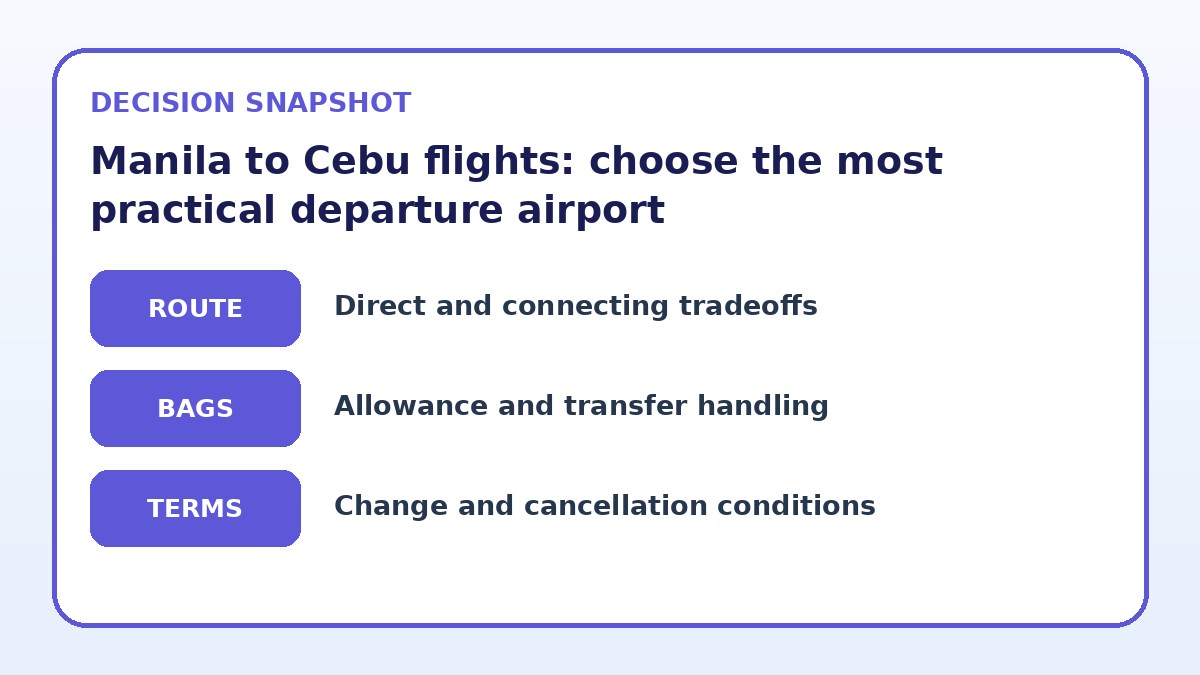
Routing: direct departures versus connecting options
The simplest routing choice for travelers with extra luggage is a direct flight from a Manila departure airport that offers nonstop service to Cebu. Direct flights reduce the number of times your checked bags are handled and eliminate the need to claim and recheck luggage at intermediate points. When comparing routings, verify whether the itinerary labeled nonstop truly departs from the Manila airport you can reach conveniently—some schedules use different city airports or terminals that change transit time and taxi costs.
Connecting options can sometimes be cheaper or provide better departure times, but they introduce baggage transfer steps and more scheduling risk. If a connection is necessary, prefer itineraries booked on a single ticket with short, but realistic, connection windows—long enough to move between gates or terminals but not so long that a long domestic layover becomes inconvenient. Always check whether the carrier will transfer bags through to the final destination or if passengers must collect and recheck at the connection point.
Baggage handling and connection risk
Extra luggage increases the chance of problems during transfer—delays, misplaced bags, or fees for oversized items. When assessing departure airports, look for airlines and routes that offer through-checking of baggage when available; through-checked bags stay on the same itinerary and are less likely to be delayed. If you must change airports or purchase separate tickets for each leg, plan for bag collection and recheck time, which can add an hour or more depending on terminal distances and local traffic.
Ask the airline or read the fare and baggage policy on the provider’s final booking page to confirm how oversized or extra bags are handled and whether special handling or advance notification is required. If mobility or special cargo services are needed, verify availability at the specific departure terminal and arrange services in advance. Consider arriving earlier than usual to allow staff time to tag and process large items, and keep documentation or photos of packed items in case of delay or damage claims.
Compare flight-selection strategies
| Flight strategy | Best for | Risk to check |
|---|---|---|
| Book a direct flight from the main Manila airport | Travelers who prioritize the fewest baggage handlings and lower connection risk | May cost more or have less flexible departure times compared with connecting options |
| Choose a connecting itinerary on a single ticket | Those who need a specific departure time or can't find a direct flight that accepts their baggage | Bags can be transferred automatically but connection delays still add risk and require realistic layover time |
| Buy separate tickets for each leg to reduce fare or access tight schedules | Flexible travelers willing to manage baggage claim and recheck themselves to save money | Higher chance of baggage collection/recheck, missed connections, and no protection for the first leg’s delay |
| Pick the secondary airport with cheaper fares but longer transfers | Budget-minded travelers with few or smaller checked items and ample time for ground transfers | Extra ground time, potential need to claim and recheck bags, and added stress moving between terminals or airports |
Recheck the complete itinerary
Confirm airports, connection handling, baggage, and change conditions before deciding.
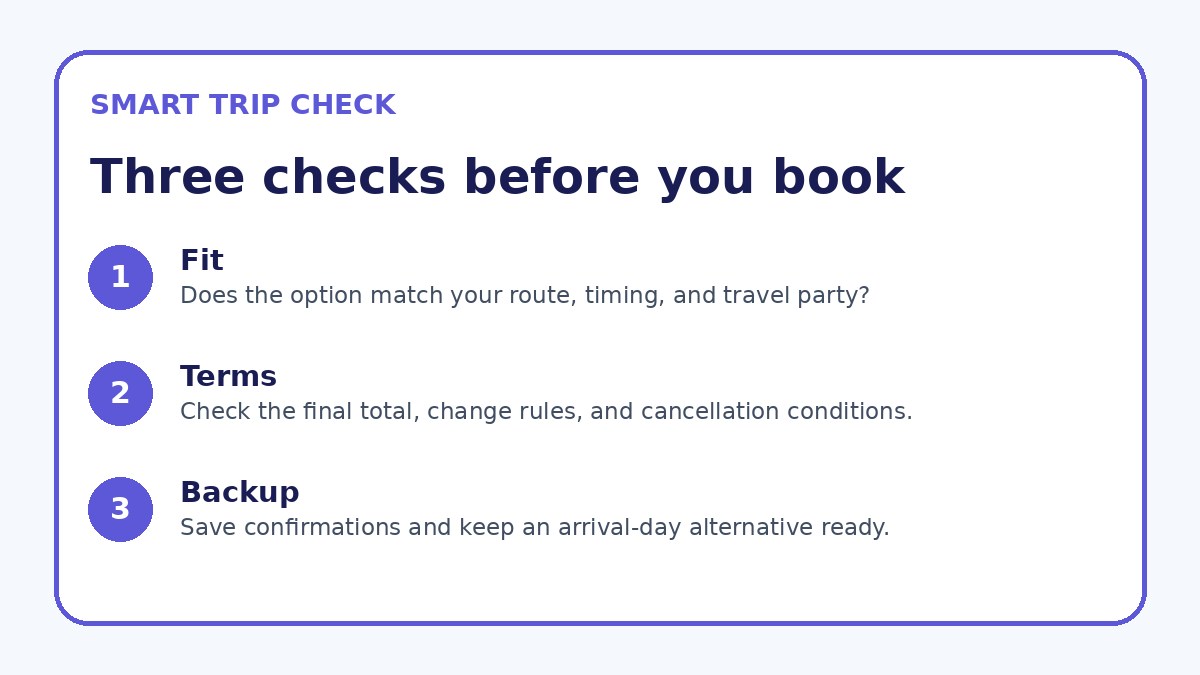
Schedule fit and day-of-travel logistics
Beyond the flight time itself, the practical airport choice depends on how easy it is to reach the terminal carrying extra baggage. Factor in travel time to each Manila airport during your planned departure window and typical traffic conditions for taxis or ride-hail options. If moving between different city airports is part of the plan, calculate transfer time conservatively—account for check-in, security queues, and the time needed to move heavy bags across terminals or between airports.
Also consider how flight times line up with your arrival at Cebu. Late-night arrivals may complicate baggage claims and onward ground transport, while early departures might force a nighttime hotel stay near the departure airport. If your itinerary requires a terminal change within the same airport, check whether the airline provides wheel or porter services, and whether terminals are connected airside or require exiting and re-entering security.
Flight details to verify
- Confirm exact travel dates and the number, weight, and dimensions of all checked items before searching fares.
- Check whether the itinerary is on a single ticket and whether baggage will be checked through to Cebu on the airline’s booking page.
- Verify terminal and airport for departure so you can plan transport time and any inter-airport transfers.
- Read the fare conditions for change and cancellation fees, and the carrier’s checked-baggage policy for oversize or extra items.
- Reserve porter or special-handling services with the airline or airport if you have bulky or fragile luggage.
- Allow extra buffer time at check-in and connection points; build in transit time for reclaiming and rechecking luggage if required.
Fare conditions, ticketing strategy, and what to verify
Fare rules materially affect travelers with extra luggage because cheap fares often limit changes and exclude checked bags. When comparing fares for Manila to Cebu flights, always open the detailed fare conditions: how many checked pieces are included, the weight and dimension limits, fees for additional items, and refund/change penalties. If your plans might shift, a slightly higher fare that allows a free change or includes your bags can be the most practical choice to avoid high reissue fees or the need to repurchase checked baggage online at gate prices.
If combining separate tickets to get a better schedule, recognize the added risk: the first carrier is not responsible for missed connections on a different ticket, and you may need to collect and recheck luggage. For multi-carrier itineraries, confirm on the final booking page whether bags are checked through and whether you must claim them. Trip.com can be an option to compare live availability and conditions, but always confirm baggage handling, terminal details, and change/reissue rules on the airline’s official booking page before you finalize.
Flight Guide questions travelers ask
Is it safer to choose a direct Manila departure when I have oversized luggage?
Yes—direct departures generally reduce the number of times your checked items are handled, lowering both delay and damage risk. A nonstop itinerary usually keeps your bags on the same aircraft or same carrier chain, removing the need to collect and recheck luggage at intermediate airports. However, verify on the airline’s official booking page that the direct flight policy includes your type of oversized item and whether special handling is needed. If a direct option forces a prohibitively inconvenient departure time or much higher fare, weigh those tradeoffs against baggage risk.
How much connection time should I allow if my tickets require a transfer?
Allow extra time compared with normal connections when you have heavy or oversized luggage, because you may need to move between terminals, claim bags, and recheck them. A conservative approach is to build at least one to two extra hours beyond the airline’s minimum connection recommendation, depending on whether you must change airports or traverse busy roadways. Always verify terminal layouts and ground transfer times in advance, and confirm baggage recheck procedures on the carrier’s final booking page to avoid surprises.
What should I check on the airline booking page about baggage before finalizing purchase?
On the airline’s booking page, confirm the included checked-bag allowance, the permitted size and weight per piece, and fees for additional or oversized items. Also check whether the itinerary is eligible for through-checking of bags to the final destination and if any special-handling request or advance notification is required. Finally, read change and reissue conditions so you know potential costs if you need to alter dates—sometimes a higher fare with better baggage and change terms is the more practical choice when traveling with extra luggage.
Final decision note
Choosing the most practical Manila departure airport for Cebu flights when you have extra luggage is about minimizing baggage touches and matching schedule and fare conditions to your needs. Start by deciding whether a direct flight from the primary airport fits your schedule; if it does, that often simplifies handling and reduces risk. If you must accept a connection or a different airport to secure the right time or price, prioritize single-ticket itineraries with confirmed through-checking and allow generous transfer buffers. Before you book, gather exact dates, bag details, and arrival preferences; then verify baggage rules, terminal details, and change policies on the airline’s final booking page so there are no surprises at check-in.
Continue planning
Check current options and final conditions
Use the provider page to confirm live availability, the final total, cancellation terms, and every condition that matters to your trip.
This evergreen planning guide was created with AI-assisted drafting and a structured quality review. It does not display live prices, schedules, availability, visa guidance, or provider rankings. Verify current details before booking. Some links are affiliate links; we may earn a commission at no additional cost to you.