Most families will find that driving in Mexico City is a tradeoff: a rental car can unlock day trips and suburban stays, but it also adds parking hassles, heavier traffic stress, and extra paperwork. If your plan centers on neighborhoods inside the city — museums, markets, parks, and walking or transit-friendly dinners — you probably don’t need a car. If your itinerary includes suburban relatives, long day trips to Tepotzotlán, Puebla, or remote national parks, a car will likely add convenience and flexibility. This guide helps you decide quickly by focusing on the value of your routes, pickup and return friction, insurance wording you must verify, and practical non-driving fallbacks. Read the quick verdict, then use the sections and checklist to compare mobility approaches and confirm the specific rental terms on the provider’s final booking page.

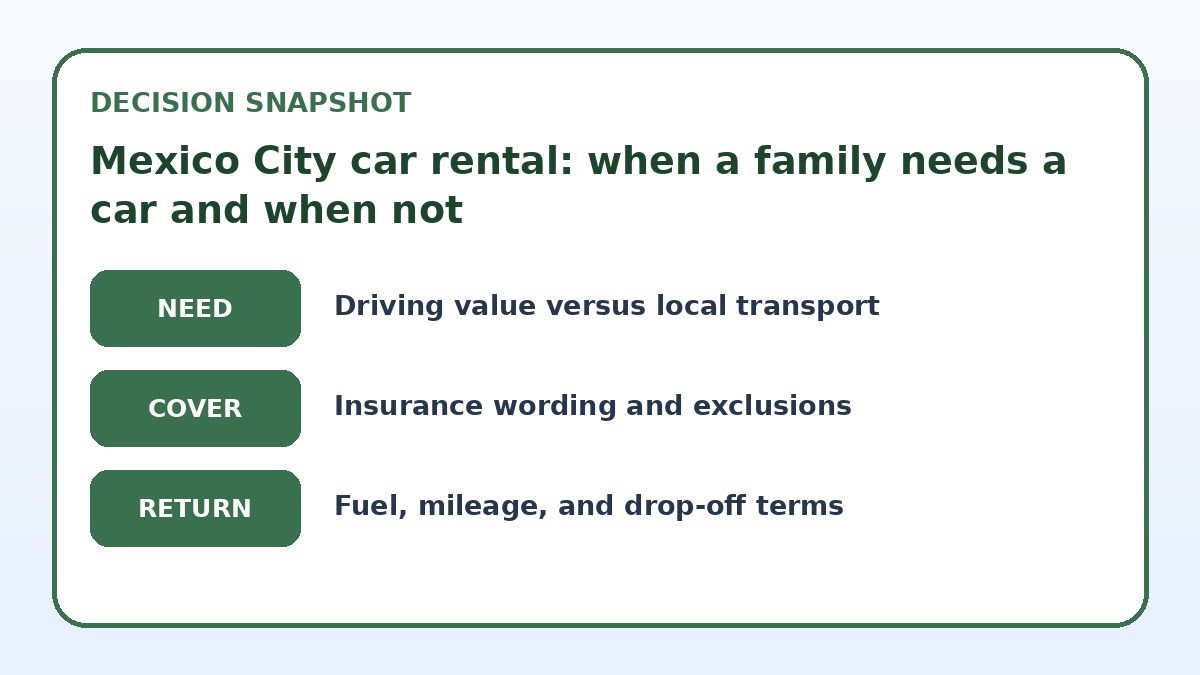
Route value: does driving meaningfully improve your family days?
Make route value the first decision filter. List each day’s main destinations and estimate whether they are within the city’s central areas (Centro Histórico, Polanco, Roma/Condesa, Coyoacán) or in outlying suburbs and regions. Central areas are dense, often walkable and well served by metro, buses, and short rideshares. If your family’s plans include museums, markets, playgrounds and evening dining inside these zones, a car spends more time parked than moving and can add city stress rather than convenience.
Conversely, driving pays when your itinerary involves multiple rural or small-town stops in a single day, airport transfers timed outside taxi app coverage, or accommodations without regular shuttles. Consider travel with young children: a car simplifies luggage and child seats for early starts or late returns. Also account for travel time variability—some suburbs are a short drive off-peak but slow in traffic—and decide if the schedule flexibility outweighs parking costs and time spent handling the vehicle each day.
Decide whether driving earns its place
| Mobility strategy | Best for | Cost or friction to check |
|---|---|---|
| Full rental car for entire stay | Families planning multiple out-of-city day trips or stays in suburbs without transit | Adds parking costs, inspection time, and insurance complexity; driving in heavy traffic can be tiring |
| Rent only for specific days | Families who mainly use transit but need a car for 1–2 day trips | Requires coordinating pickup/return logistics and may increase daily rental fees for short-term use |
| No rental: transit + rideshares | Families staying central and prioritizing museum, park, and dining days | Less flexibility for remote day trips and managing luggage or early/late travel with kids |
| No rental: public transport plus private day transfers | Families who want to avoid driving but still take organized off-city excursions | Can be more expensive per trip than driving and requires advance booking to secure child seats |
Check live rental choices only after the route test
Use the exact driver, dates, pickup point, and return plan to compare current conditions.
Insurance and contract wording: what to verify before you click
Insist on reading the exact insurance and excess wording on the reservation page and in the rental agreement. Key items to check: whether Collision Damage Waiver (CDW) or Loss Damage Waiver (LDW) is included or optional, the amount of the deductible or hold placed on your card, and whether theft protection covers accessories. Also verify whether roadside assistance is included and what geographic limits apply—some policies exclude driving on certain highways or outside the state. Don’t rely on summary lines; the final booking page should show precise limits and any required documentation.
If you plan to use your own credit card or third-party insurer, confirm on the provider’s site whether that coverage is accepted and what paperwork they require at pickup. Important exclusions to look for include undercarriage, windshield, tire and interior coverage. If child seats are necessary, check whether they’re provided, whether they meet local safety standards, and whether an extra charge or reservation in advance is required. When in doubt, ask the supplier to email the contract excerpt you’ll sign at pickup.
Compare the full rental conditions
Confirm insurance wording, exclusions, deposit, fuel, mileage, and return terms on the final page.
Pickup, return and local friction: time, inspection, and parking realities
Pickup and return logistics can negate the driving convenience if not planned. Airport counters, off-site lots, or shared shuttle services add time, and inspection procedures can hold up departures and returns while agents check for damage. Ask the rental site what exact steps happen at pickup (document check, hold amount, vehicle walkaround) and at return (final inspection, charging of fuel or damage, release of the hold). Factor in time for child seat installation and a calm briefing about local driving quirks before you leave the lot.
Parking is the day-to-day friction that families feel most. Central neighborhoods have paid parking, limited free curb space, and some streets with resident permit restrictions—verify whether your hotel provides parking, the cost of nearby lots, and whether they accept large vehicles. For multi-day trips, consider hotels with secure parking to avoid nightly searches for spots. If you plan many short outings inside the city, tally estimated daily parking fees and the likely time spent finding spaces versus the convenience of a car.
Car rental terms to verify
- List every day’s main destinations and mark which are inside central neighborhoods versus outside the city to assess driving value.
- On the rental provider’s final booking page, read the insurance, deductible, and geographic limits and save a screenshot of the wording.
- Confirm any child-seat availability, type, and extra fee with the provider in writing before pickup.
- Ask the supplier to detail pickup and return steps, including estimated time for inspection and any shuttle procedures.
- Check hotel parking options and costs; if staying in multiple places, confirm parking at each property ahead of arrival.
- If not renting, pre-book any private day transfers that include child seats and verify pickup points and cancellation policies.
Non-driving fallback: how to handle Mexico City without a rental
A strong non-driving plan combines public transit, rideshare/taxi apps, and occasional private transfers. Mexico City’s metro and Metrobús cover many central routes and are low-cost for short trips; families should plan for off-peak travel and avoid crowded times with strollers. Rideshare apps provide door-to-door convenience for evenings or trips with luggage, and registered radio taxis or airport transfers suit paid, scheduled arrivals or departures. For day trips to nearby towns, book private transfers or day tour services that include child seats when needed.
If you choose not to rent, select accommodation near your primary activities or close to a reliable transit line to reduce transfers. Pre-book any long day trips and make clear child-seat and luggage needs. Keep a small flexible budget for taxis and occasional private drivers so you can adapt when transit isn’t practical, and save the time you’d have spent on parking and vehicle paperwork for family activities instead.
Car Rental & Road Trip questions travelers ask
Is driving in Mexico City safe and family-friendly?
Driving in Mexico City is generally possible but can be challenging due to heavy traffic, complex intersections, and frequent congestion. For families, the main concerns are parking availability, time spent in stop-and-go traffic, and handling child seats during transfers. Many neighborhoods are walkable or better served by metro and rideshare apps; consider whether the time and stress of driving outweigh the convenience for your planned days. If you do drive, verify insurance limits, keep valuables out of sight, and prefer secure parking garages at your hotel or public attractions.
Can I use my credit card insurance instead of buying the rental company’s coverage?
Some credit cards offer secondary or primary rental car coverage, but acceptance and the extent of coverage vary by provider and country. Before declining the rental company’s insurance, check the rental supplier’s final booking page to confirm whether third-party coverage is accepted and whether any restrictions apply (for example, exclusions for certain vehicle classes or geographic limits). Request written confirmation and bring any required insurance contact numbers and policy documents to pickup. If your card’s coverage is secondary, you may still be responsible for the deductible held on your card at rental time.
How should families handle child seats and booster availability?
Child seats and boosters are often available from rental companies but can come with extra fees and limited supply, so request them when you reserve and get confirmation in writing. Check the provider’s final booking page for seat types and whether they meet your home country’s safety standards; you may prefer to bring your own convertible seat if you travel frequently. If using taxi apps or private transfers, ask the driver or company in advance whether they can provide seats and whether there’s an extra charge. Always install seats while parked and follow the seat manufacturer’s fit instructions for the vehicle.
Final decision note
For most families whose plans are centered in Mexico City’s core neighborhoods, a rental car adds cost and friction without improving daily life; public transit, rideshares, and occasional private transfers usually cover needs more simply. If your itinerary includes multiple off-city day trips, stays in suburban hotels without reliable transit, or complicated luggage logistics, renting on the days you need a vehicle or keeping a car for the whole stay can be worthwhile. Whatever you choose, verify insurance wording, disclosure of deductibles, child-seat availability, and pickup/return steps on the rental provider’s final booking page before confirming. That final check will tell you whether the convenience of a car truly outweighs the extra work for your family trip.
Continue planning
Check current options and final conditions
Use the provider page to confirm live availability, the final total, cancellation terms, and every condition that matters to your trip.
This evergreen planning guide was created with AI-assisted drafting and a structured quality review. It does not display live prices, schedules, availability, visa guidance, or provider rankings. Verify current details before booking. Some links are affiliate links; we may earn a commission at no additional cost to you.