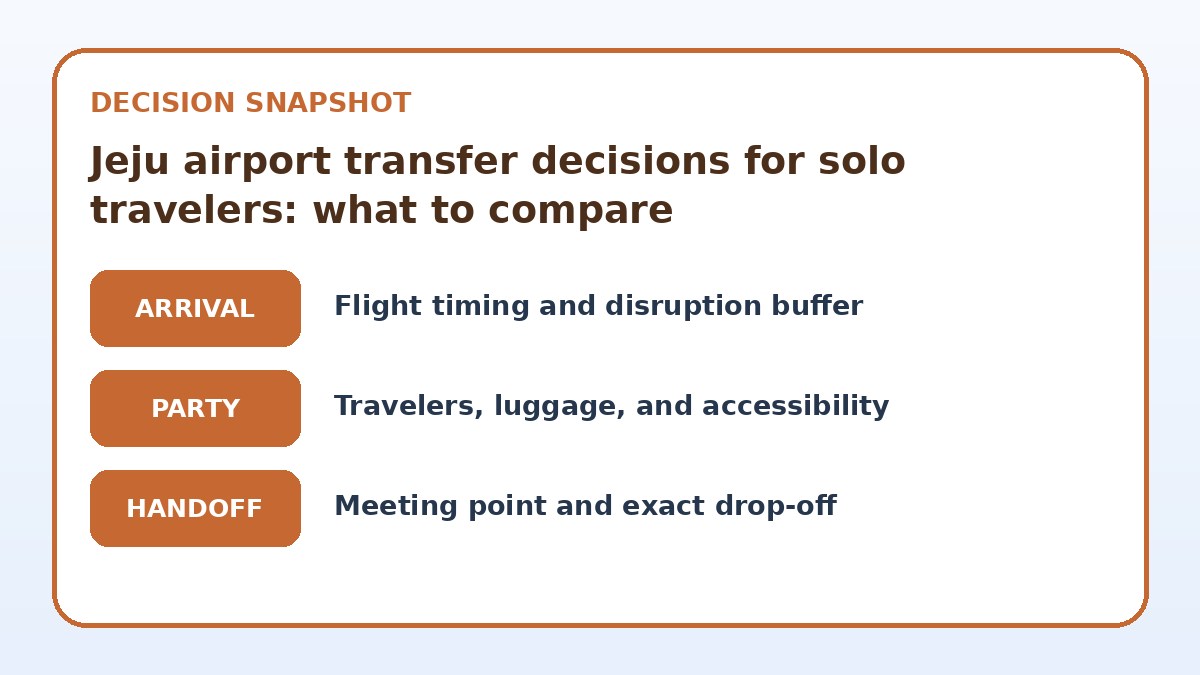
First hour after landing: you’ll want a quick decision. If you’re walking out of arrivals with light carry-on, confident navigation apps, and a hotel near major bus routes, take public transport for a low-fuss start. If you’re carrying bulky luggage, arriving late, tired after connections, or staying somewhere remote or without clear meeting points, a private transfer saves time and stress. For solo travelers the practical choice hinges on four things: how much you have to carry, whether your arrival might be delayed, how clear the meeting point instructions are, and how close your accommodation is to the main stops. Below you’ll find clear tradeoffs, step-by-step checks to make while you still have your flight and booking details open, and an easy comparison of four common arrival-transfer approaches to match your circumstances.
Check options for your arrival details
Use your flight, luggage, party size, and accommodation address to compare current choices.
Luggage and party size: how much matters
Count what you can realistically carry without help before you book. A single compact carry-on or daypack fits easily on buses and in taxis, and keeps public transport attractive. If you have multiple checked bags, a tripod, surfboard, or bulky sports gear, a private transfer or pre-booked taxi gives predictable space and spares you juggling cases across bus steps and waiting areas. Also consider whether you expect to add purchases or souvenirs that will increase your load on the return trip.
Your party size also changes the math. As a solo traveler, paying for a private shuttle that seats several can be harder to justify financially, but it may still be worth it when time or energy is tight. Solo passengers traveling with gear that won't collapse into a single bag should prioritize transfers that offer guaranteed trunk space. When comparing options, check how boards or long items are stored, whether drivers help load, and whether you can reserve a vehicle type that suits your gear.
Arrival details to have ready
- Confirm your flight number, expected arrival terminal, and whether your flight is domestic or international before comparing transfers.
- Check how many bags you’ll have and whether any items require special handling (surfboard, bike, instrument) and note that on booking pages.
- If booking private transfer, copy and save the provider’s exact meeting-point text and a map screenshot to your phone and to a note you can access offline.
- If using public transport, note the nearest bus stop or taxi rank name and the typical walking route from arrivals to that stop.
- Have your accommodation’s full address in Korean and English, plus a local contact number ready to show drivers or airport staff if directions are unclear.
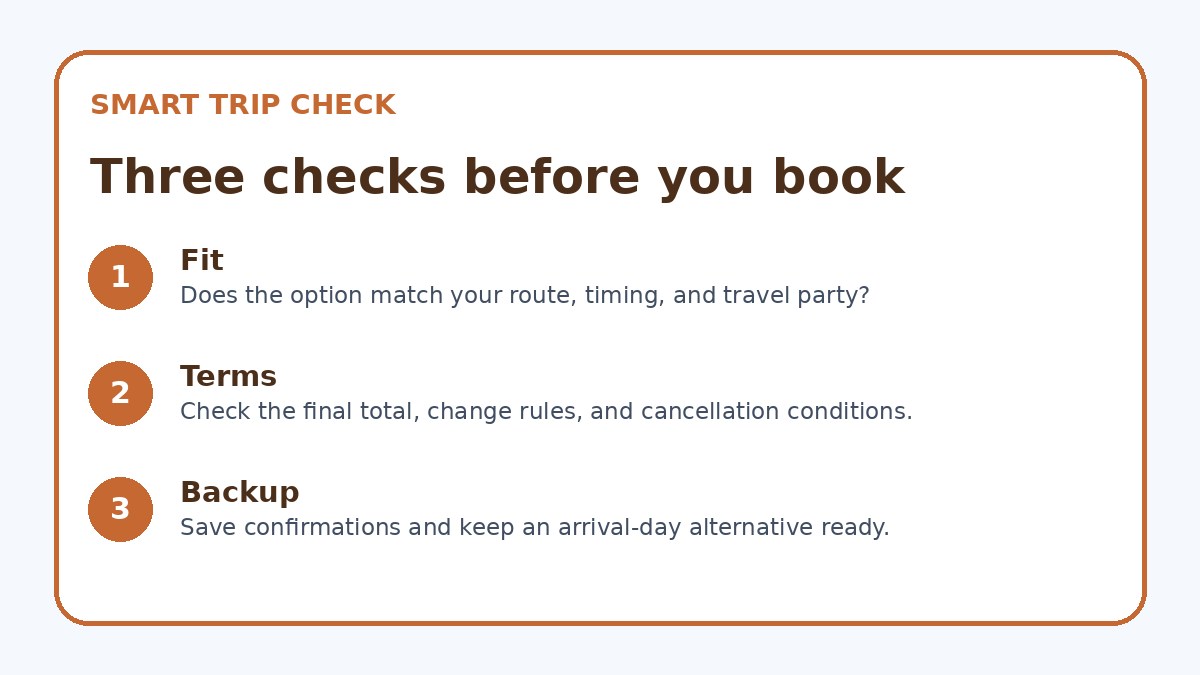
- Before departure, compare current options and reviews on provider pages and optionally check availability on Trip.com, then verify pickup-delay policies when you book.
Late or disrupted arrivals: minimizing risk
If your flight could arrive late or connection times are tight, prioritize options that reduce dependence on coordination windows. Private transfers are forgiving because drivers wait according to the pickup terms you agree with; public services run on fixed timetables and may leave you stranded at odd hours. However, do not assume every private booking automatically covers long waits—read the provider’s pickup and delay policy on the booking page to understand grace periods and how they handle extended delays.
When public transport is your plan, prepare fallback choices. Know the last bus or rail departure near your arrival time and confirm where taxis queue at the airport. Make a short list of simple phone or app steps to summon a taxi or rideshare if you miss scheduled public options. Keep your accommodation’s phone number and local-language address text-ready so a driver or airport staff can help if you are tired or need to switch to a paid option quickly.
Match the transfer to your arrival
| Arrival approach | Best for | Detail to verify |
|---|---|---|
| Public bus | Travelers with light luggage staying near bus stops who want the lowest-cost option. | More walking and fixed schedules; less convenient late at night or for distant drop-offs. |
| Local taxi on arrival | Solo travelers needing a direct ride without pre-booking and carrying moderate luggage. | Variable wait at taxi ranks and uncertainty about trunk space for oversized items. |
| Pre-booked private transfer | Arrivals with heavy luggage, late-night landings, or stays at remote addresses seeking door-to-door service. | Higher cost and need to verify clear pickup instructions and delay policies on the booking page. |
| Hybrid: bus or train into town, short taxi onward | Cost-conscious solo travelers who want to limit walking with flexible timing and moderate luggage. | Requires planning two legs and may involve carrying bags between stops; timing matters for tight schedules. |
Make the meeting plan clear
Check the final pickup instructions, waiting conditions, and exact drop-off coverage.
Meeting-point clarity: avoid the common confusion
Clear meeting-point instructions are essential for any private pick-up. Before you book, verify exactly where the driver will meet you: arrivals hall landmarks, a numbered exit, a detectable kiosk, or a signboard spot. Providers’ booking pages should show a map image and explain how drivers note delayed arrivals. If those details are missing or vague, message the operator to request a photo or short video of the meeting area so you know what to look for when exhausted.
For public transfers, meeting-point clarity means knowing the bus stop number, platform, or taxi rank, and how to move from arrivals to that point without unnecessary detours. Airports sometimes separate domestic and international exits or have construction that alters usual flow; check recent passenger reports or contact your hotel for up-to-date local advice. If you plan to use apps or an e-ticket, make sure you can display your confirmation offline in case cellular data is intermittent.
Destination-side drop-off: getting close to your door
How close a vehicle can get to your accommodation is a big factor for solo travelers. Public buses commonly stop at main transit hubs or central streets; if your stay is in a compact town center, that may be a short, manageable walk. But if your lodging sits on a rural road, a seaside cottage, or a resort with limited vehicle access, a private transfer that drops you at the exact door can justify the extra cost and reduce the stress of navigating unfamiliar streets alone.
When evaluating options, check whether your accommodation has a recommended drop-off point or entrance for cars, and whether there are stairs or long corridors between drop-off and your room. Ask hotels or hosts whether drivers can enter their property or must wait at a public gate. These small details determine whether a private transfer truly saves effort or merely replaces a short walk with a different set of directions.
Airport Transfer & Local Mobility questions travelers ask
Can I rely on airport taxis in Jeju if I arrive late at night?
Airport taxis commonly operate after late flights, but availability may vary at different hours and during peak arrival waves. If your arrival is late or unpredictable, plan a backup: identify the taxi rank location, confirm whether your accommodation can call a recommended driver, or consider booking a private transfer that explicitly states its late-arrival handling. When you choose a taxi at the airport, confirm the driver understands your destination and whether any extra charges apply for oversized luggage before you depart.
How do I decide between a pre-booked private transfer and hailing a taxi on arrival?
Decide by weighing certainty against cost. Pre-booked transfers give you a reserved vehicle and a written meeting plan, which reduces anxiety after long travel or with heavy bags—but you must read the provider’s pickup and delay policy to know how they handle late flights. Hailing a taxi is flexible and often cheaper for light, straightforward trips, but can be harder if queues are long or if a specialized vehicle is needed. Use photos of meeting points and your accommodation address in the local script to smooth either option.
If I take public buses, how do I handle final-mile navigation to small guesthouses or rural stays?
Public buses typically serve main towns and transit hubs, so for rural or small guesthouse locations plan the final mile in advance. Ask your host whether there is a recommended stop, whether they offer a pickup, or whether a short taxi from the nearest hub is customary. Download offline maps centered on your destination and keep the host’s contact ready in Korean to show a local driver. Combining a bus into a central hub with a short taxi ride is often the most cost-effective and simple solution for solo travelers.
Final decision note
For solo travelers arriving in Jeju, the fastest decision is to match your body and baggage to the moment you land. Travel light and arrive during daytime? Public transport or an airport taxi can keep things simple and economical. Arrive late, tired, or with bulky gear? A pre-booked private transfer minimizes stress and logistics if you confirm meeting and delay terms. Use the checklist while your flight and hotel details are handy: verify terminal, luggage, meeting points, and destination drop-off access. If you need to compare providers or current availability, Trip.com is one place to view options, but always verify pickup policies and meeting-point specifics on the provider’s final booking page before you commit.
Continue planning
Check current options and final conditions
Use the provider page to confirm live availability, the final total, cancellation terms, and every condition that matters to your trip.
This evergreen planning guide was created with AI-assisted drafting and a structured quality review. It does not display live prices, schedules, availability, visa guidance, or provider rankings. Verify current details before booking. Some links are affiliate links; we may earn a commission at no additional cost to you.