If you’re travelling from Dubai to Doha with extra luggage, the single most useful step before you start comparing fares is to assemble exact trip details: travel dates, number of bags including dimensions and weights, whether bags include fragile or restricted items, and whether you need hold or cabin allowance. With those pieces in hand you can quickly eliminate fares that won’t work and focus on routing, connection risk and fare flexibility. This article gives a compact, actionable checklist that helps you decide between direct and connecting options, pick baggage-friendly fares, and reduce the chance of surprises at check-in or transfer. Read it before you pull up any live search results so you spend your energy on realistic ticket choices instead of on options that won’t accept your luggage.
See live routes for your exact travel day
Compare direct and connecting choices with the same baggage and traveler details.
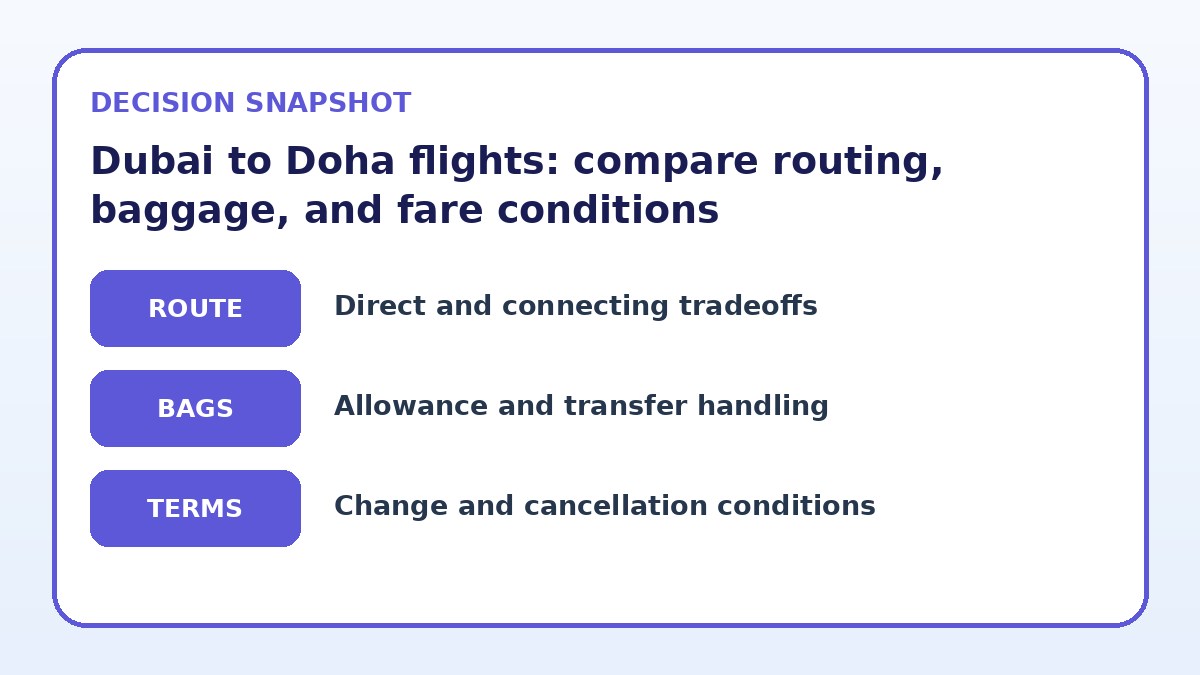
Routing: direct vs connecting and what to prioritize
When you have extra luggage, routing is about more than elapsed time. Direct flights reduce handovers and baggage handling events, which usually lowers the risk of misrouted or delayed bags. If direct flights operate on your dates and fit your schedule, they are often the simplest choice for travellers with heavy or bulky bags. However, direct options may have stricter weight limits or different baggage allowances than connecting carriers, so don’t assume direct equals cheaper or more generous for luggage.
Connecting itineraries can offer better fares or more useful schedule slots, but each connection is another opportunity for a bag to be delayed or rechecked. If you must connect, prioritize longer connection times to allow for transfer processes and potential short delays. Check whether a single ticket covers all legs; an itinerary booked as one ticket usually protects you under airline transfer policies and may force the carrier to assist with delayed bags, while separate tickets can leave you responsible for collecting and rechecking luggage.
Baggage and connection risk: rules to verify before booking
Before you commit, list exactly what counts as your luggage: number of bags, total weight per bag, and any oversize or special items like sporting equipment or instruments. Different fare classes and carriers can include or exclude checked pieces, and fees for overweight or oversized items vary. Verify whether the fare you’re looking at includes checked baggage or requires purchasing it as an add-on — and whether the add-on must be bought before airport check-in to get the lower online rate.
Also check who is responsible for baggage transfers on connecting itineraries. If your journey involves codeshares or separate tickets, confirm whether each carrier will transfer checked bags automatically. Where responsibility is unclear, prepare to collect and recheck bags yourself and allow extra time. Inquire about accepted dimensions and whether soft or hard cases have different handling practices; some carriers or airports have stricter procedures for oddly shaped items that can affect whether they accept them as checked baggage.
Compare flight-selection strategies
| Flight strategy | Best for | Risk to check |
|---|---|---|
| Book the cheapest connecting ticket and add bags later | travellers prioritizing lower upfront fare and who can accept higher risk of transfer issues | may face higher fees, separate transfer responsibilities, and increased chance of baggage delays |
| Choose a direct flight with baggage included | travellers seeking simplicity and fewer handling events for bulky or heavy items | direct options may be more expensive or have stricter per-piece limits despite fewer transfers |
| Buy a flexible fare that includes extra baggage | travellers who value easy rebooking and predictable baggage rules | higher base fare but reduced stress and clearer protections if plans change |
| Book separate carriage for oversized items and standard passenger ticket | travellers with one or two very large items that carriers treat as cargo | adds logistics and cost but keeps passenger ticket simple; requires extra coordination |
Recheck the complete itinerary
Confirm airports, connection handling, baggage, and change conditions before deciding.
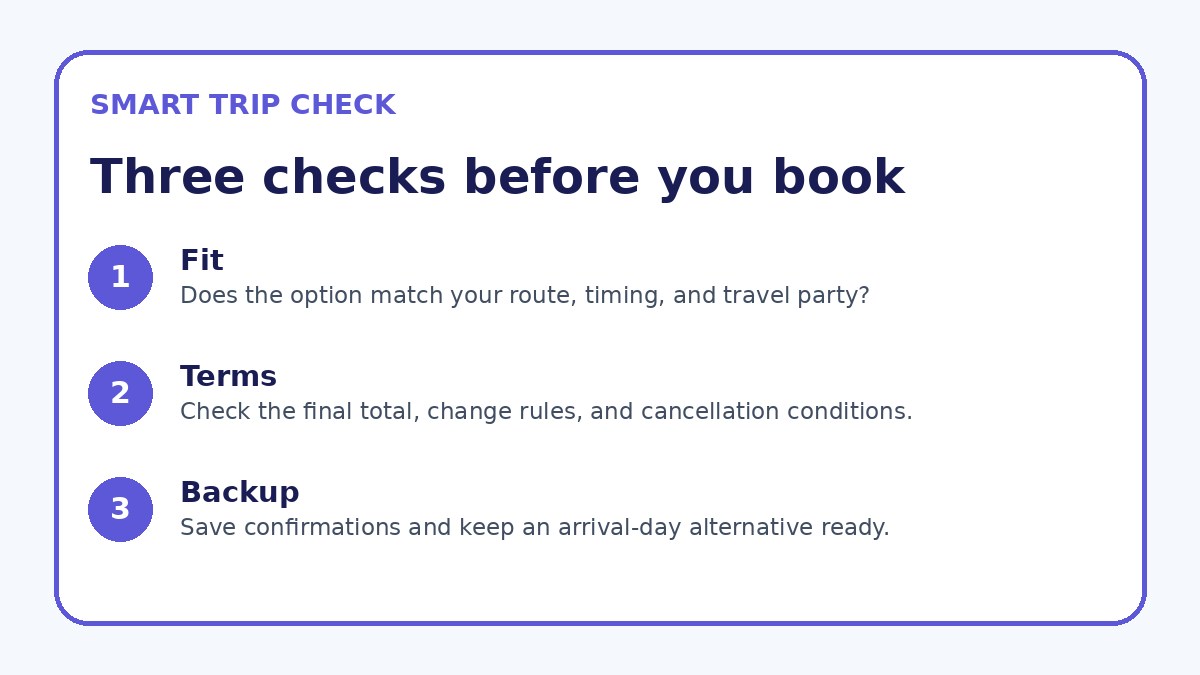
Schedule fit and contingency planning for bulky luggage
Match flight times to your ground logistics. If you’re picking up equipment or large bags from a storage facility or sending items through a courier before departure, coordinate those windows with departure and arrival times. Avoid late-evening arrivals that make it difficult to resolve baggage problems immediately, and be cautious about very short connections that leave no margin for unexpected delays. If your flight arrives late in Doha, check the availability of baggage services or airport support after hours.
Think through simple contingency plans: a longer connection, travel insurance that covers delayed baggage, or a local courier that can forward a delayed bag. Having a backup plan reduces stress if a piece of luggage is separated from you. Also prepare documentation and photos of valuable or fragile items to speed claims, and know where to file a report at both departure and arrival airports if baggage goes missing or sustains damage.
Flight details to verify
- Record exact travel dates, full traveler names, passport details if needed, and the total number of bags including precise weights and dimensions before searching live fares.
- On each fare’s booking page, confirm whether checked baggage is included in the ticket; if not, find the exact online add-on price and whether it must be purchased before airport check-in.
- For any connecting itinerary, verify whether baggage is interlined on a single ticket or if you must collect and recheck pieces between flights; allow additional connection time if manual transfer is required.
- Check the airline’s official baggage policy for weight, size, and special-item rules (instruments, sports gear) and confirm whether overweight or oversize fees apply per piece or per kilogram.
- Confirm the scheduled arrival time in Doha and the availability of after-hours baggage services or customer support; plan a contingency (longer connection or insurance) if arrival is late.
- Take photographs and note serial numbers of valuable items, pack fragile items securely, and prepare documentation to speed claims in case of damage or delayed baggage.
Fare conditions and verifying final details before purchase
Fare conditions determine what you can change or refund and how baggage is treated. Before booking, read the fare rules for baggage inclusion, change and cancellation penalties, and whether purchased bags are refundable or transferable. Confirm whether the fare allows paid upgrades at check-in and whether those upgrades change baggage allowances. If a particular fare class looks appealing for baggage, verify on the airline’s booking page that the allowance shown in the search engine matches the carrier’s published rules.
When provider-specific facts could change, verify them on the airline’s final booking page and in the carrier’s baggage policy. Trip.com may be useful to compare live availability and conditions, but always check the airline’s page to confirm dimensions, weight limits, and any special handling requirements. Before paying, have the exact traveler names, passport details if required, and bag specifications ready so the booking system presents accurate baggage charges and options.
Flight Guide questions travelers ask
How do I compare baggage allowances when browsing multiple Dubai to Doha flights?
Start by noting your exact baggage needs (pieces, weight, dimensions) and then check each fare’s detailed baggage allowance on the airline’s booking page. Low-cost fares often exclude checked bags or cap weight per piece; legacy carriers may include one or more pieces but with per-piece weight limits. Compare whether online purchases of extra baggage are cheaper than paying at the airport, and whether the addition can be made for the whole itinerary when connecting. If differences are unclear, contact the carrier directly before booking.
Is it safer to book two separate tickets if one leg has cheaper baggage rules?
Booking separate tickets can offer a lower fare on one leg but increases risk: you may need to collect and recheck bags between carriers, and if an earlier flight is delayed you usually have no protection for missed connections. For travellers with extra luggage, a single ticket that covers all legs typically simplifies transfers and assigns responsibility to the operating carrier for baggage issues. If you do choose separate tickets, build long connection buffers and confirm baggage transfer policies with both providers.
What documentation should I bring for fragile or valuable items in checked luggage?
Photograph each item, its serial number, and the packed condition before checking it. Keep purchase receipts or appraisal documents and place a copy in your carry-on and another in the checked bag if possible. Declare fragile items at check-in if the carrier requires it and ask for a damage tag if offered. These steps make it faster to file a claim if damage occurs and can be required evidence for any compensation process.
Final decision note
Travelling Dubai to Doha with extra luggage is manageable if you prepare before you search. Start by gathering exact dates and bag specifications, then use the checklist to screen routing, baggage inclusions, and fare conditions before you compare live fares. Prefer direct itineraries when minimizing handling is critical, or choose flexible fares when you value clear change and baggage protections. Always confirm the airline’s official baggage rules and any add-on costs on the carrier’s booking page before you pay. With a clear plan and contingency options, you’ll reduce surprises at check-in and increase the chance that your luggage arrives with you.
Continue planning
Check current options and final conditions
Use the provider page to confirm live availability, the final total, cancellation terms, and every condition that matters to your trip.
This evergreen planning guide was created with AI-assisted drafting and a structured quality review. It does not display live prices, schedules, availability, visa guidance, or provider rankings. Verify current details before booking. Some links are affiliate links; we may earn a commission at no additional cost to you.