If you're traveling from Seoul to Gangneung with kids, the practical choice is to pick the travel mode that best fits your family's luggage, patience for transfers, and on-the-road flexibility. For many families, a direct intercity train or private car-share gives the simplest door-to-door flow; coaches can be cheaper but add transfer friction, and combining modes can unlock scenic stops or hotel locations not served directly. This article helps you weigh terminal fit (station versus bus terminal versus pick-up/drop-off), luggage and stroller handling, timing flexibility, and a realistic disruption backup plan. Read on to build a multi-city ground-transport plan that connects where you start in Seoul to your final Gangneung door, with clear tradeoffs and actionable checks before booking.
How to choose between rail, coach, car, or a combination
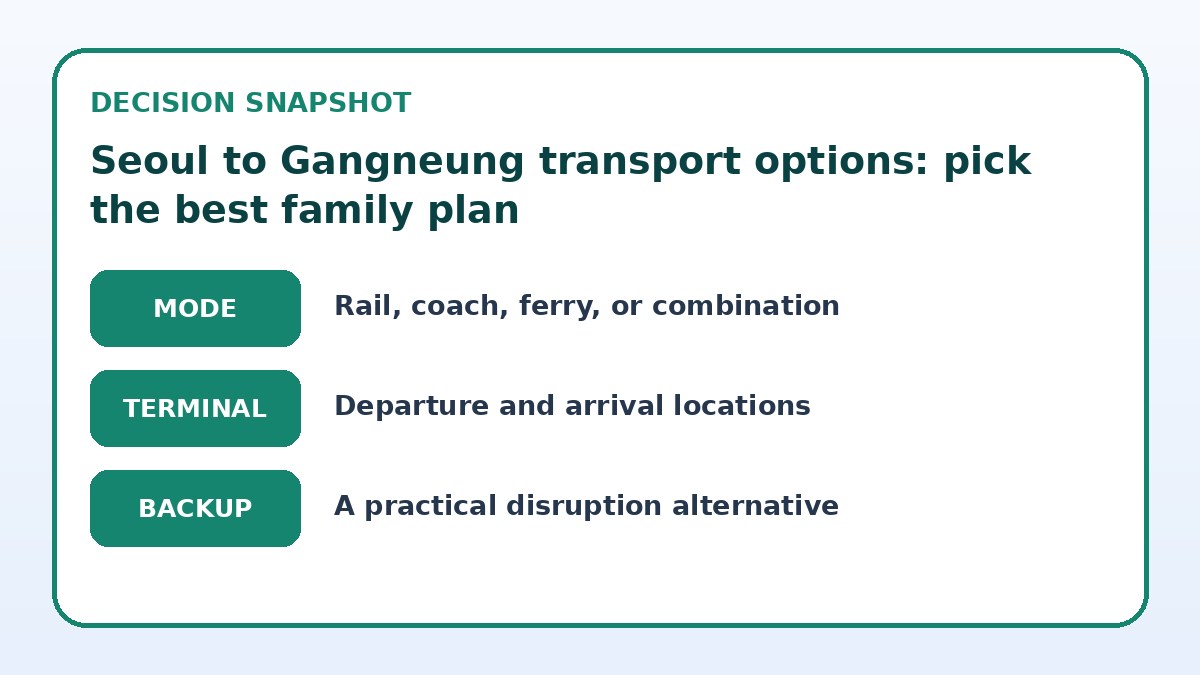
Start by listing door-to-door needs: where in Seoul you’ll start, where in Gangneung you need to finish, how much luggage (including strollers) you’ll carry, and whether you want flexible scenic stops en route. Rail usually wins when both ends are station-adjacent and you value on-board room and predictable journey rhythm; coaches can be simpler when stations are inconvenient for your hotels; cars or private transfers suit families wanting full control over timing and stops.
Next, match those needs to practical factors: terminal location (does the bus terminal sit near your lodging?), transfer count (how many times must you change vehicles?), and on-the-ground connections (do local taxis or shuttles run reliably at your arrival hour?). Combine modes deliberately: for example, take a train for the main leg and a short taxi from Gangneung station to a coastal hotel to reduce carrying luggage long distances while still enjoying train comfort.
Choose the end-to-end journey plan
| Journey approach | Best for | Friction to check |
|---|---|---|
| Direct intercity train | Families wanting predictable, comfortable travel with minimal in-vehicle transfers and easy onboard facilities. | May require taxi or shuttle at each end if stations are not near your lodging; limited stops for scenic detours. |
| Intercity coach/bus | Groups seeking single-ticket continuity with simpler point-to-point scheduling and lower transfer planning. | Higher transfer friction at busy bus terminals and less flexibility for mid-route stops or luggage handling. |
| Rental car or private driver | Families prioritizing door-to-door control, flexible stops, and direct hotel drop-offs without public-terminal hassles. | Responsible for parking, driving fatigue, and possible extra time handling child seats and road navigation. |
| Mixed-mode (train + taxi or coach + rental segment) | Travelers balancing comfort with local access — use train for main leg, car or taxi for first/last mile and stops. | Requires careful timing and buffer planning; more moving parts increase potential for missed connections. |
Check live intercity options
Look beyond the ride itself and compare terminals, transfers, luggage, and arrival fit.
Terminal fit, luggage and transfer friction
Terminal fit matters most with young children. Train stations are designed for passenger flow with wider platforms and typically easier stroller access, while bus terminals can be crowded and require carrying bags up stairs or through narrow corridors. Check whether your chosen terminals have elevators, level entry, or family restrooms—if you need specific facilities, verify them on the provider or station website before booking.
Luggage and transfers add time and stress. Count transfers and approximate carry distances: each transfer multiplies the effort of a toddler and a suitcase. If you plan to change mode in a different city, allow generous time buffers and prefer services that advertise priority or luggage compartments. For last-mile gaps, check taxi availability at arrival or whether your hotel offers a shuttle; Trip.com is a convenient place to compare current availability and connections but always confirm directly on the provider’s final booking page.
Timing flexibility and on-route planning for families
Families often trade speed for flexibility. A strict fixed-schedule coach or train gives certainty but less room to handle delays, diaper needs, or unexpected snack breaks. If your party includes young children, pick departure times that avoid nap upheavals and allow a relaxed buffer on either end. Consider splitting the journey: an early morning depart with a planned long stop halfway can turn travel time into a mini-excursion and reduce pressure.
Plan for accommodation and meal windows around travel. If you must change vehicle types mid-route, arrange the connecting segment with a buffer of at least 45–90 minutes depending on airport or station layouts. When comparing options, treat departure frequency as a flexibility metric: more frequent services reduce risk if you miss one, but they may require local transport to reach less central terminals more often.
Compare the practical alternatives
Use the final page to confirm what is actually offered on your dates and save a workable fallback.
Intercity travel checklist
- Map your exact start address in Seoul and final Gangneung address to compare door-to-door time for each mode.
- Verify station or terminal names, elevator/stroller access, and proximity to your accommodations on operator or station pages.
- Count luggage pieces and confirm baggage rules and storage options with each provider before booking.
- Reserve child seats or boosters if using a rental car or private driver and note any required documentation.
- Build at least a 45–90 minute buffer for scheduled connections when comparing combined-mode itineraries.
- Save customer service numbers and alternative service times in your phone before departure for quick rebooking if disrupted.
Disruption backup and door-to-door practicality
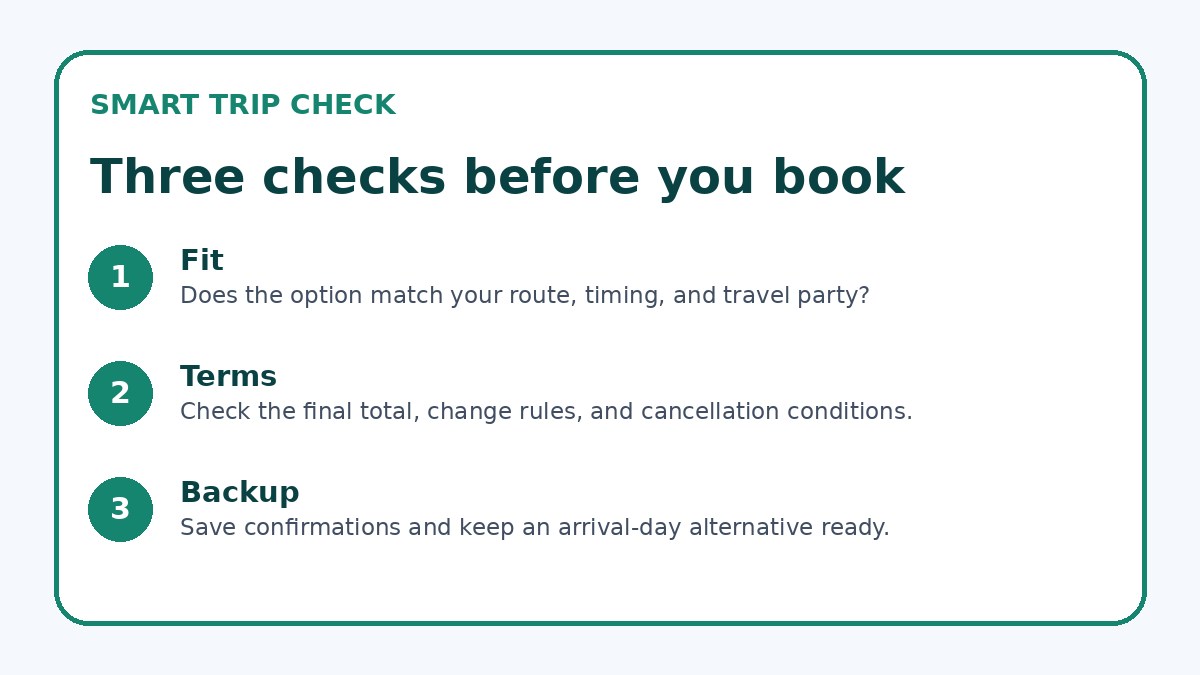
A simple disruption plan keeps the trip family-friendly. Always identify at least one alternative service (earlier or later train, a different coach line, or a rental car option) and know nearby stations or parking locations where you could switch modes. For each booking, record customer service contacts and the exact terminal names; this saves precious time when rearranging with kids in tow.
Door-to-door practicality is more than the seat on the vehicle: factor first/last-mile transfers, luggage handoffs, and how late-night arrivals will affect your onward mobility. If a direct service is unavailable, prioritize routes that minimize walking with luggage and consider pre-booking a short taxi from arrival to avoid searching for cabs. Verify any provider-specific baggage rules, required station check-in times, and accessibility features on the operator’s official booking pages before you finalize bookings.
Rail & Intercity Transport questions travelers ask
Is the train usually the easiest option for families traveling from Seoul to Gangneung?
Trains are often the easiest in terms of onboard comfort and predictable running patterns, especially if both your Seoul departure point and Gangneung destination are close to stations. They typically involve fewer changes and level station access that helps with strollers and children. However, 'easiest' depends on your hotel locations and luggage: if stations are far from your accommodations, the convenience advantage can be reduced by additional taxi rides. Always verify station access features and exact first/last-mile connections on the provider’s booking page before choosing.
How should I plan meals and diaper breaks on the journey?
Plan departures to align with your children’s usual meal or nap times when possible. For direct services, pack easy-to-eat snacks and a small blanket to make short naps comfortable. If you plan a mixed-mode route, identify likely stop towns or service areas ahead of time and allow a generous buffer to get off, stretch, and use facilities. When booking, check whether the scheduled vehicle offers onboard restrooms and whether the stations along your route provide family-friendly facilities.
What practical backups should I arrange in case of delays or cancellations?
Identify at least one alternative service on the same day (earlier or later) and one different mode (for example, a rental car company you could call if public transport is disrupted). Keep digital and printed booking confirmations, and write down customer service phone numbers. If you cannot rebook quickly with kids, know the nearest hotels by the terminal and short taxi routes from the station. Confirm cancellation and change policies on the provider’s final booking page so you understand penalties or rebooking steps ahead of time.
Final decision note
Building a family-friendly ground-transport plan from Seoul to Gangneung means matching terminal fit and luggage realities with your need for timing flexibility and a clear disruption backup. Start by mapping exact door-to-door addresses, compare how each mode handles first/last-mile logistics, and favor options that reduce transfers and long walks with baggage. If you need flexibility, consider a mixed-mode plan: a comfortable main-leg train plus a short taxi or rental segment for the final mile. Verify accessibility and baggage details on the operator’s booking pages, save alternative service times, and keep customer service contacts handy. With a few simple checks and buffers, you can create a calm, practical route that suits your family’s pace.
Continue planning
Check current options and final conditions
Use the provider page to confirm live availability, the final total, cancellation terms, and every condition that matters to your trip.
This evergreen planning guide was created with AI-assisted drafting and a structured quality review. It does not display live prices, schedules, availability, visa guidance, or provider rankings. Verify current details before booking. Some links are affiliate links; we may earn a commission at no additional cost to you.