If you’re taking London to Paris flights for the first time, the single most useful decision is how you balance routing and baggage against airport time. Direct options reduce risk and simplify baggage, but connecting routings can offer lower fares or better timings if you accept transfer complexity. Your planning checklist should start with exact travel dates, number of travelers, and whether you need to bring hold luggage or oversized items. That information immediately narrows which ticket types and airports are realistic. This guide gives the practical answer up front: for most first-time visitors who value simplicity, pick a direct service and buy a fare that includes hold baggage; if you need to save money or prefer specific schedules, accept a longer connection and build buffer time between flights. Below you’ll find how to compare routes, quantify baggage and connection risk, match schedules to your plans, and read fare conditions before you book.

See live routes for your exact travel day
Compare direct and connecting choices with the same baggage and traveler details.
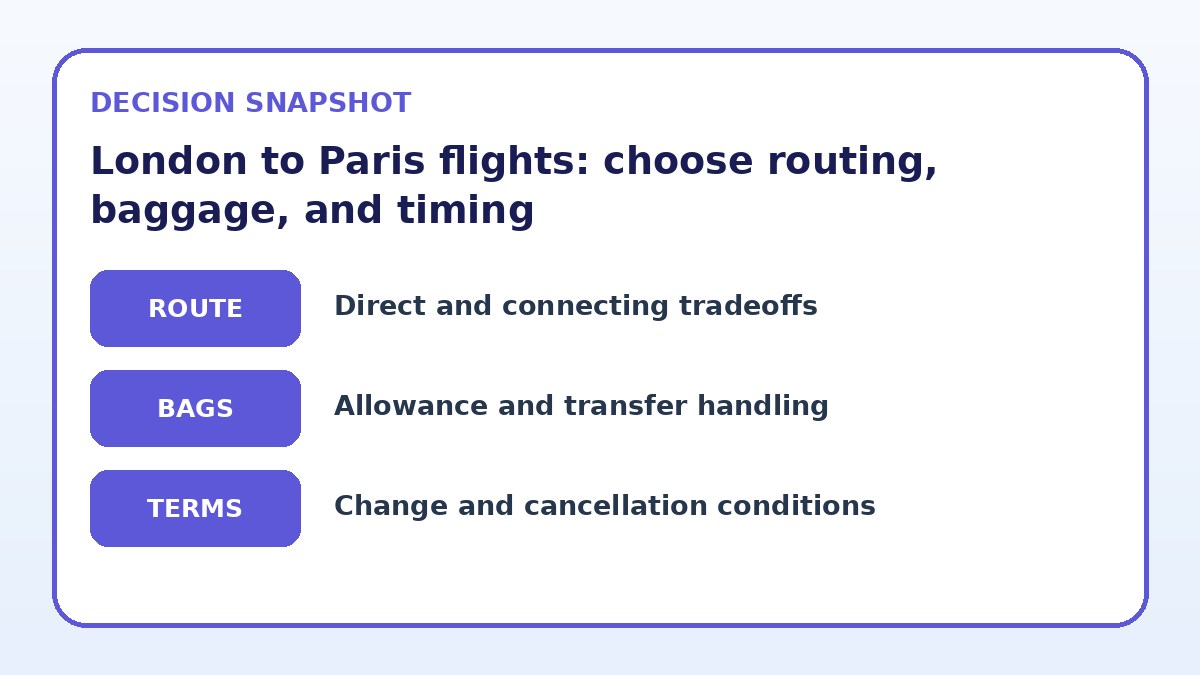
Routing: direct versus connecting and airport choices
On the London to Paris corridor you’ll typically see direct services and some multi-leg routings. Start by listing the airports you can realistically use on both ends — note that multiple London airports and multiple Paris airports exist and they differ in transfer times to city centers. For a first trip, prioritize options that minimize transfers: a direct flight or a single seat on the same ticket reduces the number of steps you must manage on travel day. Put your departure and arrival neighbourhoods into a map app to compare door-to-door time alongside scheduled flight duration.
Connecting flights can be worth considering when direct schedules don’t fit your plans or when a connection yields much better value, but they introduce risk. Check whether connections require changing airports or terminals; inter-airport transfers in either city can add substantial time and cost. If you choose a connection, prefer itineraries with the same operating carrier across legs and one ticket so the airline is responsible for missed connections and through-checked baggage. If tickets are separate, treat the routing as two independent trips and add much larger buffers.
Baggage: allowances, sizes, and where to verify rules
Before you search live inventory, decide precisely what you will carry: number of bags, estimated weight, and whether you have oversized or special items. Fare categories vary widely — some include a checked bag, others only a cabin bag within restrictive size and weight limits. For first-time visitors, buying a fare that explicitly includes at least one checked bag removes a frequent point of stress at boarding gates. When comparing options, read the carrier’s baggage page on the final booking screen and confirm the exact cabin measurements, weight limits, and fees for additional or oversized items.
If you plan to mix carriers or buy separate tickets, don’t assume you’ll be able to transfer a checked bag between two unrelated airlines. Verify on the booking page whether through-checking is supported. Also identify rules for items like musical instruments, sporting equipment, or lithium batteries — these often require advance notice or special handling and may incur additional charges. Keep a digital and printed copy of your baggage allowance and receipts to speed interactions at check-in and at the gate.
Compare flight-selection strategies
| Flight strategy | Best for | Risk to check |
|---|---|---|
| Direct all-in fare (checked bag included) | Travelers prioritizing simplicity and low connection risk | Typically higher headline price but fewer steps and less chance of missed connections |
| Low-cost carrier carry-on only | Solo travelers or light packers aiming to save on fare | Strict cabin limits and possible extra fees if you need to add hold luggage later |
| Connecting itinerary on one ticket | Those needing specific departure or arrival times not offered direct | More complex transfers; choose same-ticket itineraries to reduce personal risk |
| Separate tickets (mix-and-match carriers) | Price-sensitive travelers comfortable building buffer time | Higher transfer risk—no through-checked baggage and less protection for missed connections |
Recheck the complete itinerary
Confirm airports, connection handling, baggage, and change conditions before deciding.
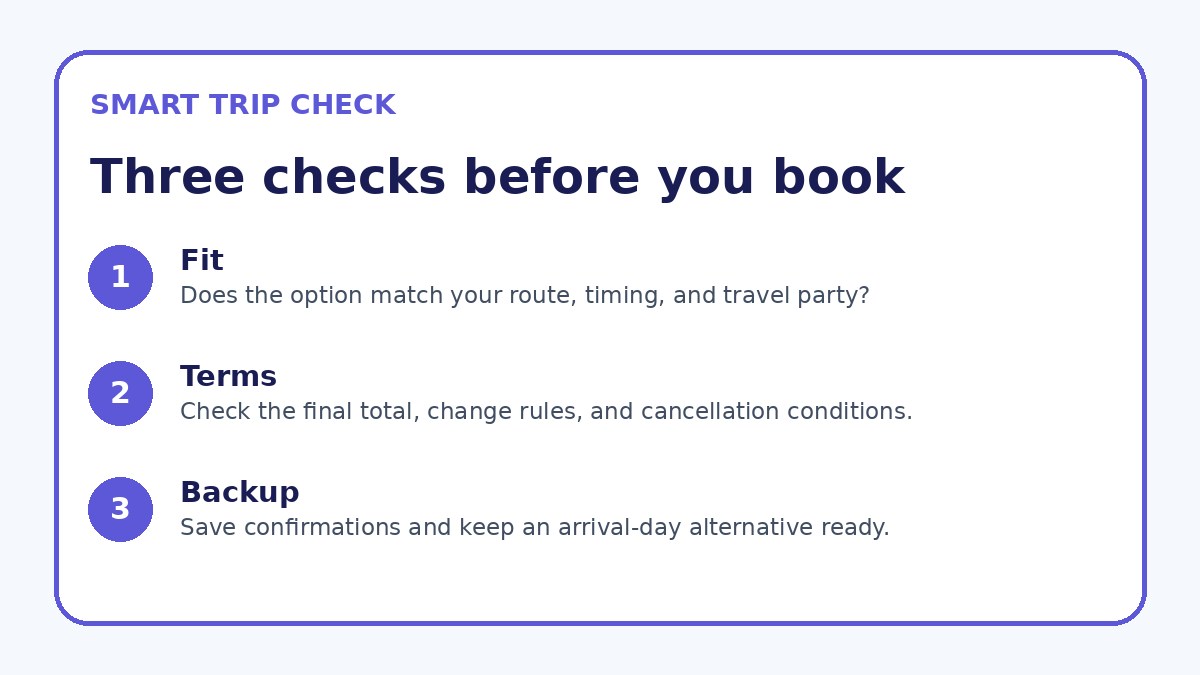
Connection risk and airport-time planning
Calculate airport time the same way pilots and frequent travelers do: break the process into check-in, bag drop, security, possible passport/immigration control, boarding, and transit time to/from city centres. For direct flights, arrive earlier if you have checked luggage or need extra help; if you travel only with a verified cabin bag and have mobile boarding, you can usually arrive later. For connections, base your minimum transfer buffer on whether you must clear immigration, change terminals, or recheck luggage. Public transfer times, peak-hour security queues, and local transport strikes are variables to research on your exact travel dates.
If you’re booking connecting itineraries, choose a plan with clear minimum connection times from the operating carrier and add a personal buffer. A small buffer is fine when all legs are on a single ticket with the same alliance and the airport is compact; add more time for large hubs, different terminals, or if you are unfamiliar with the airports. Document realistic earliest and latest possible arrival times into Paris so you can choose onward ground transport that matches. Cross-check train and ferry alternatives in case a flight delay makes a surface option more practical.
Flight details to verify
- Write down exact travel dates, number of travelers, and ages before searching fares so quotes are accurate.
- Decide whether you need at least one checked bag; if yes, filter for fares that include checked baggage in the base price.
- Check the operating carrier and confirm on the final booking page whether bags are through-checked for connecting itineraries.
- Calculate minimum airport arrival time using your baggage plan and verify terminal details on the airline’s site.
- If booking separate tickets, add at least two hours per domestic transfer and three hours for international connections as a personal buffer.
- Save screenshots or PDF copies of fare rules, baggage allowances, and change/cancellation policies after purchase.
Schedule fit and fare conditions to verify before booking
Before you click buy, prepare exact trip dates, traveler ages, and whether you need changes or refunds. With those details ready, read the fare rules on the booking confirmation page: permitted changes, cancellation penalties, baggage inclusions, and the seat assignment policy. Pay attention to whether the fare is non-refundable, whether name corrections are allowed, and the cost to change dates — these details vary across fare buckets even on the same flight. If seats or baggage are sold separately, add those prices to your total to compare real costs.
Also verify who operates each leg (check the operating carrier) and whether any segments are marketed by one airline but operated by a partner. On the final booking screen confirm layover durations, terminal numbers, and whether the fare provides protection if a connection is missed. If you prefer to compare current options in one place, you may check Trip.com, but always confirm baggage and change/cancellation rules on the airline’s or ticketing agent’s final page before payment.
Flight Guide questions travelers ask
How early should I arrive at the London airport for a direct flight to Paris?
Arrival time depends on your baggage and the airport. If you have checked luggage or need to complete passport control, plan extra time for check-in and security queues. For carry-on-only passengers with online check-in and no additional services, you can arrive later than those with hold luggage, but still allow time for security and gate boarding. Check the airline’s recommended arrival window and the airport’s guidance for international departures on your travel date, then add a personal buffer for unfamiliar procedures.
Can I rely on through-checked baggage when I have a connection between London and Paris?
Through-checking depends on whether your legs are on the same ticket and whether the airlines involved have interline agreements. If both flights are on one ticket with the same carrier or partnering carriers, through-checking is commonly available, but you must confirm on the booking page. If you purchase separate tickets, assume you will need to collect and recheck baggage between flights. Always verify baggage transfer policy on the airline’s final booking confirmation and keep allowances and receipts handy at check-in.
What size of cabin bag is acceptable when comparing low-cost and legacy carriers?
Cabin bag sizes vary by carrier and fare class; some low-cost fares permit only a small personal item, while legacy carriers often allow a larger cabin bag plus a personal item. Measure your bag before booking and compare the carrier’s exact dimensions and weight limits on the booking or baggage page — don’t rely on general guidance. If your bag is close to a limit, check the fee for upgrading to a fare with a cabin bag included or adding hold luggage, then weigh the cost versus convenience.
Final decision note
Planning London to Paris flights for the first time becomes straightforward when you prioritize how much complexity you accept. If minimizing airport time and baggage hassle matters most, favor direct flights with a fare that includes checked baggage and verify terminal details in advance. If cost or schedule flexibility is your priority, allow extra buffer time for connections and confirm baggage transfer rules, especially on separate tickets. Always have exact trip dates and traveler details ready before you compare live offers, and read the final booking page carefully for operating carrier, baggage inclusions, and change rules. With a short checklist and those verifications, you’ll reduce surprises and make your first London–Paris trip far more relaxed.
Continue planning
Check current options and final conditions
Use the provider page to confirm live availability, the final total, cancellation terms, and every condition that matters to your trip.
This evergreen planning guide was created with AI-assisted drafting and a structured quality review. It does not display live prices, schedules, availability, visa guidance, or provider rankings. Verify current details before booking. Some links are affiliate links; we may earn a commission at no additional cost to you.