Practical answer up front: if you have bulky or many bags and prioritize simplicity, a private transfer or taxi is usually the easier option; if you travel light enough to manage your luggage on board and aim to save money, public transit (metro, bus, or shared airport services) can work well. Mexico City’s airport hubs and road traffic mean luggage management matters as much as cost. This article helps you decide by weighing door-to-door convenience, physical effort, reliability under urban traffic, and safety of luggage in each option. You’ll get clear decision criteria, realistic tradeoffs for different traveler types (families, solo travelers with large suitcases, budget travelers, and groups), and a checklist of what to confirm before you book.
See current options before you compare the details
Availability and final conditions change. Open Trip.com now or keep reading for the practical comparison.
Assessing your luggage and mobility needs
Start by inventorying every piece of luggage and who will carry it. Large checked suitcases, fragile cases, and baby gear change the equation: they increase handling time, require space inside a vehicle, and may need careful placement to avoid damage. If anyone in your party has limited mobility, a private transfer removes the need to navigate crowded platforms, stairs, or narrow vehicle doors. Count not just the items but their dimensions and whether bags are wheeled; wheeled suitcases are significantly easier to manage through terminals and into cars than duffel bags or soft backpacks that can be awkward to grip.
Also think about how often you’re willing to handle your luggage along the route. Public transit commonly requires platform changes, short walks between stations, and moving luggage through bus aisles—tasks that are manageable alone but tiring after a long flight. If you must store items temporarily (for example, on an onward flight), factor in time to check or retrieve them. Finally, consider whether you prefer a single handoff—driver to hotel—or multiple small carries. That preference often decides between private and public transfer choices more than cost alone.
Private transfers: convenience and what to verify
Private transfers offer door-to-door service, help with luggage handling, and the convenience of meeting a driver at arrivals. They excel when you need child seats, have oversized items, or want to avoid peak-hour crowds. However, because providers, pickup procedures, and vehicle sizes vary, verify key facts on the booking page before committing. Check the stated vehicle type and its luggage capacity, where the driver will meet you (inside terminal, curbside, or a specific door), if any extra stops are allowed, and the cancellation or amendment policy in case your flight is delayed.
On the day, give your provider a realistic flight status and mobile contact number so they can adjust pickup timing. If you’re booking through a third-party site or an app, confirm whether the quoted price includes tolls, parking, and waiting time; these extras are often added by drivers or platforms. For transfers arranged by hotels, ask the hotel to confirm that the vehicle can accommodate your bags; hotel-arranged vehicles sometimes use smaller cars for standard bookings and need explicit requests for larger vehicles.
| Approach | Best for | Tradeoff to check |
|---|---|---|
| Private transfer or taxi | Travelers with many or large bags, limited mobility, families, or late-night arrivals. | Higher cost but less handling, more predictable door-to-door service, and driver assistance. |
| Airport shuttle or shared ride | Small groups with moderate luggage who want lower cost but some assistance. | Lower per-person cost than private vehicle; may include stops and limits on bulky items. |
| Public bus or metro | Light travelers prioritizing lowest out-of-vehicle cost and who can manage their bags. | Requires lifting and transfers, can be crowded, and may lack elevators at some stations. |
| Combination (taxi to transit hub) | Those balancing cost and convenience—use taxi for first/last mile and public transit for the main leg. | Splits cost and effort; still requires at least one luggage transfer between vehicles. |
Ready to check the option that fits your plan?
Use your exact dates and traveler details so the provider page can show the current total and conditions.
Public transit options and practical tips
Mexico City has multiple public options that can connect you between the airport and the city. When using metro lines, airport buses, or shared shuttles, plan for luggage access, transfer points, and off-peak scheduling. Look up whether elevators and escalators are available at your transfer stations; some stations can be crowded and have limited vertical access. If you have more than one large suitcase, public transit becomes progressively less practical: bus and train aisles can be narrow, and drivers or platform staff won’t be able to help load bags into overhead space the way a driver would with a private vehicle.
Pack efficiently for public travel: use luggage with sturdy wheels, keep valuables and essentials in a carry-on or daypack, and place fragile or odd-shaped items where they won’t impede movement. Time your trip to avoid rush hours if possible, since comfort and space matter when you have extra bags. Finally, learn the layout of the arrival terminal in advance—knowing where ground transportation, shuttle stops, and ticket machines sit can save time and repeated carries through the terminal.
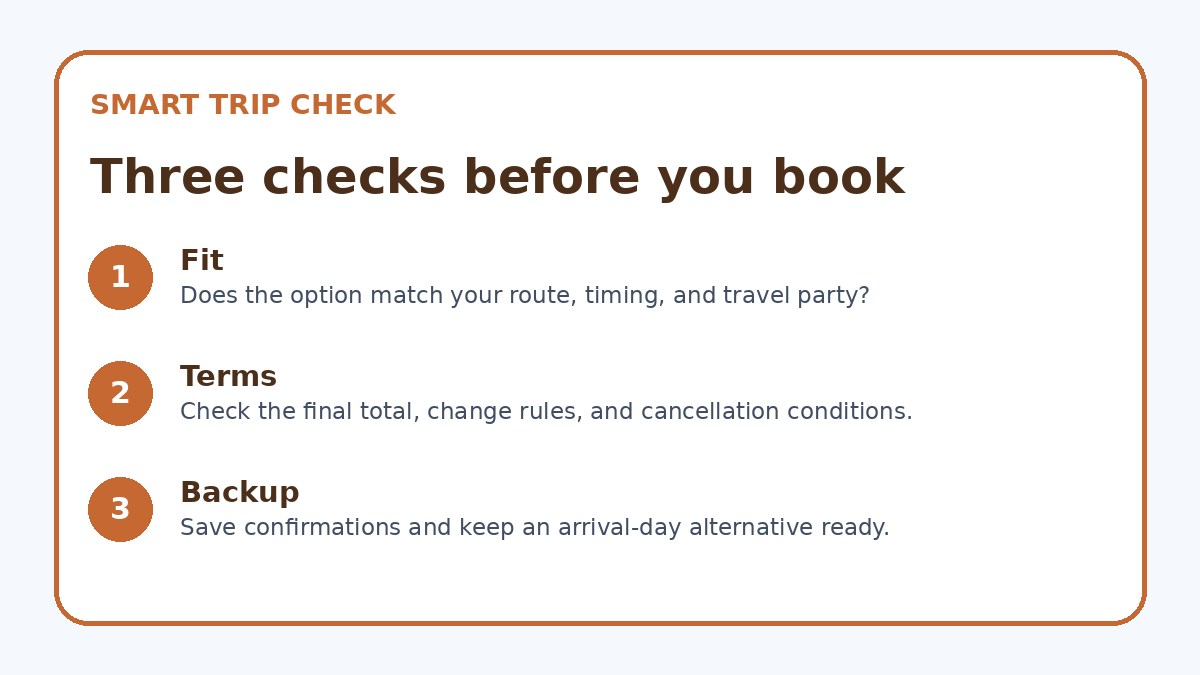
Before you book
- Count your bags and measure largest suitcase dimensions to confirm vehicle luggage capacity or transit practicality.
- If booking private, confirm pickup point, driver contact, allowed waiting time, and any luggage-related limits on the provider’s final booking page.
- If using public transport, map station layouts to verify elevator/escalator access and plan transfers to avoid stairs when possible.
- For groups, compare total per-person cost of a private vehicle versus multiple public fares before choosing.
- Pack a small daypack with essentials and valuables to avoid opening large suitcases during transfers or repeated handling.
- Note your flight status and share up-to-date arrival info with any pre-booked driver or shuttle to avoid missed pickups.
How to decide: cost, time, and stress factors
Compare real costs and hidden tradeoffs, not just headline fares. Calculate total door-to-door time, including waiting for a vehicle, walking with bags, and likely traffic. For private transfers, add potential waiting or meet-and-greet times; for public transit, include station transfers and walking distances. Consider your tolerance for uncertainty—if you are on a tight schedule, the predictability of a private transfer may outweigh a small extra spend. Conversely, budget travelers who can manage their luggage and tolerate transfers will usually come out ahead using public transport, especially if staying near a direct line or bus route.
Also weigh non-monetary costs: stress, physical exertion, and safety of bags during transfers. For example, late-night arrivals might make a private taxi or pre-booked transfer a more attractive option due to fewer public transport options and higher comfort. If you’re comparing options online, validate real-time details on the provider’s booking or operator page—vehicle size, pickup location, luggage allowance, and any time-sensitive policies should be confirmed before purchase.
Frequently asked questions
Is it safe to bring large suitcases on Mexico City public transit?
Public transit in Mexico City is widely used, but safety for luggage depends on the specific service and time of day. During busy periods, crowded platforms and trains increase the risk of jostling and accidental damage; keep valuables on your person and maintain a firm grip on checked items. Look for services with luggage areas or less crowded carriages. If your bags are expensive or fragile, a private transfer reduces risk by keeping luggage within your sight and in a single vehicle.
How do I know if a private transfer car will fit all my bags?
Vehicle sizes and luggage capacities vary between suppliers. Before booking, check the exact vehicle model or class offered and any stated limits on number and size of suitcases on the provider’s booking page. If sizes aren’t listed, contact the operator directly and describe your luggage (number, approximate dimensions). For oversized or unusually shaped items, request a larger vehicle class explicitly; don’t assume a standard sedan will fit multiple large suitcases.
Are shared airport shuttles a good compromise for extra luggage?
Shared shuttles can balance cost and convenience: they often load luggage for you and cost less per person than a private car. The tradeoff is possible extra stops and a fixed routing that may not be door-to-door. Confirm on the shuttle’s page whether oversized items are accepted and whether stops are direct or require short walks. If you have many suitcases or tight timing, a private transfer may still be preferable despite the higher fare.
Final planning note
Choosing between public and private transport for a Mexico City airport transfer comes down to a candid assessment of your luggage, timeline, budget, and physical comfort. If your bags are bulky, numerous, fragile, or you’re traveling with small children or limited mobility, a private transfer or taxi reduces handling and uncertainty. If you travel light, enjoy planning, and want to save money, public transit or a shared shuttle can work well—just map transfers and accessibility in advance. Whatever you pick, verify vehicle size, pickup details, luggage rules, and any timing conditions on the provider’s final booking page before confirming. For a quick comparison of current options, you can check listings on Trip.com as one place to view availability and booking terms.
Continue planning
Check current options and final conditions
Use the provider page to confirm live availability, the final total, cancellation terms, and every condition that matters to your trip.
This evergreen planning guide was created with AI-assisted drafting and a structured quality review. It does not display live prices, schedules, availability, visa guidance, or provider rankings. Verify current details before booking. Some links are affiliate links; we may earn a commission at no additional cost to you.