If you’re weighing London car rental for your first visit, decide first whether driving actually improves your trip. For most short stays in central London the hassle of parking, congestion zones, and low-emission rules often outweighs the flexibility of a car; but if your plan includes day trips to the Cotswolds, countryside estates, or a multi-stop route through southern England, a car can be decisive. This guide gives the practical answer up front: choose airport pickup when you need to drive out of the city immediately and want fewer transfer steps; choose city pickup when you plan to stay inside London longer, prefer public transport on arrival, and want to avoid airport surcharges and longer initial drives. Below are clear tradeoffs, insurance points to check, pickup and return friction, and a non-driving fallback that keeps your itinerary flexible.

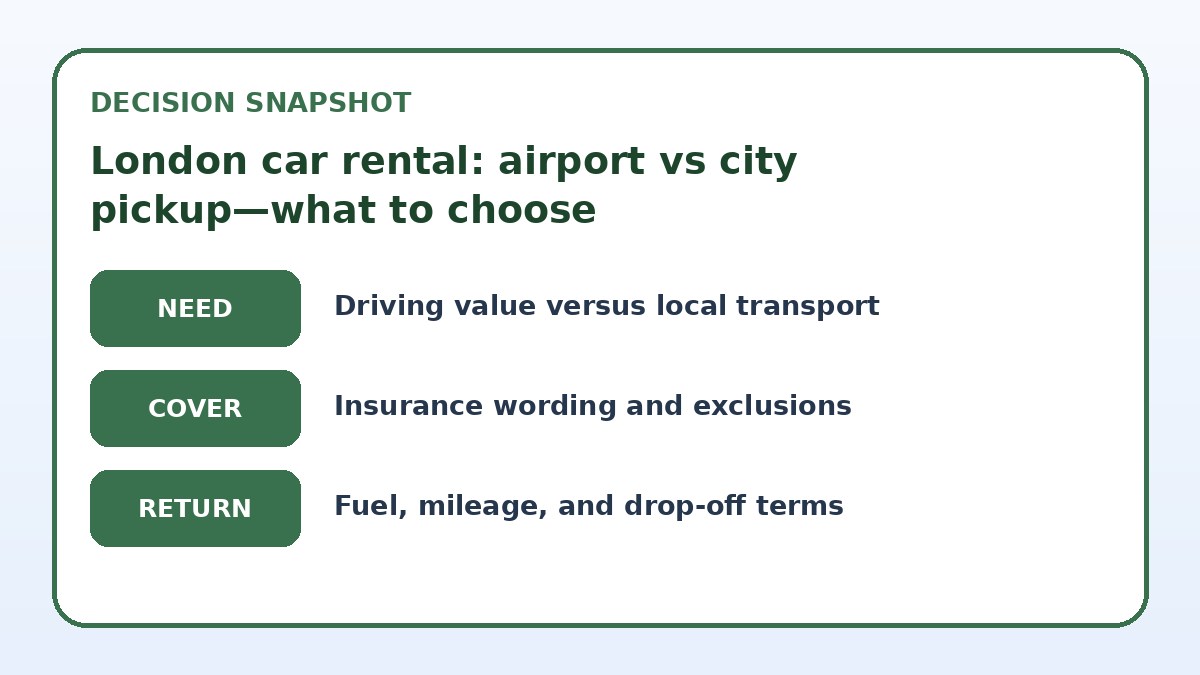
Route value: when a car truly helps your London trip
Ask whether a car changes what you can do. If your core plans are museums, West End shows, markets, and neighborhoods inside the M25, public transport plus occasional taxis usually wins: trains, the Tube, buses and walking are faster and cheaper than dealing with parking and low-emission requirements. Conversely, if your trip includes the Peak District, coastal escapes, or multiple dispersed attractions outside Greater London, a car unlocks routes and rural villages that are slow or poorly served by public transit. Think route-to-value: calculate door-to-door travel time and the number of places you could realistically visit by car versus rail or coach in the same schedule.
Also consider how much driving you want to do. UK roads outside cities are pleasant and often scenic, but they require concentration on narrow lanes, different roundabout conventions, and frequent speed changes. If you prefer relaxed days with few hours at the wheel, structure one or two long drives from a central base instead of daily city exits. Finally, route value depends on season and daylight; some rural lanes are less comfortable to navigate after dark. If your itinerary depends on daylight or a single long outbound leg, airport pickup becomes more attractive because it eliminates an extra urban transfer with luggage.
Decide whether driving earns its place
| Mobility strategy | Best for | Cost or friction to check |
|---|---|---|
| Airport pickup and drive out immediately | Travelers starting with a long outbound drive who want to maximize driving time and minimize extra transfers. | May incur airport fees, longer initial motorway navigation, and possible desk queues or shuttle waits. |
| City pickup after public-transport arrival | Visitors staying several nights in central London who prefer to use public transport on arrival and avoid airport surcharges. | Requires a transfer from the airport to the city and may have limited branch hours or constrained parking for returns. |
| One-way rental (airport to city or city to airport) | Flexible itineraries where starting and finishing locations differ, saving backtracking time. | Often attracts one-way fees and requires confirming drop-off availability and opening hours in advance. |
| No rental: rail, coach and local taxis only | Visitors focused on London’s central attractions or those who prefer avoiding parking and emission-zone complications. | Limits access to remote rural sites and may require more planning for multi-stop countryside routes. |
Check live rental choices only after the route test
Use the exact driver, dates, pickup point, and return plan to compare current conditions.
Insurance and coverage: exact wording you must check
Insurance details materially affect cost and risk. On the rental company’s final booking page, check the excess amount, whether Collision Damage Waiver (CDW) is included or optional, and whether Theft Protection covers your type of vehicle and parking circumstances. Look for explicit language about windscreens, tyres and undercarriage: these are often excluded and can lead to surprise fees. If you rely on a credit-card insurance benefit, verify the insurer’s list of covered rental providers and the precise claim requirements; banks and card issuers usually list conditions and documentation you must produce after an incident.
Also confirm cross-border permissions, driver age limits, and any restrictions on where you can drive (for example, Northern Ireland or parts of mainland Europe). Airport pickups sometimes include optional cover bundles sold at the desk; these can be convenient but vary in price and terms. Don’t accept verbal assurances—download and save the final policy wording or take a screenshot of the insurer’s page. If you need third-party supplemental cover, compare it against the rental company’s excess to ensure you’re not overlapping protections unnecessarily.

Compare the full rental conditions
Confirm insurance wording, exclusions, deposit, fuel, mileage, and return terms on the final page.
Pickup and return friction: practical steps to save time
Airport pickup often prioritizes convenience for immediate road departures: there may be consolidated rental hubs or dedicated transfer shuttles from terminals, but expect queues at busy times and possible shuttle waits depending on the airport layout. Airports can add fees—airport or concession charges—and the first miles usually involve motorway navigation and unfamiliar exits. If your flight arrives late, confirm whether the rental desk runs late-night service and what the after-hours pickup process is. Always check the provider’s exact instructions for after-hours collection on the booking confirmation page so you’re not left waiting at the curb.
City pickup reduces airport friction but comes with its own logistics: you’ll need to transfer from the airport by public transport or taxi to the city branch, which could be nearer your hotel. City branches may have tighter street access, limited parking for returning the car, and different opening hours—some close earlier than airport desks. For returns, check whether the city location accepts one-way drops if your departure is from a different airport; one-way fees can be significant. Regardless of pickup point, photograph the vehicle on collection and note fuel, mileage and existing damage on the rental record to avoid disputes at return.
Car rental terms to verify
- Compare door-to-door travel time for each major day in your itinerary to see where a car saves time.
- On the rental booking page, confirm excess amounts, CDW terms, and what is explicitly excluded from coverage.
- Check pickup and return hours for both airport and city branches and the process for after-hours collection.
- Look up congestion zone, low-emission zone, and any local charges that apply to your planned driving area.
- Photograph the vehicle’s condition on collection and get the rental agent to note existing damage on the agreement.
- If undecided, book a cancellable reservation or a short rental window to test driving before committing to long hires.
Non-driving fallback: plan B that keeps your itinerary intact
Design a fallback that lets you cancel or alter the car plan without wrecking your trip. For first-time visitors especially, keep public transport options open by learning mainline rail routes from London to your likely day-trip targets and noting coach services for farther destinations. Many destinations outside London are reachable by an efficient combination of rail and regional buses; book flexible or refundable rail tickets if your plans may change. If you reserve later, choose pickup options with a reasonable free-cancellation window so you can switch to rail if driving proves unnecessary or inconvenient.
Also incorporate easy local transfers: know the costs and timings of taxis or app-based ride services for the first 24 hours in case you decide against an immediate pickup. If your hotel is centrally located, consider holding a city-branch reservation you can activate only after you’ve assessed local traffic, parking availability, and whether a rental genuinely adds value. Keep an eye on live transit options using an app or the provider’s pages—Trip.com can be a quick place to compare current availability—but always verify schedules and booking conditions on the operator’s official page before purchase.
Car Rental & Road Trip questions travelers ask
Will renting a car in London save me time compared with public transport?
It depends on your itinerary. For central London activities—museums, theatres and neighborhood wandering—public transport is usually faster and removes parking hassle. If your trip consists of day trips into the countryside or a route connecting towns with limited rail links, a car will often save door-to-door time. To decide, map the locations you want to visit, estimate public-transport durations using official timetables, and compare them to driving times including likely parking and congestion delays. That comparison gives a practical, trip-specific answer.
What insurance points should I verify before I book a London car rental?
Verify the excess amount, whether Collision Damage Waiver and Theft Protection are included or optional, and the exact wording for parts commonly excluded such as tyres, windscreens and undercarriage. If you plan to use credit-card insurance, check the issuer’s list of covered rental companies and claim requirements. Also confirm driver age limits, additional driver fees, and any geographic restrictions. Always save or screenshot the final rental policy wording and the insurer’s terms from the provider’s booking page to avoid misunderstandings later.
How do airport and city pickups differ for returns and one-way rentals?
Airport desks often stay open later and are set up for arrivals, but may charge airport or concession fees and require shuttle transfer; city branches can be closer to your hotel but may have shorter opening hours and limited drop-off options. One-way rentals are useful for finishing at a different airport or city branch, yet they can carry extra charges and require advance confirmation of drop-off acceptance. Before booking, check the rental company’s final confirmation for one-way availability, exact return instructions, and any additional fees tied to your chosen locations.
Final decision note
For first-time visitors, the practical rule is: don’t rent a car by default—choose it because your planned route truly needs wheels. Pick airport pickup when your trip starts with a significant outbound drive and you want to eliminate an extra transfer; pick city pickup when you’ll spend several days in London and prefer to arrive by public transport. Always verify insurance wording, cross-border permissions, opening hours and local charging zones on the rental provider’s final booking page before you finalize anything. Keep a flexible fallback using rail and regional coaches so you can switch strategies without losing time or money.
Continue planning
Check current options and final conditions
Use the provider page to confirm live availability, the final total, cancellation terms, and every condition that matters to your trip.
This evergreen planning guide was created with AI-assisted drafting and a structured quality review. It does not display live prices, schedules, availability, visa guidance, or provider rankings. Verify current details before booking. Some links are affiliate links; we may earn a commission at no additional cost to you.