If you’re carrying large suitcases, sports gear, or multiple bags, the most practical choice from Osaka to Kyoto is the option that minimizes handling, transfers and time spent hauling luggage between terminals and stations. For most travelers that means prioritizing door-to-door simplicity: a direct private transfer or a single-transfer rail journey that allows reserved luggage space and easy access to the stations’ exits. But budget, flexibility, and timing change the calculus — coaches can reduce cost and luggage hassle, while some trains offer reserved compartments and elevator access that make rail surprisingly smooth. Below I give a clear recommendation up front, then step through how to compare terminal fit, luggage friction, timing flexibility, and a disruption backup so you can pick the option that works best for your group and baggage.
Terminal fit: where you start and finish matters
Start by mapping exact pick-up and drop-off points. Stations in Osaka (like central city stations) and Kyoto’s main terminals have different layouts, elevator access, and pedestrian flows that determine how easy it is to move heavy bags. A transfer that drops you at a hotel entrance or literally at a station exit is far easier than one that leaves you at a distant bus bay requiring a long walk, stairs, or a short local connection. For rail, check which platform entrances link directly to elevators and which require moving between levels; for road transfers, confirm driveway access and luggage-friendly curbside service.
Match your luggage profile to the terminal infrastructure: if you have oversized bags or multiple suitcases, seek options that explicitly offer curbside luggage assistance or allow loading into a vehicle’s trunk. If your Kyoto accommodation is in an area with narrow streets or limited vehicle access, a rail option that stops at a nearby station may be more practical than a private car that must park and transfer bags by hand. Always verify elevator and escalator availability at arrival and departure points on the provider’s final booking page or local station maps.
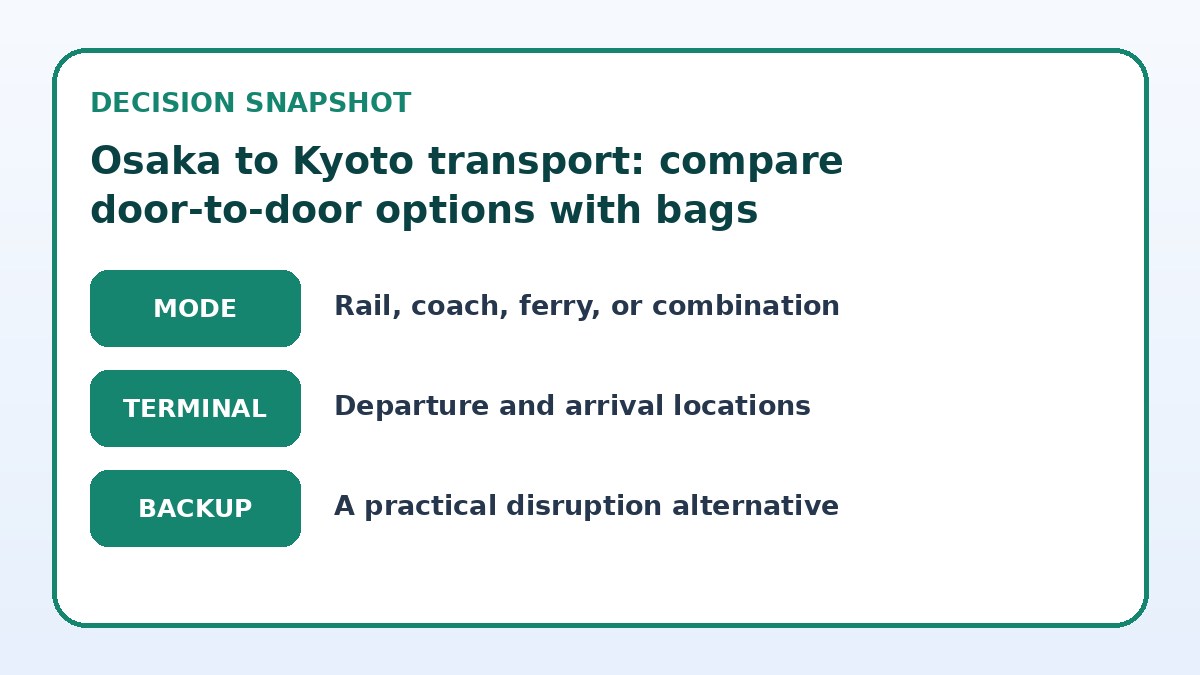
Choose the end-to-end journey plan
| Journey approach | Best for | Friction to check |
|---|---|---|
| Private door-to-door transfer | Travelers with many or oversized bags and minimal mobility who want single-move handling | Higher cost and potential traffic delays compared with rail or coach |
| Single-transfer rail trip with reserved seats | Those who want a balance of speed, station access, and fewer baggage touches | Requires planning for platform access and verifying luggage space on the train |
| Intercity coach with underfloor baggage | Budget-conscious travelers wanting to avoid carrying bags on/off platforms | Less frequent departures and possible further walking from stops to final address |
| Hybrid: taxi to station + reserved train | Travelers who need last-mile convenience but prefer rail for the main leg | Involves coordinating two providers and one extra luggage transfer between vehicle and train |
Check live intercity options
Look beyond the ride itself and compare terminals, transfers, luggage, and arrival fit.
Luggage and transfer friction: minimize touches
Count the number of times your baggage will be handled between door and door. Each transfer — staircase, platform, taxi, or bus bay — adds friction. A direct private car keeps baggage handling to a minimum, while public options can vary: some trains allow reserved luggage spots on board or larger luggage areas near car ends, whereas local commuter trains may have limited room and require carrying bags on and off multiple times. For coaches, most use underfloor storage where you load once, but you must handle suitcases at coach stops and potentially walk further at each terminal.
Think about physical challenges too: if you’re traveling with children, mobility concerns, or heavy cases, choose options with elevator access and minimal platform changes. If reserving trains, look on the booking page for information about reserved luggage spaces, carriage types, or the ability to pre-book seat rows near doorways. If the operator’s site lacks detail, contact them or check the station’s official accessibility guides. Planning these small points ahead prevents last-minute lifting and long corridor hauls.
Timing flexibility: schedules, peak hours, and plan B
Decide how strict your schedule is. If you must arrive at a specific time, a private transfer gives reliable door-to-door arrival windows (subject to traffic) and removes the need to align with train or coach timetables. Public transport can be predictable in off-peak hours but may become crowded during rush hours, making luggage awkward. When using rail, pick services with frequent departures so a missed train won’t force long waits with baggage; if you prefer coach, note that some services run less frequently and a missed connection can add significant delay.
Build slack into your itinerary. Allow extra time for check-out, luggage collection, and station navigation, especially when changing from suburban subway lines to intercity services. If you’re booking refundable or changeable train tickets, confirm the provider’s rebooking policy on the final booking page. For time-critical transfers, identify an easily reachable taxi rank at the origin and destination as your immediate backup — taxis can solve tight timing problems when public options fail.
Compare the practical alternatives
Use the final page to confirm what is actually offered on your dates and save a workable fallback.
Intercity travel checklist
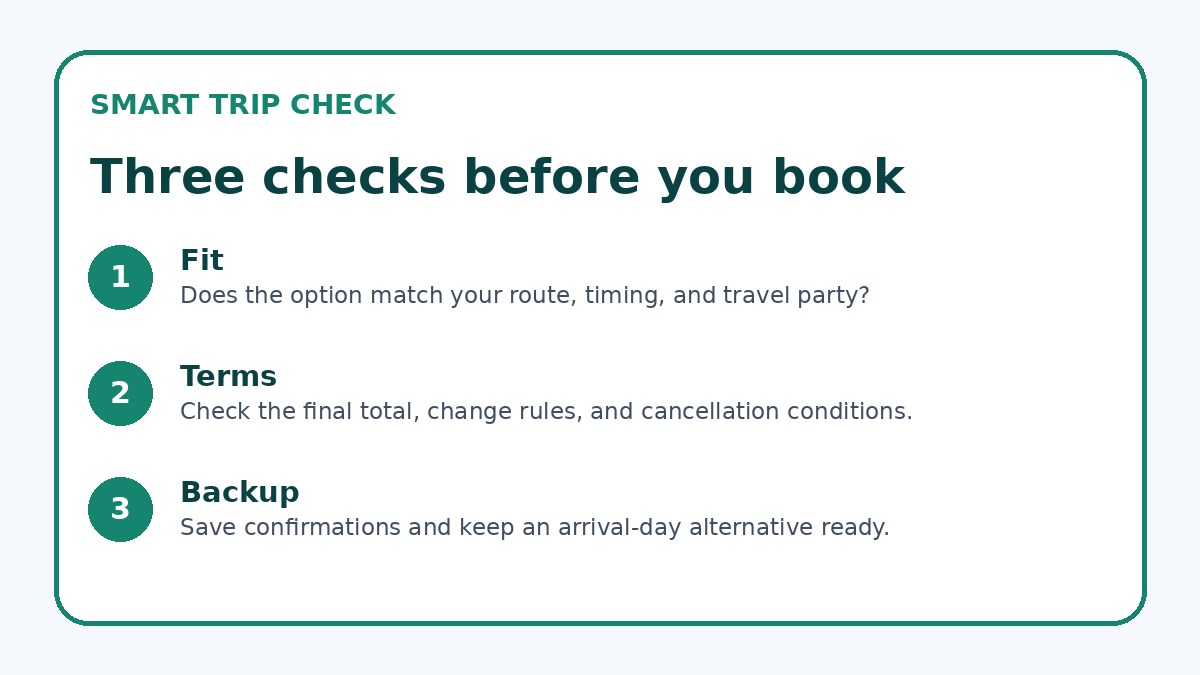
- Check exact pick-up and drop-off points for your chosen option and confirm elevator or curbside access on the provider’s final booking page.
- Count suitcases and measure oversized items; confirm the chosen service’s luggage allowances and whether reservations are required for large items.
- If taking rail, reserve seats near carriage doors or luggage spaces and note platform access between levels at both stations.
- If using a private transfer, provide clear address details and photos of your accommodation entrance so the driver can find a curbside spot.
- Plan at least 60 minutes of buffer time for unexpected delays and identify the next two alternative departures or taxi ranks.
- Save contact numbers for your operator, local taxi companies, and your accommodation; keep digital confirmations accessible offline.
Disruption backup: what to do if plans change
Prepare at least one practical backup plan. If your chosen train is delayed, know the next few departures and whether they are more suitable for luggage handling. Keep the contact number of a reliable local taxi or private transfer service, and know approximate pick-up points. If you booked a coach, find out whether the operator allows rebooking on another departure and where the nearest alternative stops are. If weather or rail disruptions are common during your travel window, consider a higher-flex private option or start earlier to absorb potential delays.
When a disruption happens, act quickly: prioritize moving your bags to a safe, sheltered area and confirm your new route before changing modes. If you need to switch from rail to road, look for nearby large taxis or minivan services that can handle multiple cases. Keep digital copies of reservation confirmations and local contact numbers offline, and use a mapping app to identify the shortest walking path between alternate terminals. Being able to pivot smoothly is as important as your primary booking for low-stress luggage travel.
Rail & Intercity Transport questions travelers ask
Is taking the train from Osaka to Kyoto practical with large suitcases?
Yes—many travelers use trains successfully with large suitcases, but practicality depends on the train type and station layout. Look for intercity services that allow reserved seats and have luggage areas near car ends; avoid peak commuter trains where space is limited. Verify elevator access at both your origin and destination stations and check the provider’s booking page or station map for carriage layouts. If you expect difficulty carrying bags up or down stairs, consider a private transfer or a coach with underfloor baggage storage.
How do I choose between a private transfer and a coach when I have a lot of luggage?
Decide what you value most: a private transfer minimizes handling because bags stay in one vehicle and you get door-to-door service, while a coach often provides secure underfloor storage and is usually cost-effective. Compare the distance from drop-off points to your accommodation — coaches might stop further away and add a short walk. Confirm whether the operator assists with loading and unloading, and check traffic patterns at your travel time since road congestion can affect private transfers.
What should I verify on a provider’s final booking page before I book?
Always verify luggage policies (dimensions, weight, and extra-item rules), exact pick-up/drop-off addresses, accessibility features like elevators or ramps, seat reservation options, and rebooking or cancellation conditions. For trains, look for carriage layouts and whether luggage must be stored in specific areas; for private transfers, confirm vehicle size and any curbside assistance. If the booking page lacks detail, contact the provider directly and keep a screenshot of the confirmed terms.
Final decision note
Choosing the most practical way to travel from Osaka to Kyoto with extra luggage comes down to minimizing transfers and matching terminal access to your baggage needs. Private transfers offer the simplest door-to-door solution for heavy or numerous bags, while a well-planned rail journey with reserved seating and station elevator access balances speed and convenience. Coaches are useful when you want to avoid platform lifts and prefer loading once. Whatever you pick, verify luggage rules, confirm exact pick-up and drop-off points, and plan at least one realistic backup to keep your trip calm and manageable.
Continue planning
Check current options and final conditions
Use the provider page to confirm live availability, the final total, cancellation terms, and every condition that matters to your trip.
This evergreen planning guide was created with AI-assisted drafting and a structured quality review. It does not display live prices, schedules, availability, visa guidance, or provider rankings. Verify current details before booking. Some links are affiliate links; we may earn a commission at no additional cost to you.