If you need to move business luggage between Vancouver and Seattle, pick the option that reduces transfers and handling. For most business travelers carrying a suitcase and a carry-on, priority should be on terminal fit (where you start and finish), luggage friction (how many times bags are moved), and time predictability. Rail or coach that boards at central city terminals can limit transfers; ferries or cross-border car options may be useful when door-to-door pickup or flexible departure times matter. This article gives a practical decision path: how to assess terminal locations, how much luggage each mode tolerates, what to expect at cross-border points, and quick contingency plans for disruptions. It focuses on end-to-end practicality—getting you and your luggage from your Vancouver door to your Seattle destination—so you can choose the smoothest, most reliable approach for a business trip.
How to choose between rail, coach, ferry, or car
Start by mapping door-to-door time, not just in-vehicle time. Trains and intercity coaches usually use central stations, which can be ideal if your meetings are downtown; that reduces the number of last-mile transfers and can let you wheel luggage straight into an office or hotel. Ferries and private car options often require traveling to a terminal or pier that may be further from downtown cores but can be helpful if you need a vehicle at the other end or want to avoid multiple transfers.
Compare not only the advertised ride duration but how many times you must handle luggage. A direct rail or coach that loads luggage at a single terminal and unloads near your final address typically wins for luggage ease. If a ferry or driving option removes the need for public-transit connections, it could be preferable despite a longer on-water segment. Base your decision on where you start and finish in Vancouver and Seattle, and how many handoffs you and your bags can tolerate.
Choose the end-to-end journey plan
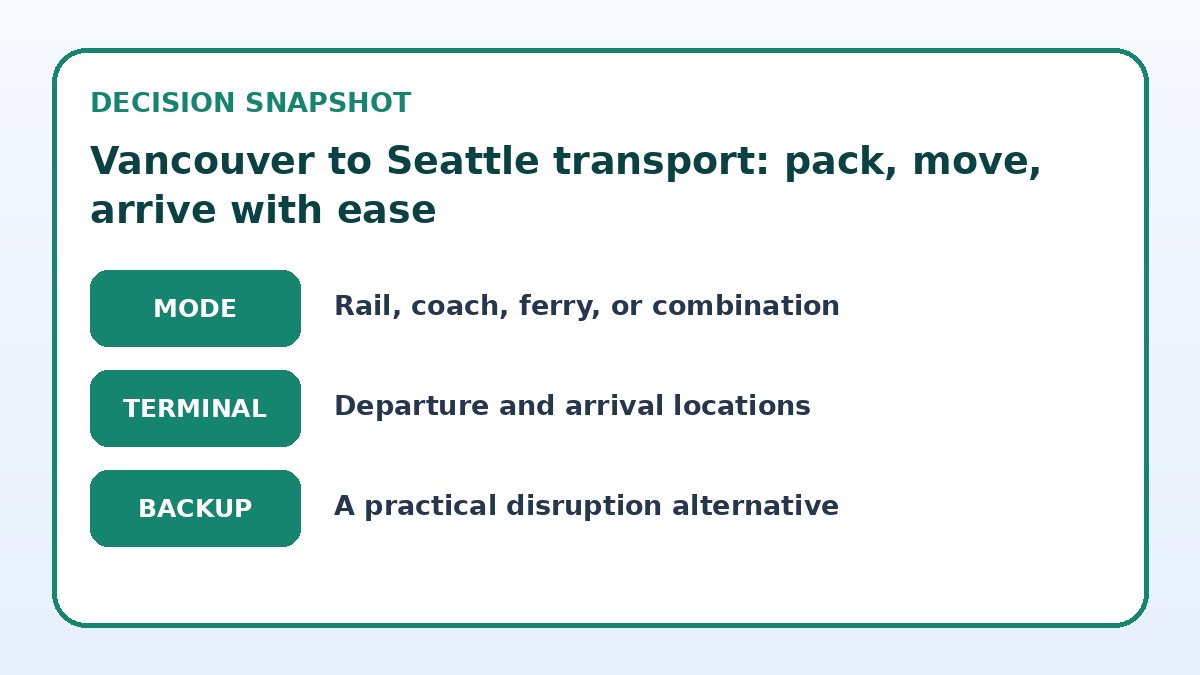
| Journey approach | Best for | Friction to check |
|---|---|---|
| Central rail or intercity coach | Minimal transfers and easy downtown drop-offs for standard business luggage. | May require advance booking and can have limited off-peak services or platform stairs at some stations. |
| Private car or rideshare door-to-door | Maximum door-to-door convenience and control over luggage handling. | Potentially higher cost and subject to border delay impact on driver turnaround or waiting rules. |
| Ferry combined with ground transfer | When vehicle access at both ends is needed or for larger/awkward items that fit in a car. | Requires more planning for terminal access and likely extra transfers from ferry terminals to downtown. |
| Mixed-mode with courier for checked items | Travelers who need hands-free mobility for meetings and separate, secure shipment of bulky items. | Additional coordination and lead time to arrange pickup/delivery and extra cost for courier service. |
Check live intercity options
Look beyond the ride itself and compare terminals, transfers, luggage, and arrival fit.
Terminal fit and luggage handling realities
Examine departure and arrival points for elevator access, curbside loading, and distance to taxi or rideshare pickup. Central rail stations and major coach terminals usually have level boarding or short ramps and staff who assist with bulky bags, but their platforms and ticketing areas vary by operator. If you’re relying on a hotel transfer or a rideshare, confirm curb access and any rules about waiting or short-term loading zones to avoid carrying heavy cases across long sidewalks or stairs.
If a service requires a short shuttle or transfer between an airport, pier, or station and the final terminal, factor that handling into your plan. Ask whether luggage is stowed under a coach, carried into a rail baggage car, or stayed with you in the passenger cabin; those differences determine whether checked pieces may be difficult to retrieve quickly during a tight meeting schedule. When in doubt, assume you’ll be responsible for moving your luggage between vehicles unless the operator explicitly offers through-checked or assisted handling.
Timing flexibility and scheduling for business needs
Business travel requires predictability. Favor services with multiple daily departures from convenient terminals so you can shift departure times if a meeting runs long or if you need buffers for border processing. Rail and coach corridors often offer more frequent midday and evening options; ferries and private car services may have set sail or pickup times that need stricter planning. Look at realistic door-to-door windows, including transfer time, rather than just the advertised transit time.
If your schedule is tight, plan to travel on earlier departures to build a buffer against delays. Account for check-in, any baggage drop or security steps, and border checks. For same-day return trips, choose carriers or routes that minimize time spent re-clearing customs or switching modes. Consider splitting a longer transit into two simpler segments—for instance, city-to-border then short onward transfer—to reduce late surprises and keep luggage handling manageable.
Compare the practical alternatives
Use the final page to confirm what is actually offered on your dates and save a workable fallback.
Intercity travel checklist
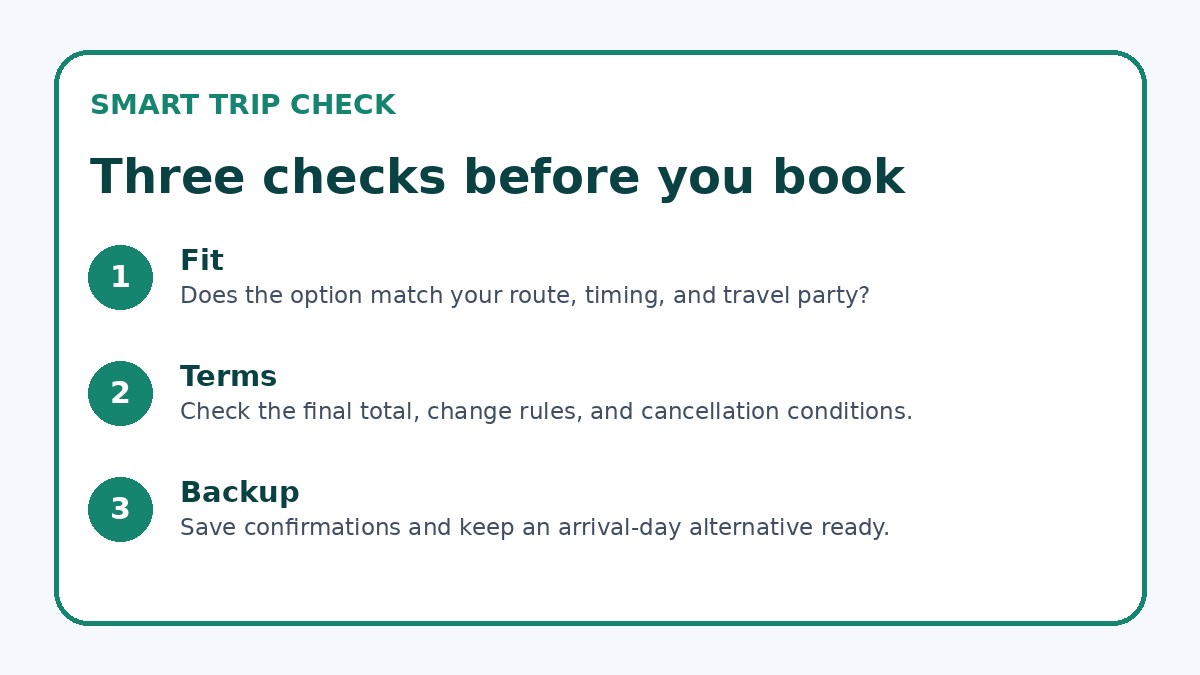
- Confirm your departure and arrival terminal addresses and measure door-to-door distance to hotels or meeting venues.
- Verify the operator’s luggage policy on the final booking page: size limits, number of free items, and handling procedures.
- Allow extra time for border/immigration processing; plan at least one alternative departure in case of delays.
- Pack an essentials bag with documents, charger, and a change of clothes to carry on your person during transit.
- Identify a local storage or courier service near arrival in Seattle to forward bulky baggage if needed.
- Take photos of checked items and keep serial numbers and receipts in a digital folder accessible during your trip.
Disruption backups and minimizing luggage risk
Have a clear backup plan: a second-day ticket option, an alternate route with fewer transfers, or a courier for urgent materials. For critical documents or expensive equipment, carry them as your personal item on-board rather than in checked luggage. If you must check items, photograph contents and the bag’s identifying features, keep serial numbers handy, and have a receipt for any checked baggage claim.
Also identify local services that can store or forward luggage if your arrival or meeting schedule changes. Hotel concierge hold, luggage storage at major stations, or a same-day courier can rescue an itinerary if you get delayed crossing the border. Always verify luggage policies and any limits on size, weight, or prohibited items on the operator’s final booking page so you’re not surprised at check-in.
Rail & Intercity Transport questions travelers ask
Can I rely on trains or coaches to handle large checked suitcases between Vancouver and Seattle?
Many intercity coaches and some trains accommodate large suitcases, but handling rules vary by operator. Confirm whether luggage is stored undercarriage, in a checked hold, or in the cabin with you by reading the operator’s luggage policy on their booking page. If a through-checked option exists, verify whether you need to tag items at departure and where to collect them at arrival. For delicate or high-value items, consider carrying them with you or using a dedicated courier to avoid multiple handoffs.
How should I plan for customs and border checks when traveling with business luggage?
Treat customs and immigration as the most unpredictable section of a cross-border journey. Build buffers into your schedule and have all necessary documents accessible—passport, work permits if applicable, and itemized lists for any equipment or samples. Check whether the transport provider offers pre-clearance or whether you must clear at a specific checkpoint; verify these details on the provider’s official booking resources. For commercial samples or technology, prepare any paperwork a customs officer may request to prevent hold-ups.
Is it better to ship heavy or bulky items ahead instead of bringing them on the trip?
Shipping bulky items ahead can reduce transfer friction and let you travel lighter, but it adds lead time and requires reliable pickup/delivery coordination. Use a reputable courier that provides tracking and proof-of-delivery, and schedule delivery to a secure address—your hotel or a workplace—only after confirming they accept packages. Always verify the courier’s cross-border customs handling and whether duties or paperwork apply; check the courier’s booking page for current policies before committing to ship.
Final decision note
For business travelers between Vancouver and Seattle, the right choice balances terminal convenience, the number of luggage handoffs, and schedule predictability. Central rail or coach services tend to reduce transfers if you’re headed downtown, while private car options maximize door-to-door control. Ferries work well when you need vehicle access, and using a courier to forward bulky items separates luggage logistics from your meeting schedule. Before booking, confirm luggage rules and terminal details on the provider’s final booking page, allow time for border processing, and prepare a backup plan to keep your trip and your luggage on schedule.
Continue planning
Check current options and final conditions
Use the provider page to confirm live availability, the final total, cancellation terms, and every condition that matters to your trip.
This evergreen planning guide was created with AI-assisted drafting and a structured quality review. It does not display live prices, schedules, availability, visa guidance, or provider rankings. Verify current details before booking. Some links are affiliate links; we may earn a commission at no additional cost to you.