
If you’re traveling from Sydney to Melbourne for work and carrying one or more pieces of luggage, the practical choice depends on how much you need to take, how important speed and reliability are, and whether you want to avoid transfers. For most business travellers, flying is fastest and easiest for short city-to-city journeys, but trains and cars can be better when you need to move larger cases, avoid security queues, or work en route. This guide gives a clear decision path: compare door-to-door time, luggage allowances and handling, and how each option fits a packed business schedule. It also explains tradeoffs—comfort, flexibility, check-in hassle—and what exactly to confirm on a provider’s booking page before you commit.
See current options before you compare the details
Availability and final conditions change. Open Trip.com now or keep reading for the practical comparison.
Compare travel modes by luggage realities
Start by listing exactly what you’ll take: number of cases, typical dimensions, any fragile or valuable items, and whether you need quick access to work materials during transit. Flights typically allow one carry-on and one checked bag on many journey types, but rules vary by fare type, route, and carrier. Trains often provide fewer formal limits and more space to store luggage near your seat, though individual services sometimes have size or quantity recommendations. Driving gives the most flexibility for bulky items but adds the responsibility of packing, loading, and parking at both ends.
Think about handling risk and convenience. Checked airline luggage is loaded and unloaded by staff, which is efficient but introduces handling-related loss or delay possibilities; trains and private cars keep your luggage within reach. If your itinerary includes multiple hops—trains plus taxis or flights with connections—count each transfer as an extra handover where delays or misplacement can happen. For valuable or fragile equipment, aim for a single handover path or keep the item as carry-on whenever practical.
Timing, work time and productivity tradeoffs
Business travelers value predictable arrival times and the ability to work en route. Flying typically reduces travel hours between city centres if you have quick transit to and from airports, but factor in check-in, security, and recommended arrival windows. Train services often provide a more relaxed environment for focused work: plug sockets, tables, and more stable space to open a laptop while your luggage sits beside or above you. Driving can be unreliable in peak traffic and prevents you from working if you are the driver, although hiring a car with a driver preserves productivity at the cost of expense.
Decide how much raw travel time you can tolerate versus how much productive time you need. If a tight morning meeting requires you to be fresh and present on arrival, faster transit may beat having extra work time onboard. Conversely, if you need several uninterrupted hours to prepare or deliver remote work, the train’s onboard environment or a chauffeured transfer that lets you work en route could be superior. Balance travel predictability, the physical effort of handling luggage, and your need for secure working conditions.
| Approach | Best for | Tradeoff to check |
|---|---|---|
| Fly with carry-on only | Short overnight trips needing speed and minimal luggage | Strict size limits and risk of gate-checked items if carry-on is oversized |
| Fly with checked baggage | Travellers needing extra wardrobe or heavier equipment | Extra handling and potential delays at baggage claim |
| Intercity train | Those who want workspace and easier on-board luggage access | Schedules and seat reservations may limit flexibility |
| Drive or chauffeur service | Groups, bulky equipment, or door-to-door convenience | Road traffic unpredictability and responsibility for loading/unloading |
Ready to check the option that fits your plan?
Use your exact dates and traveler details so the provider page can show the current total and conditions.
Booking checks and things to verify before you commit
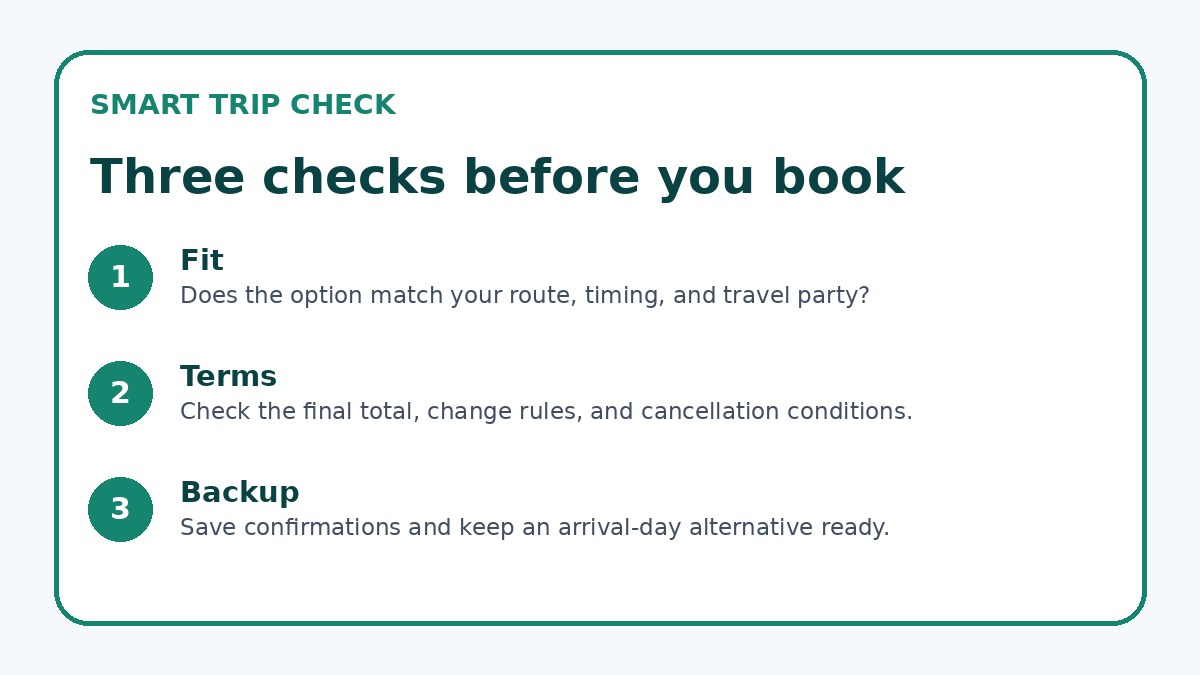
Before purchasing a ticket, read the provider’s luggage policy on their final booking page: permitted dimensions and weights, fees for excess baggage, whether advanced seat or luggage reservations are required, and rules for large or fragile items. For flights, check carry-on size, free checked allowance by fare class, and whether priority or business fares include extra or priority baggage handling. For trains, confirm luggage space per passenger, reserved space for oversized items, and whether station staff will help with heavy bags. For car hires, verify trunk capacity and any restrictions on transporting certain goods.
Also confirm check-in and boarding times, cancellation or rebooking conditions, and how luggage issues are handled if a service is disrupted. If you rely on a connecting ride—taxi, rideshare, or shuttle—ensure it allows the luggage you’ll have. When using third-party booking platforms like Trip.com to compare current options, use that for availability checks only and then verify luggage rules on the operator’s official page before finalizing, because intermediaries might not show all baggage conditions.
Before you book
- List every piece of luggage and measure dimensions and weight before you compare transport options.
- Confirm the exact baggage allowance and fees on the operator’s final booking page, not just summary listings.
- Plan door-to-door time including transfers, security, and possible baggage handling delays for each option.
- Pack a compact work bag with essentials you’ll keep with you: laptop, charger, documents, and a change of clothes if needed.
- Reserve seats or luggage space where offered—trains and premium transfers sometimes require advance allocation.
- Photograph packed items and keep electronic copies of travel documents and receipts for any claims or unexpected issues.
Packing smart and managing luggage at each step
Pack to the constraints of your chosen transport and your work needs. Use a carry-on that fits airline strictures if flying, and consider protective packing for electronics and documents that you’ll keep with you. For train or car trips, use sturdy luggage you can stack and secure; soft-sided bags sometimes fit better in limited storage nooks. Label every item with contact information and add a digital copy of critical documents to your phone in case anything is delayed. Use lightweight, compressible packing cubes to keep essentials accessible during transit without opening large suitcases in public areas.
At transfer points—airport, station, or parking—plan how you will move bags quickly and comfortably. Keep one small work bag or briefcase with immediate-access items: laptop, charger, meeting notes, ID and passes. If you expect to leave luggage at a hotel or meeting venue, ask about storage hours and security. For last-mile mobility in both cities, choose transport that fits your bag count; some rideshares and taxis have limited trunk space, while pre-booked airport transfers can be asked to accommodate larger loads.
Frequently asked questions
Which option is easiest with multiple suitcases for a short business trip?
If you have several medium-to-large suitcases, driving (yourself or with a driver) or taking a train generally reduces handling steps because you keep control of your bags and avoid airport check-in. With a private car you load once and unload once; trains typically provide ample space near seats or in dedicated luggage areas. Flying means additional handovers—check-in, loading, unloading—so consider how much risk and delay you can tolerate. Always verify trunk or onboard storage capacity with the provider if you have unusually large or heavy items.
Can I work effectively while travelling between Sydney and Melbourne?
Yes—choosing the right mode affects productivity. Trains offer a stable workspace with room for a laptop and fewer interruptions from security procedures, making them suitable for focused preparation. Flights give you less uninterrupted work time but can be efficient if your itinerary minimizes airport transit. Chauffeured transfers allow working during travel too. Consider battery life, mobile connectivity, and where you’ll store devices securely when moving through stations or airports to maintain both productivity and equipment safety.
What luggage pitfalls should I avoid when booking transport?
Common pitfalls include assuming carry-on limits are the same across operators, forgetting to factor in transfer baggage rules, and not reserving luggage space where required. Don’t rely solely on summary fare information—open the carrier’s detailed baggage policy on the booking page to check exact weight, size, and item counts. Also avoid last-minute booking of services whose vehicles or car classes may have limited trunk space. If you carry fragile or high-value gear, plan for a single secure handover or keep the item as carry-on when possible.
Final planning note
Choosing how to travel from Sydney to Melbourne with luggage is a balance between speed, control, and convenience. For lightning-fast city-to-city travel, flying with a single carry-on works well; for larger loads or uninterrupted work time, trains and private cars are strong alternatives. The key to a smooth trip is to measure your bags, match them to a transport option’s practical allowances, and confirm all baggage rules and transfer arrangements on the operator’s official booking page before you buy. With those checks done and a sensible packing plan, you’ll arrive ready for business.
Continue planning
Check current options and final conditions
Use the provider page to confirm live availability, the final total, cancellation terms, and every condition that matters to your trip.
This evergreen planning guide was created with AI-assisted drafting and a structured quality review. It does not display live prices, schedules, availability, visa guidance, or provider rankings. Verify current details before booking. Some links are affiliate links; we may earn a commission at no additional cost to you.