Practical answer up front: if you’re carrying a lot of luggage, driving in Rome can be helpful for door-to-door transfers, but only if you confirm two things before booking—a fuel policy that won’t penalize you for partial tanks and a mileage allowance that covers your planned kilometres. Extra suitcases and bulky items change the vehicle category and sometimes the permitted drivers and coverage. If fuel rules require returning the tank exactly as you received it or force pre-paid fuel with no refund, you may pay for fuel you didn’t use. Likewise, short mileage caps can add substantial per-kilometre fees if you plan day trips outside central Lazio. This guide shows what to check on the rental page, how to weigh insurance and pickup/return friction, and what to choose instead when driving is more hassle than help.
Route value: when extra luggage makes driving worth it
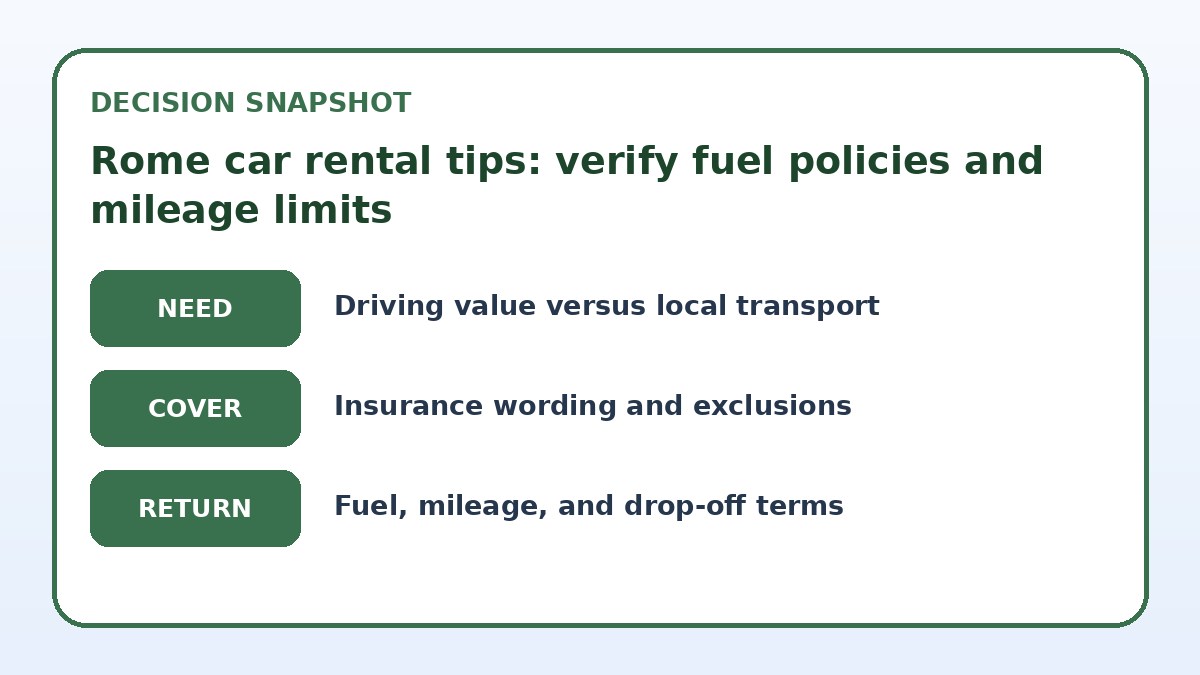
Decide whether a car materially improves your itinerary by listing the number and size of bags, where you’ll stay, and the distances between stops. Driving is most valuable when your lodgings are outside the historic centre or when your group needs direct transfers to villas, remote ruins, or coastal day trips where public transit is infrequent. Also consider the cumulative hassle of multiple transfers with heavy bags on metro stairs, buses, or busy trams—those minutes become physical effort and potential taxi costs.
If most of your plans are inside central Rome (Trastevere, Centro Storico, Campo de' Fiori), driving is often more trouble than it’s worth due to restricted areas and parking scarcity. But if you have several long day trips planned—Tivoli, Ostia Antica, coastal beaches—or arrive late with many suitcases, a rental can save time. Quantify the travel time and door-to-door convenience you gain versus the added time spent at pick-up, drop-off, and potential ZTL checks to make an informed choice.
Decide whether driving earns its place
| Mobility strategy | Best for | Cost or friction to check |
|---|---|---|
| Rent a larger car with higher allowance | Travelers with many and heavy bags wanting direct control | Higher base rate, more expensive fuel consumption, and possibly higher insurance excess |
| Standard compact car with prepaid fuel | Short city stays with minimal outside driving | May require returning with specific fuel reconciliation; limited trunk space and mileage caps can be restrictive |
| Private transfer or taxi for door-to-door service | Groups with bulky luggage seeking convenience and no fuel headaches | Less flexibility for day trips and potentially higher cost for long-distance journeys |
| Public transit + luggage storage options | Lightpackers or those staying central who want to avoid driving hassles | Reduced convenience for late arrivals and remote day trips; multiple transfers with baggage |
Check live rental choices only after the route test
Use the exact driver, dates, pickup point, and return plan to compare current conditions.
Insurance and contract wording: what to verify on the final page
Don’t assume standard coverage will protect luggage or additional drivers; read the rental page and final contract carefully. Verify whether the collision damage waiver (CDW) includes a deductible or excess, and whether buying a supplement reduces or eliminates that excess. Also check policy language on third-party liability limits, roadside assistance, and whether the rental company explicitly excludes damage caused by overloaded trunks or unsecured rooftop carriers.
Ask about coverage for personal items and whether the vehicle’s insurance has weight or load limits affecting validity. Confirm the allowed number of drivers and any extra-driver fees, because a second driver handling long transfers can reduce fatigue and risk. If coverage language is vague on luggage-related exclusions, contact the provider to request written clarification before you finalize the booking; keep screenshots or saved pages for reference at pickup.
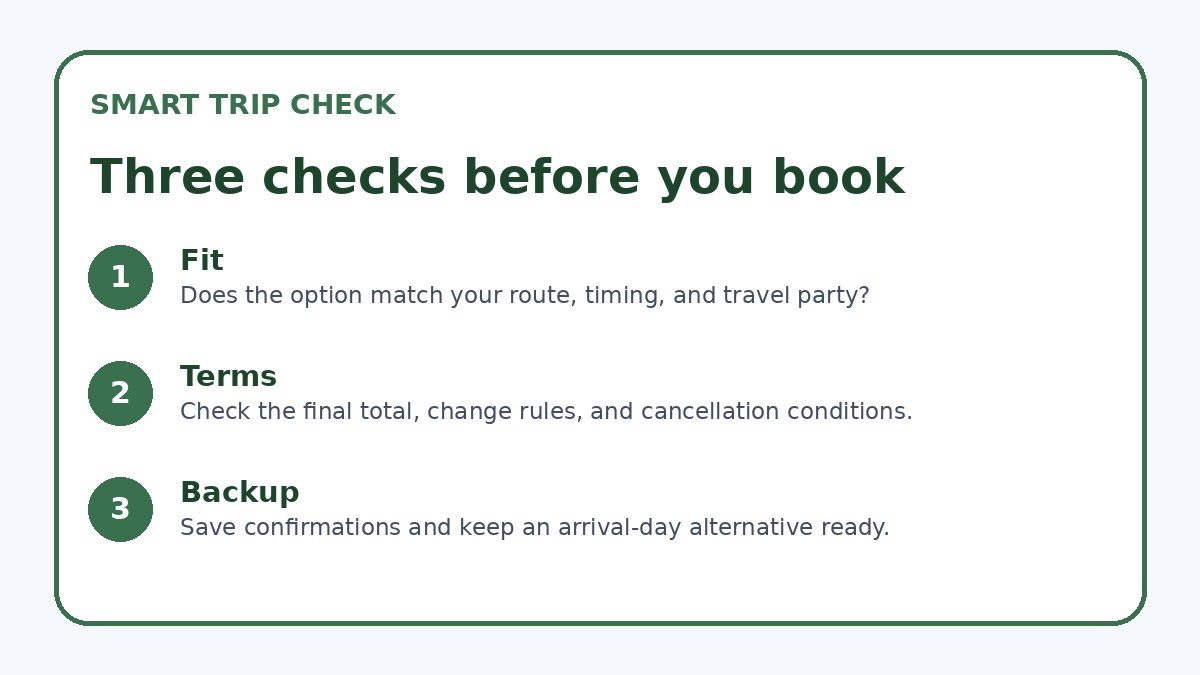
Compare the full rental conditions
Confirm insurance wording, exclusions, deposit, fuel, mileage, and return terms on the final page.
Pickup and return friction: airport, city, and ZTL logistics
Pickup convenience varies significantly by location. Airport counters often offer a wide vehicle selection but can involve shuttle waits, long queues, or remote lots; city-center offices might be closer to hotels but have smaller fleets and tight streets. Check the rental page for exact pickup address, shuttle or walk time, whether a staff member will walk you out to the car, and any required documentation like an International Driving Permit. For heavy luggage, a short, staff-assisted pickup is worth a small premium.
Returning the car in Rome can be a source of extra charges if you miss the drop-off window or if the return depot is outside the ZTL (restricted traffic zone), requiring extra parking or transfer time. Confirm opening hours and after-hours return procedures if you land late. On the final booking page, verify clear instructions for fuel reconciliation at return, photo requirements for damage checks, and confirmation that rooftop boxes or tow bars are allowed and insured; these details affect both cost and convenience.
Car rental terms to verify
- Read the exact fuel policy on the booking page and note whether it’s full-to-full, pre-purchase, or charged by the company with administrative fees.
- Calculate projected kilometres for your itinerary and verify the rental’s included mileage; note the per-kilometre overage charge on the final contract page.
- Confirm vehicle trunk volume or reserve a higher category (estate/SUV) and ask the provider if rooftop boxes are permitted and insured.
- Check pickup and drop-off logistics: exact depot address, shuttle times, after-hours return, and any documented damage/photo procedures.
- Review insurance wording for excess amounts, luggage exclusions, and allowed drivers; take screenshots of the final policy text before arrival.
- If avoiding driving, pre-book a suitably sized private transfer or identify luggage-storage options at arrival points and your first hotel.
Non-driving fallback: realistic alternatives with extra luggage
If driving proves awkward, plan a fallback that handles bulky bags without major delay. Airport-to-city private transfers or taxis can be competitive for groups with lots of luggage, offering door-to-door service without the worry of fuel rules or ZTL fines. Check vehicle size when booking a transfer—many companies offer station wagons or minibuses that accommodate large suitcases and might cost less than an upgraded rental with a rooftop box.
Public transit still works if you can travel light for city days and use locker services or hotel check-in options: some hotels will store luggage while you sightsee. For longer day trips, regional trains or guided excursions often have luggage-friendly carriages or scheduled luggage policies—verify those on operator pages. Always compare total time, comfort, and cost of the non-driving option versus the rental once you factor in fuel penalties, mileage overages, parking fees, and parking search time.
Car Rental & Road Trip questions travelers ask
How do I tell whether a rental’s fuel policy is fair for my luggage-heavy trip?
Look for the phrase ‘full-to-full’ on the rental page—this typically means you pick up and return the car with a full tank and only pay for what you use. If the page offers ‘pre-purchase’ or ‘fuel service charge’, read the paragraph describing refunds or unused litres; some companies don’t refund partial unused fuel and may add handling fees. Also check whether the provider requires photographic proof of tank level at return and whether they charge a refill administrative fee. If any term is unclear, ask the company in writing and keep the reply.
What mileage checks should I do when planning day trips from Rome?
Start by mapping your planned day trips and add expected local driving around accommodations—include return to the airport if you’ll drop the car there. On the rental’s final booking page, find the included mileage allowance (daily or total) and the stated overage rate per kilometre. Multiply potential overage kilometres by that rate to see real costs. If your net projected kilometres are close to the allowance, upgrade to an unlimited mileage option or a higher allowance vehicle to avoid surprise fees; confirm the upgrade terms on the contract page.
Will adding rooftop boxes or roof racks void my insurance?
Some rental contracts explicitly allow roof boxes and racks when supplied by the company or when pre-approved; others ban third-party equipment or limit insured loads. Before arranging a rooftop carrier, check the provider’s accessory policy on the booking page and the insurance conditions for load limits and fastening requirements. If the policy is silent, request written confirmation that the accessory is permitted and will remain covered. Always follow weight limits and secure luggage to avoid being held liable for damage resulting from overloaded or improperly attached carriers.
Final decision note
Driving in Rome with extra luggage is useful in many scenarios, but it comes with tradeoffs you can control by checking specific contract language. Prioritize confirming fuel policy mechanics, mileage allowances and overage rates, accessory permissions for rooftop storage, and exact pickup/return logistics. Read insurance and excess wording carefully and get written clarifications for any luggage-related exclusions. If the rental terms or airport pick-up friction look costly or unclear, a private transfer or a higher-category pre-arranged vehicle can simplify arrival and reduce risk. Use these checks on the final booking page to compare true door-to-door convenience against the non-driving alternatives before you commit.
Continue planning
Check current options and final conditions
Use the provider page to confirm live availability, the final total, cancellation terms, and every condition that matters to your trip.
This evergreen planning guide was created with AI-assisted drafting and a structured quality review. It does not display live prices, schedules, availability, visa guidance, or provider rankings. Verify current details before booking. Some links are affiliate links; we may earn a commission at no additional cost to you.