Practical answer first: pick a neighborhood that minimizes late-night transfers and gives flexible check-in plus easy, short routes to your first full-day plans. For many travelers arriving late with extra luggage, the best immediate tradeoff is staying close to a main rail station (Gare du Nord, Gare de Lyon) or an airport-focused area (near Charles de Gaulle/Roissy public transit links) if you prefer a simpler transfer. Alternatively, a central arrondissement like the 1st/2nd or a hotel near a metro hub (Châtelet-Les Halles, Saint-Lazare) reduces drag for a morning start but can be busier at night. Before you book, shortlist three areas based on: how you’ll arrive (train, airport shuttle, taxi), how many and how bulky your bags are, and whether you need a late check-in, luggage hold, or an accessible elevator/stairs-free room.

Check live stays in the areas that fit
Use your dates and party size to compare current rooms after you narrow the neighborhood fit.
Neighborhood fit: match arrival type to area
Start by mapping how you reach Paris: international flights land at CDG or Orly, Eurostar arrives at Gare du Nord, and long-distance TGVs use Gare de Lyon or Montparnasse. If your arrival is very late and you want the least friction, choose an area adjacent to that entry point. Hotels around Gare du Nord, Gare de l'Est, Gare de Lyon, and Montparnasse give the simplest post-arrival transfer because taxi ranks and late-night public transport options cluster there. This reduces the number of times you must lift, carry, or wheel heavy bags up stairs, through tunnels, or along busy sidewalks.
If you prefer to sleep centrally and unpack before exploring, a hotel in the 1st, 2nd, or near Châtelet-Les Halles places you within walking distance of major sights and many metro lines; however these neighborhoods can have narrow sidewalks and busy staircases at stations that add friction if you have multiple big suitcases. A mid-distance compromise is staying in the 8th, 9th, or Latin Quarter—easier nighttime access with good morning routes. Ultimately, match the area to how tired you’ll be, how much luggage you have, and whether you value a fast morning start or an easier late-night arrival.
Choose an area-selection strategy
| Area approach | Best for | Tradeoff to check |
|---|---|---|
| Stay near arrival station (Gare du Nord/Gare de Lyon) | Minimizing late-night transfers and quick access to taxis/late trains | Less central for sightseeing the next morning; can be busy or noisy at night |
| Central arrondissement (1st/2nd/Île de la Cité) | Short morning routes to major sights and easy walking starts | More stairs, narrower sidewalks, and trickier late-night luggage movement |
| Metro hub neighborhood (Châtelet-Les Halles/Saint-Lazare) | Flexible connections across the city with fewer transfers | Busy stations that may require lifts or long walks between lines |
| Airport-proximate or business fringe (near CDG links/La Défense) | Simpler arrival from flights and quick business access next day | Often farther from tourist attractions and evening dining options |
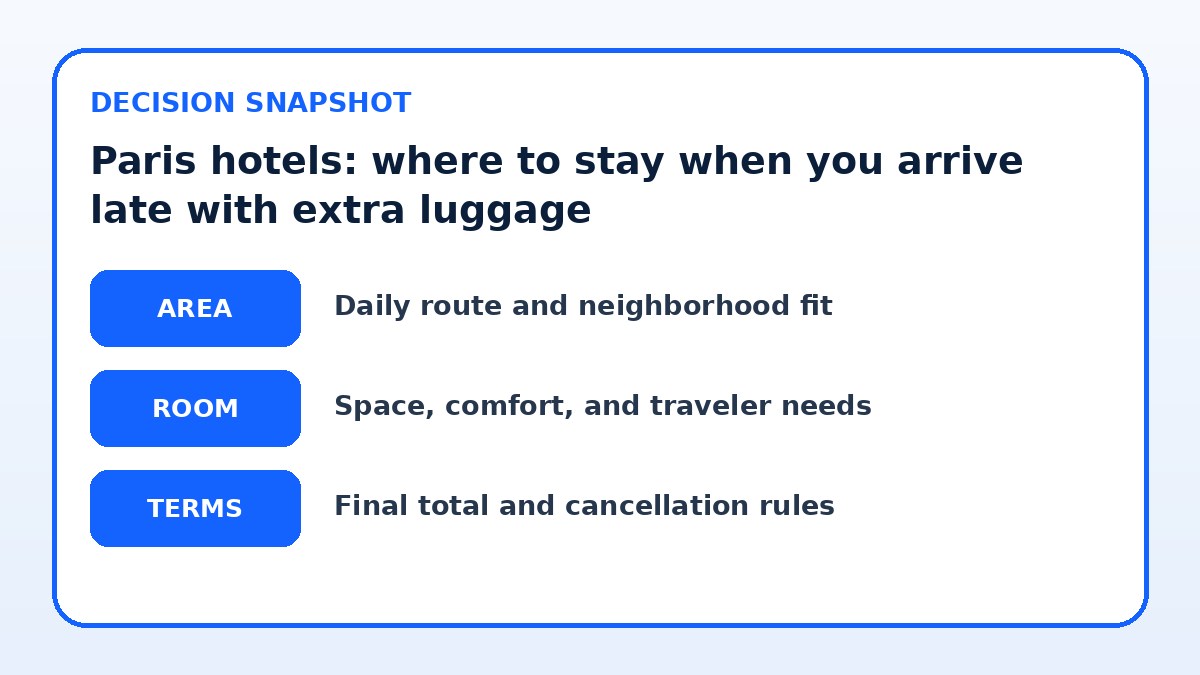
Daily-route friction: move-from-hotel to your first plans
Think beyond the arrival night. On day one you’ll likely want to reach a museum, meeting, or a train connection. A hotel that saved you from a long late-night transfer might add an extra cross-city commute in the morning. Look at how many transfers, the walking distance from your hotel to the nearest metro or RER station, and whether those routes require stairs or lifts. If you have bulky bags, avoid hotels that force a two-stage route to major hubs; a single short taxi or one metro ride is usually less draining.
Use a mental map: if your morning plan centers around the Louvre or Île de la Cité, a central hotel trims commutes. If you need to be near business districts (La Défense, the 8th arrondissement) first thing, pick a hotel on that side of the river. Also consider luggage-friendly first-day options: book a later museum slot, arrange a meetup near your hotel, or plan an easy, low-walking morning while you offload baggage and recover from travel.
Now compare like with like
Keep the same dates, guests, room needs, and cancellation preferences while you compare the final choices.
Room and party needs: what to request when you book
When you shortlist hotels, filter by practical room features. Request a ground-floor or low-floor room, an elevator-served room with wide doors, and—if you travel with oversized or multiple suitcases—rooms with walk-in space to unpack. Families or groups should ask for connecting rooms or a suite with extra storage instead of booking multiple small rooms that complicate luggage movement. Mention special luggage like bikes or musical instruments; not every hotel can store or handle oddly shaped items.
Confirm bed configuration, extra rollaway beds, and whether the hotel can provide a luggage rack or temporary storage if you plan to sightsee on the arrival night. If you travel with mobility constraints, ask about step-free access from street to reception and from reception to rooms. Always ask the hotel to confirm these details in writing on their booking page or by email so you have a record at check-in; this avoids surprises and helps porters prioritize where to move your bags on arrival.

Hotel booking check before payment
- Confirm your hotel's official late check-in window and request written confirmation by email.
- Ask the hotel about luggage storage policies, including size limits, fees, and maximum storage duration.
- Request a ground-floor or elevator-served room and confirm step-free access from street to room if needed.
- Plan at least one single-transfer route from your arrival point to the hotel and check for night metro availability or taxi ranks.
- Photograph your transport receipts and forward arrival details to the hotel so reception expects you.
- Choose a flexible booking or verify cancellation terms in case your arrival time changes.
Final booking terms: what to verify before committing
Treat the booking page as the definitive source: verify check-in window, late-arrival policy, and luggage storage terms directly with the hotel. Many properties allow reception staff to accept late check-ins but require advance notice; some offer luggage storage for a fee or free for a limited period. Don’t assume the hotel will hold bags overnight without written confirmation. If late arrival is likely, select a rate that includes flexible check-in or keep a record of your communication with the hotel confirming late arrival and luggage handling.
Also check cancellation and modification rules in case delays change your plans, and confirm whether payment is required at booking or on arrival. When provider-specific facts could change—shuttle schedules, porters, or storage limits—ask the hotel to reconfirm 24–48 hours before arrival. If you'd like a quick cross-check for availability or options, you can compare live inventory on Trip.com, but rely on the hotel’s own booking terms as final.
Hotel Guide questions travelers ask
Should I book a hotel near the airport if I arrive after midnight with many suitcases?
If you arrive after midnight with several large suitcases, an airport-proximate hotel or one close to the airport transit link reduces the stress of a long late-night transfer and minimizes time spent moving luggage. These hotels often have simpler taxi access and fewer public-transport changes. However, consider your next-day plans: staying at the airport means a longer commute into central Paris in the morning. Compare the convenience of a short nighttime transfer against the extra morning travel, and confirm late check-in and storage options with the hotel before booking.
How can I be sure a Paris hotel will accept late check-in and hold my bags?
Always check the hotel’s stated check-in hours and late-arrival policy on its booking page, then contact the property directly to notify them of your expected arrival time. Ask specifically about luggage storage availability, any charges, and where stored items will be secured overnight. Request a confirmation email or booking note that records the arrangement. If the hotel uses third-party front desks or key boxes for late arrivals, verify how you will collect keys and how staff can assist with luggage on arrival.
What room features matter most when arriving late with bulky luggage?
Prioritize ease of access: a ground-floor or low-floor room, elevator access with wide doors, and enough floor space to place luggage while unpacking. For groups or families, connecting rooms or a suite with closets and extra storage prevent repeated trips up narrow staircases. If you have nonstandard items (bikes, instruments), ask the hotel whether they can store them safely. Requesting these features in advance and getting confirmation on the booking page reduces the chance you’ll be moved to an unsuitable room at check-in.
Final decision note
Shortlist areas before you open live inventory: pick an arrival-station neighborhood for the least late-night hassle, a central arrondissement for an easy morning start, or a metro-hub compromise for flexible connections. Match your choice to your arrival time, luggage volume, and first-day plan. When you find a hotel you like, verify late check-in, luggage storage, step-free access, and room layout directly on the property’s booking page and get confirmation in writing. These steps let you book with confidence and ensure a smoother, less stressful first night in Paris.
Continue planning
Check current options and final conditions
Use the provider page to confirm live availability, the final total, cancellation terms, and every condition that matters to your trip.
This evergreen planning guide was created with AI-assisted drafting and a structured quality review. It does not display live prices, schedules, availability, visa guidance, or provider rankings. Verify current details before booking. Some links are affiliate links; we may earn a commission at no additional cost to you.