Practical answer: for first-time travelers on New York City to Los Angeles flights, pick the most direct schedule that fits your comfort with baggage rules and allow extra airport time if you check bags or prefer calmer boarding. Decide whether you need a checked bag or can manage with carry-on only before searching fares — that decision often changes which flights look best once fees and connection risk are included. Booked nonstop flights shorten total travel time and reduce connection risk, but a connecting itinerary can be cheaper or open different departure windows. Before you check live options, have exact travel dates, full traveler names, preferred airports in New York (JFK, LGA, EWR), and whether you’ll check bags, travel with sporting equipment, or need extra time for assistance. That lets you compare schedules, transfer times, and fare rules side by side when you view current availability.

See live routes for your exact travel day
Compare direct and connecting choices with the same baggage and traveler details.
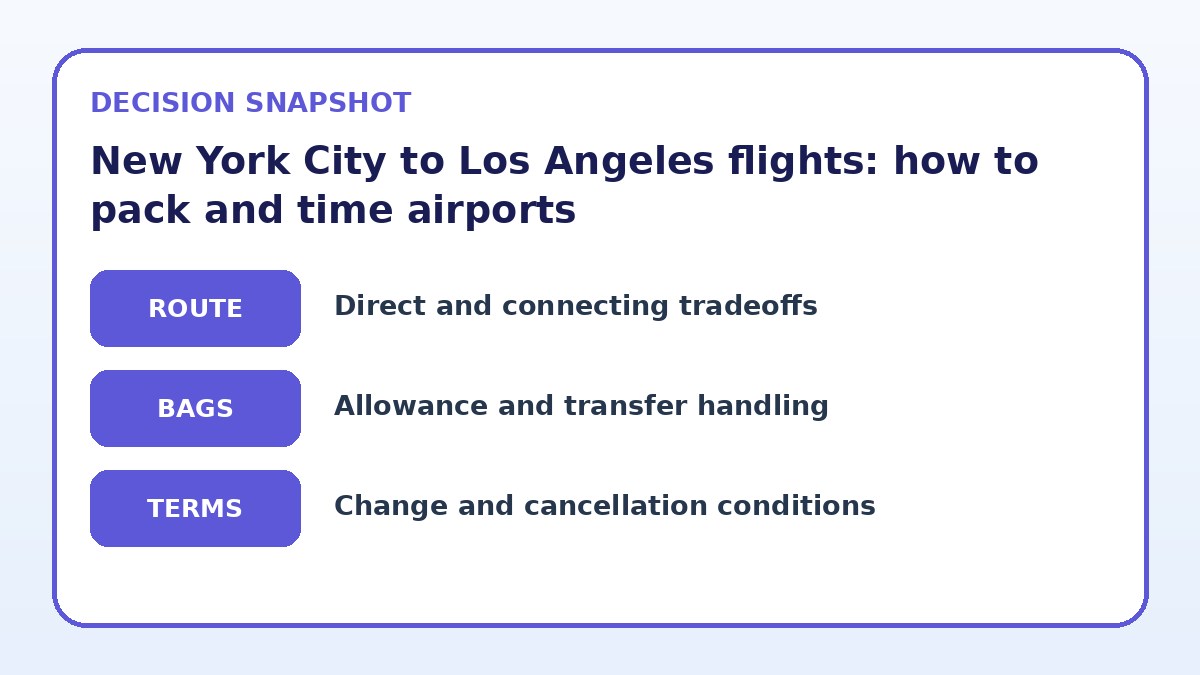
Routing: direct versus connecting and airport choices
Routing starts with which New York airport you’re leaving from and which Los Angeles airport you’ll arrive at. New York has three major airports—decide whether you prefer JFK for international-style terminals, LaGuardia for shorter ground transfers from Manhattan, or Newark for western New Jersey access. Los Angeles has multiple passenger airports too; confirm whether your arrival is LAX or a smaller regional airport. When comparing itinerary options, treat each airport pair separately because transfer times, ground transportation, and the number of nonstop options can vary. Don’t assume every search result labeled “New York to Los Angeles” uses the same origin or destination airport.
Weigh nonstop flights against connecting ones: nonstop saves connection risk and time but may provide fewer departure windows that match your schedule. A one-stop itinerary can offer better departure or arrival times, sometimes lower base fares, or access to a different alliance’s cabin availability. If you consider a connection, check whether layovers are domestic-to-domestic within the same terminal or require a terminal change and possible security re-entry. These details determine how much buffer time you need on both ends and whether the connection is realistic for your comfort level.
Baggage decisions and how they shape airport time
Decide early whether you will travel carry-on only or check one or more bags. Carry-on only saves time at arrival because you skip Baggage Claim, and at departure you may only need the standard security arrival time. Checked bags add time before departure—plan extra time for checking and tagging, and extra arrival time if you’ll collect luggage at your destination. Also, confirm size and weight rules on the airline’s booking page because dimensions and allowances vary, and fees or restrictions affect your total travel cost and ease of passing through security.
Special items—sports equipment, oversized cases, or musical instruments—often require advance notice and sometimes different handling, which can mean earlier drop-off windows or gate-check options. If you plan to gate-check due to cramped overhead space, factor in the time to gate-check and pick up the item on arrival. When comparing fares, read the fare conditions on the airline’s final booking page to see whether baggage fees, carry-on rules, and refund/change conditions are included or optional. Small differences in baggage policy can outweigh a lower base fare once you add fees and the time cost of managing extra bags.
Compare flight-selection strategies
| Flight strategy | Best for | Risk to check |
|---|---|---|
| Nonstop departure at a higher base fare | Travelers who value simplicity and minimal connection risk | May cost more and offer fewer convenient departure times; baggage fees still apply per carrier policy |
| One-stop itinerary to lower base fare or better times | Flexible travelers willing to accept a transfer for schedule or price benefits | Higher connection risk and longer total door-to-door time; verify minimum connection time |
| Carry-on-only with tight preflight timing | Light packers who want to save time at baggage claim and skip checked-bag fees | Less luggage capacity and risk of gate-checking if overhead space is limited |
| Buy flexible/refundable fare with extra cost | Those who need booking flexibility or anticipate schedule changes | Higher upfront cost; may duplicate value if you never change plans |
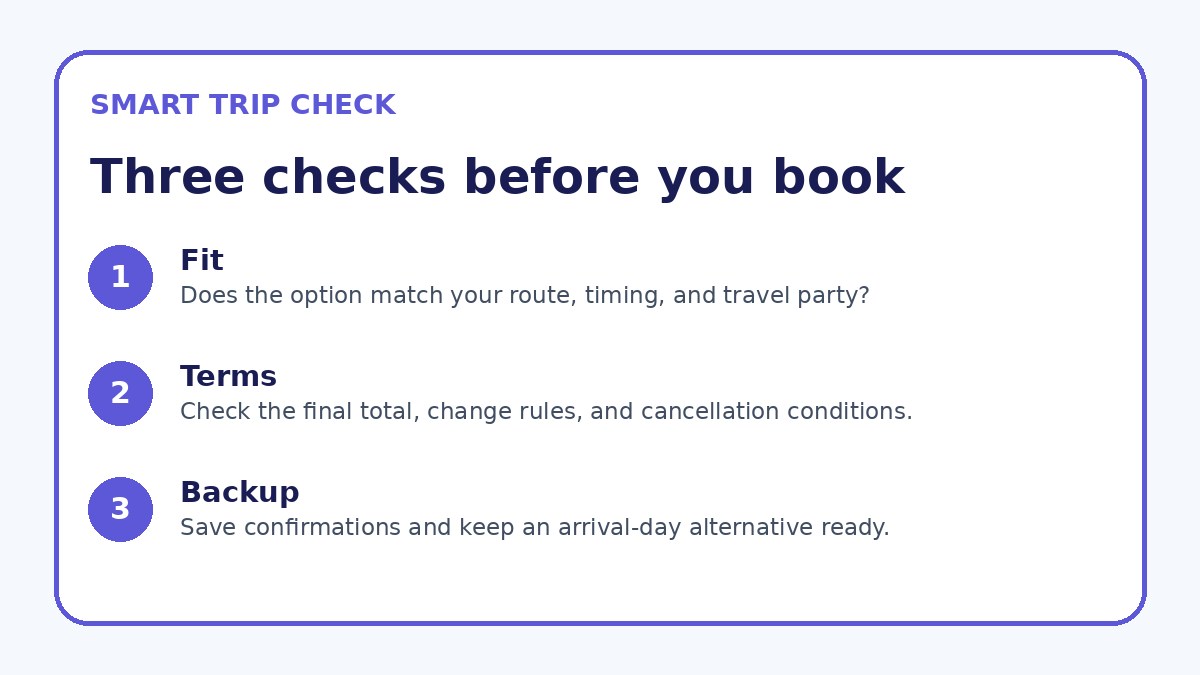
Recheck the complete itinerary
Confirm airports, connection handling, baggage, and change conditions before deciding.
Connection risk, schedule fit, and when to add buffer time
Connection risk depends on how much time the itinerary gives you between flights and whether both segments are on the same ticket. Same-ticket connections generally protect you if an earlier delay causes a missed connection; standalone tickets do not. When you must switch terminals or re-clear security, add considerable buffer—these actions can easily take 30–60 minutes depending on airport layout. If you are traveling during peak hours, expect longer security lines and add time accordingly. Evaluate your personal tolerance for risk: if you dislike rushing, pick longer connection times or a nonstop flight even at a higher fare.
Schedule fit also means evaluating arrival times in Los Angeles against your ground transportation and plans. Arriving earlier in the day reduces the chance of driving in heavy evening traffic, but early-morning departures from New York may require very early wake-ups and longer pre-departure commutes. Balance the overall door-to-door time: a cheap overnight connecting itinerary might save money but cost you sleep and increase the chance of delay-related problems. Always compare total travel time, not just airborne duration, when choosing between schedules.
Flight details to verify
- Confirm exact origin and destination airports (JFK, LGA, EWR, LAX, or other regional) before searching fares.
- Decide whether you will travel with carry-on only or check bags and note size/weight limits on the carrier’s final booking page.
- Enter full traveler names, dates of birth, and contact details to see accurate fare rules and baggage allowances during booking.
- Compare total door-to-door travel time, including ground transfers and potential traffic at both origin and destination.
- Verify minimum connection times, terminal transfer requirements, and whether both segments are on one ticket before committing.
- Check the airline’s official policy pages (or the booking confirmation) for change/cancellation terms and baggage fee details.
Fare conditions, refunds, and what to verify before booking
Fare conditions influence the true cost and flexibility of your ticket. Before finalizing a booking, verify on the airline’s or booking site’s final confirmation page whether baggage is included, what change and cancellation terms apply, and whether seat selection or preferred boarding is extra. Low-cost fares sometimes exclude carry-on bags or impose strict change penalties. Make sure passenger names match government ID exactly and check any requirements for minors, lap infants, or passengers needing assistance. If you use a third-party site, cross-check critical policy details on the carrier’s own site before payment.
Also confirm how refunds or credits are handled if your plans change. Some fares offer nonrefundable but changeable tickets for a fee; others provide refundable tickets at a higher price. If travel insurance is an option you’re considering, verify what scenarios it covers and whether it reimburses for bag delay or missed connections due to airline delay. Use this verification step to avoid surprises at check-in or on travel day—when policies matter most is usually at the airport.
Flight Guide questions travelers ask
How early should I arrive at a New York airport for a domestic flight to Los Angeles?
For domestic flights, many travelers arrive at least 90 minutes before departure as a baseline, but this depends on whether you check bags, your airport choice, and time of day. If you’re checking luggage, add 30–45 minutes for drop-off and any lines at the check-in counter. Peak travel times, such as morning and early evening, can increase security line times—so aim for 2 hours if you prefer a relaxed pace. If you have TSA PreCheck or Clear, you may reduce this time, but confirm those services and any required enrollment before assuming a shorter arrival window.
Is it better to purchase a flexible fare or save and accept baggage fees?
That depends on your tolerance for change and the likelihood your itinerary will shift. Flexible fares cost more upfront but reduce stress and potential change fees; they’re useful if your schedule is uncertain. If travel dates are fixed and you’re comfortable with strict rules, a lower fare plus paid baggage can be cheaper overall. When comparing, write out the total cost including checked-bag fees and the estimated value of flexibility—that comparison will show whether paying more for flexibility is worth it for your plans.
How should I plan connections in Los Angeles if I need ground transport after arrival?
Plan arrival times with your onward ground travel in mind: arriving earlier in the day often reduces the time you’ll spend in traffic to central destinations. Allow time for Baggage Claim if you checked luggage and for rideshare or shuttle pickup processes at the airport. If you have a short onward commute and are carrying only a carry-on, you can be out of the terminal faster; otherwise build in an additional 30–60 minutes. Confirm terminal-specific pickup areas for your chosen ground transport and check real-time traffic conditions before departure to align arrival times with your onward plans.
Final decision note
For first-time travelers, the clearest starting point is deciding baggage strategy and your tolerance for connection risk before comparing New York City to Los Angeles flights. That one decision shapes how much airport time you’ll need, which flights are practical, and whether a slightly higher fare is worth the convenience of a nonstop or flexible ticket. Gather exact dates, traveler names, airport preferences, and luggage needs before you search live availability so you can compare apples to apples. When ready to book, verify baggage allowances, change rules, terminal information, and connection protections on the airline’s final booking page. If you want a broad comparison of current options, Trip.com can be one place to view live schedules, but always confirm carrier-specific rules on the airline site before paying.
Continue planning
Check current options and final conditions
Use the provider page to confirm live availability, the final total, cancellation terms, and every condition that matters to your trip.
This evergreen planning guide was created with AI-assisted drafting and a structured quality review. It does not display live prices, schedules, availability, visa guidance, or provider rankings. Verify current details before booking. Some links are affiliate links; we may earn a commission at no additional cost to you.