If you need to book Sydney to Melbourne flights for business, start with a short, practical pre-booking checklist that focuses on time, reliability, and total door-to-door impact. Your priority will often be predictable arrival times, minimal risk of delay, and a smooth transfer from the aircraft to meetings or onward transport. This article gives the immediate actions to take before you hit the booking button and explains the tradeoffs—Direct versus connecting flights, flexible fares versus strict savings, and airport choices that change your ground time. Use these steps to avoid last-minute surprises and ensure the itinerary supports your work day rather than complicating it. For current availability check a reputable aggregator like Trip.com as one of several sources, but verify policy and schedule details on the carrier’s final booking page.
See current options before you compare the details
Availability and final conditions change. Open Trip.com now or keep reading for the practical comparison.
Decide which airports and times match your business schedule
Sydney and Melbourne each have more than one airport option that can affect your travel time and convenience. For business travelers the right arrival airport often matters more than a slightly cheaper fare because it determines how long a taxi, rideshare or train journey will take to your meeting or hotel. When comparing flights, map the full route from your office or hotel to the departure terminal and from the arrival terminal to your first appointment. Doing so reveals hidden time costs—peak-hour traffic, distance to the CBD, and public-transport frequency—that influence whether an earlier flight truly saves you time.
Also consider flight departure and arrival windows relative to your working day. Early-morning departures can get you to Melbourne for a full day but may require leaving home very early to reach the Sydney terminal and clear security. Evening departures leave the day free but risk running into higher delay rates or missed connections if your prior commitments run late. Prioritize windows that include a comfortable buffer between landing and meetings (45–90 minutes minimum for direct arrivals, more for airports with longer transfer times).
Weigh direct flights against connecting itineraries
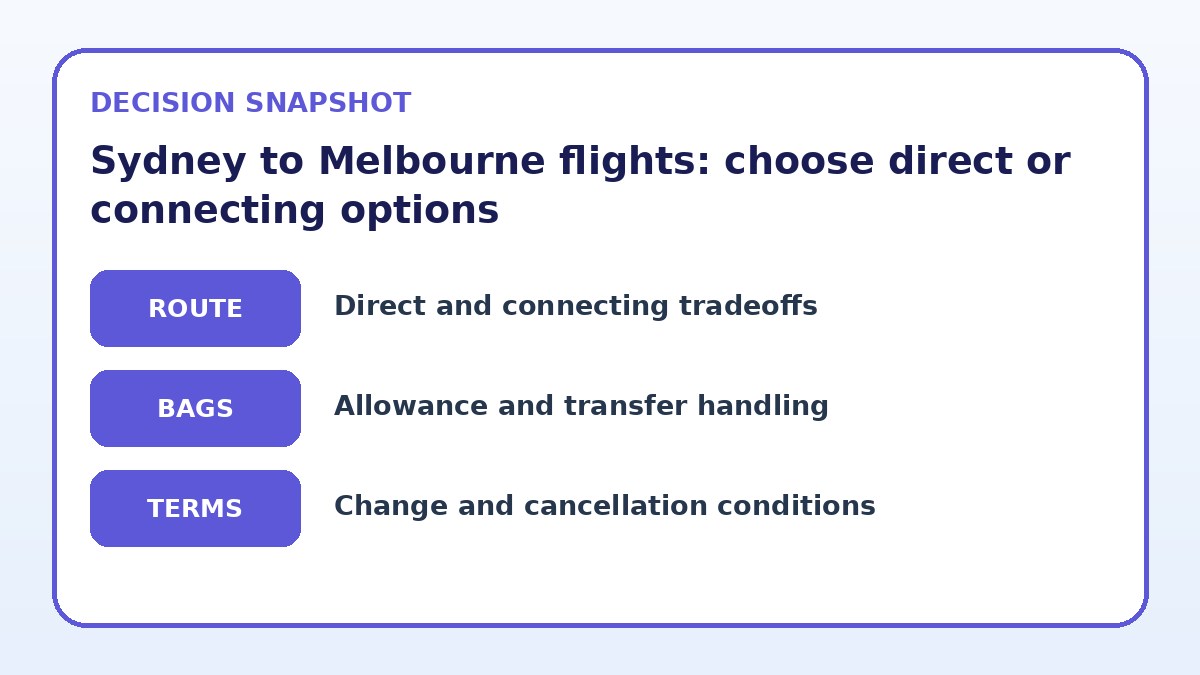
Direct flights usually reduce complexity: fewer boarding events, no risk of missing a connection, and shorter overall transit time. For short business hops like Sydney to Melbourne, direct options often make sense if you value predictability and minimal hassle. However, connecting flights may occasionally offer better times or prices, and they can be viable if the connection window is generous and both legs are operated by reputable carriers. When assessing a connecting itinerary, check how the airline handles missed connections, whether the connection requires terminal changes, and how much minimum connection time the carrier recommends.
To compare, look beyond price: evaluate cumulative on-time performance and the size of the transfer buffer. If you must connect, avoid extremely tight connections and prefer single-ticket itineraries where the airline assumes responsibility for rebooking in case of delay. If the legs are on separate tickets, allocate extra time and be prepared to manage rebooking yourself. For business travelers, the small premium for a direct flight or for a single-ticket connection often pays off in stress reduction and time savings.
| Approach | Best for | Tradeoff to check |
|---|---|---|
| Direct flights | Minimizing complexity and door-to-door time | May cost more or have fewer departure time choices |
| Connecting flights on a single ticket | Accessing better schedules or loyalty benefits while keeping protection | Adds connection risk and longer total travel time |
| Cheapest non‑flexible fares | Lower upfront cost for fixed plans | Limited flexibility—change fees and cancellation restrictions |
| Flexible or refundable fares | Business travelers who need schedule freedom | Higher fare but saves time and stress if plans shift |
Ready to check the option that fits your plan?
Use your exact dates and traveler details so the provider page can show the current total and conditions.
Check fare rules and carry-on versus checked baggage impact
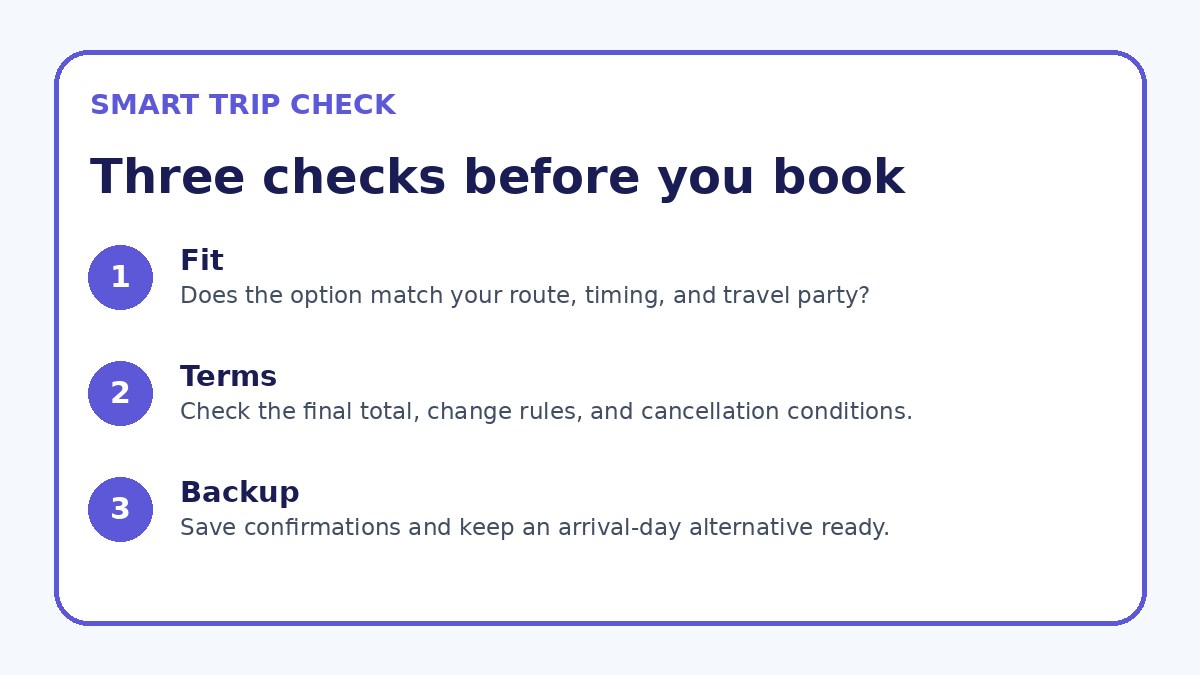
Business plans change, so review fare conditions carefully before booking. Flexible or semi-flexible fares let you change times with lower fees or minimal fare difference, which can be crucial if meetings are rescheduled. Conversely, the cheapest non-refundable fares may severely limit your options and add change or cancellation charges that erase the apparent savings. On the booking page verify the exact change and cancellation rules, how much notice is required, and whether name changes, date swaps, or refunds are permitted. If you need to adjust travel at short notice, a more flexible fare class can be a smarter choice.
Baggage rules also matter for business travel. A carry-on-only itinerary can save time at both ends of the trip and reduce the risk of delay at baggage claim, but it limits what you can bring—laptops, chargers or presentation materials may need careful packing. If you require checked baggage, confirm how it’s included in the fare and whether priority boarding or dedicated lines are offered. Also check whether checked baggage is protected in single-ticket connections; on separate tickets you may need to collect and recheck bags, which affects minimum connection times.
Before you book
- Map door-to-door time: estimate time from your start point to Sydney terminal, add check-in and security buffer, flight time, and travel from Melbourne terminal to your first appointment.
- Compare direct flight options first; if choosing a connection, verify single-ticket protection and allow generous minimum connection time.
- Read the fare rules on the carrier’s final booking page: change fees, refundability, name-change policy, and how schedule changes are handled.
- Confirm baggage allowances and whether carry-on suffices for your laptop and documents; decide if checked luggage or priority boarding is necessary.
- Plan ground transport: pre-book a rideshare or transfer if punctuality matters, and note public transport alternatives and estimated commute times.
- Prepare a disruption plan: note alternative same-day flights, enable schedule alerts, and share emergency contact details with your travel coordinator.
Confirm ground transport, lounge access, and disruption plans
Once you’ve shortlisted flights, plan the ground leg to ensure timely transfers between airports and appointments. Look up public-transport schedules, estimated rideshare or taxi times, and traffic patterns for the relevant hours. If you rely on punctuality, consider booking a private transfer or choosing flights that land near the meeting location to reduce uncertainty. Also check airport amenities like lounges if you need a quiet space to work on arrival or between flights. If lounge access is important, verify eligibility—ticket class, loyalty status, or paid lounge options—on the carrier’s booking page.
Finally, prepare a disruption plan. Identify alternative flights on the same day, know the carrier’s rebooking policy, and set alerts for schedule changes. Share contact details for your travel arranger or company travel desk and make sure colleagues know any contingency contacts. If your itinerary includes a tight connection or a critical meeting soon after landing, build a buffer by choosing an earlier flight or a more flexible fare so you can pivot without missing essential business commitments.
Frequently asked questions
How much buffer time should I allow between landing and a business meeting in Melbourne?
Aim for at least 45–90 minutes after a direct arrival for meetings in central Melbourne, depending on the airport and local traffic patterns. If you land at an airport further from the CBD or arrive during peak-hour traffic, increase the buffer to 90–120 minutes. If the itinerary includes a checked bag, add the expected baggage-claim time. For connecting arrivals or flights that often experience delays, schedule an even larger buffer or consider an earlier flight to avoid risking a late arrival to a critical meeting.
Is it safe to book separate tickets for each leg if it’s cheaper?
Booking separate tickets can be cheaper but carries extra risk because airlines typically treat each ticket independently. If the inbound flight is delayed and you miss the second ticketed flight, you will likely be responsible for rebooking and any costs. For business travel where time reliability matters, prefer single-ticket itineraries that give the airline responsibility for missed connections, or allow a large buffer between separately booked flights to reduce stress and risk.
What should I verify on the airline booking page before I pay?
On the carrier’s final booking page confirm the exact flight times, baggage allowance, seat selection fees, and all fare conditions, including change and cancellation fees. Check whether your fare includes lounge access or priority services if those are important. Verify which airport terminals are used for departure and arrival, and review the carrier’s policy on delays and rebooking. If you rely on frequent-flyer credit, confirm the ticketed fare class qualifies for points or status credit.
Final planning note
For business travel between Sydney and Melbourne, the best bookings focus on time reliability and minimal complexity rather than marginal fare savings. Start by mapping total door-to-door time, prioritize direct flights when they align with your schedule, and choose fare types that reflect your need for flexibility. Always verify fare rules, baggage allowances, and terminal details on the carrier’s booking page before finalizing. Build a simple disruption plan and confirm ground transport so your arrival supports—rather than derails—your work commitments. With this checklist in hand you can make practical choices that keep meetings on time and travel stress under control.
Continue planning
Check current options and final conditions
Use the provider page to confirm live availability, the final total, cancellation terms, and every condition that matters to your trip.
This evergreen planning guide was created with AI-assisted drafting and a structured quality review. It does not display live prices, schedules, availability, visa guidance, or provider rankings. Verify current details before booking. Some links are affiliate links; we may earn a commission at no additional cost to you.