If you and your partner are planning Melbourne to Queenstown flights, the practical answer is to prioritise fare flexibility and clear, written change/cancellation terms before you book. Choose a fare that explicitly states how many free changes (if any) it allows, how much credit or refund you’ll receive for cancellations, and whether fees scale by passenger or per booking. When comparing options, factor in how likely your plans are to shift — work commitments, weather, or family needs — and whether you need identical rules for both passengers. Read the airline’s final booking page carefully: confirm who pays fees, whether taxes are refundable, and whether refunds are processed to the original form of payment or as travel credit. If you want a single place to compare availability and rules, Trip.com can show current fares, but always verify the supplier’s official policy at checkout.
See current options before you compare the details
Availability and final conditions change. Open Trip.com now or keep reading for the practical comparison.
Understanding the common change and cancellation models
Airlines typically use three broad approaches to changes and cancellations: refundable tickets, flexible non-refundable fares that allow changes for a fee or free of charge, and strictly non-refundable tickets with high fees or no value on cancellation. Refundable fares generally cost more but return money to the original payment method. Flexible non-refundable fares often convert cancelled bookings into airline credit or vouchers; those credits may come with expiry dates and conditions limiting routes or fare classes.
When you compare rules, look beyond the headline phrase 'free changes'—this can mean free date changes but still include fare differences and taxes. Also check whether name corrections are permitted and whether changes must be made a set number of hours before departure. For couples, it’s important to see whether the airline treats the reservation as a single unit: if one person cancels, does the other keep their seat under the same rules, or will re-issuance be required?
How to compare direct versus connecting options for flexibility
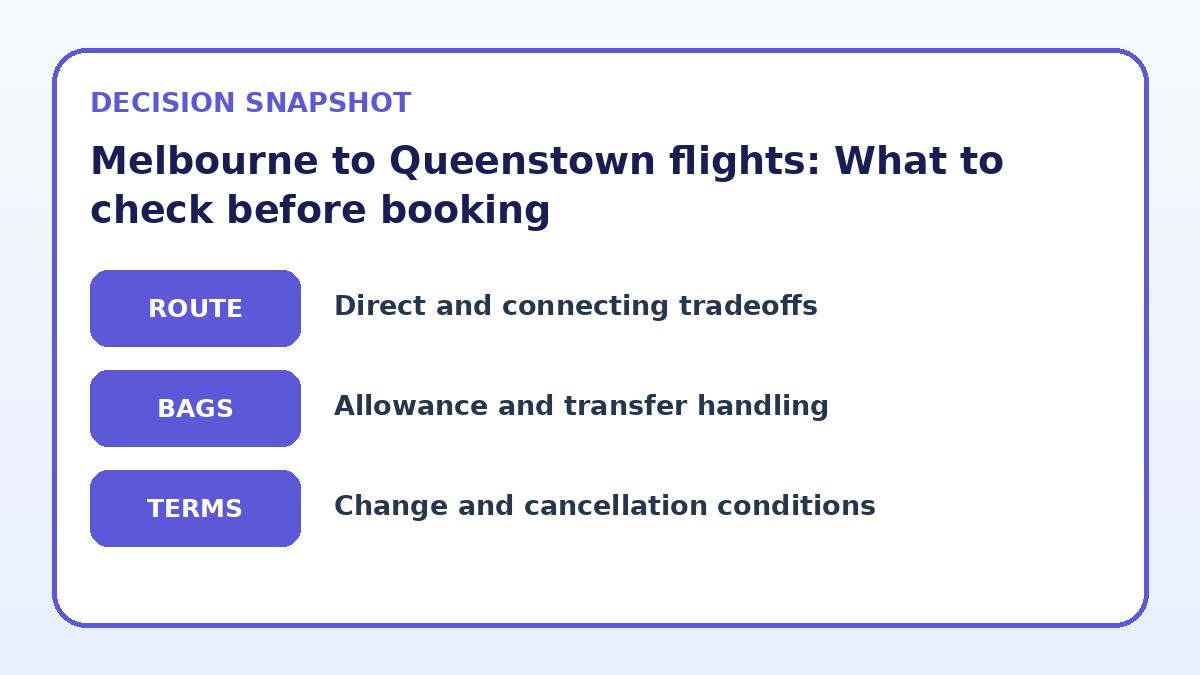
Direct flights are often simpler when modifying travel because there is only one carrier to negotiate with, reducing the risk of conflicting policies. If both legs are on the same ticket with a single airline, a single change policy and fee usually apply. However, some direct flight fares are less flexible than certain connecting itineraries offered by major carriers. Always check whether the fare conditions differ for nonstop versus multi-leg options on the Melbourne to Queenstown route.
Connecting itineraries can be useful if they use multiple carriers or codeshares; they might offer a cheaper flexible fare or different change rules combining two sets of conditions. This can be a tradeoff: a connection can increase complexity if you must coordinate between carriers for changes or refunds. Before booking, confirm whether changes to one segment force changes to the whole itinerary, and whether the original booking class will be honored on the new date or if you’ll face an additional fare difference.
| Approach | Best for | Tradeoff to check |
|---|---|---|
| Buy refundable fares for both passengers | Couples who want maximum peace of mind and cash refunds if plans change | Higher upfront cost compared with non-refundable or flexible fares |
| Book a flexible non-refundable fare or bundle | Couples who expect possible date shifts but want lower fares than fully refundable tickets | May convert cancellations to credit and can still require paying fare differences |
| Purchase separate tickets for each person | Couples with very different certainty about travel plans | Loses group booking benefits and may increase total fare if seats aren’t matched |
| Buy cheap non-refundable seats plus travel insurance | Couples trying to lower upfront cost while protecting against covered reasons for cancellation | Insurance may not cover all reasons and adds a distinct cost and claim process |
Ready to check the option that fits your plan?
Use your exact dates and traveler details so the provider page can show the current total and conditions.

Couples’ planning priorities and decision criteria
Start by listing your priorities: is minimizing financial loss most important, or is keeping the total price lower while accepting some risk preferable? If you both have unpredictable schedules, choose fares that allow free or low-cost changes and permit name corrections without penalties. If one person is certain of travel and the other less so, consider booking separate fares to avoid cross-liability—this way changes or cancellations by one traveler won’t necessarily impact the other’s ticket.
Also consider ancillary protections: refundable seat selection, travel insurance that covers cancellations for illness or work, and options to add the airline’s flexible bundle only for one passenger. When comparing options, weigh the total cost of flexibility (higher fare plus any bundled benefits) against the estimated likelihood and cost of changes. Use a simple decision matrix—probability of change times expected cost—to see whether the higher upfront fare is justified for peace of mind.
Before you book
- Confirm on the airline’s final booking page whether changes are free, subject to fee, or require paying the fare difference.
- Check if cancellations return funds to your original payment method or issue airline credit, and note any expiry dates for credits.
- Verify whether change and cancellation fees apply per passenger or per booking and how that affects your joint reservation.
- Review name-change rules and whether minor name corrections are allowed without full reissue or fee.
- Compare the total cost of flexible add-ons (seat selection, bundles) against the price difference to refundable fares.
- If using a third-party seller like Trip.com, screenshot the fare rules and confirm them on the airline’s site before finalising payment.
What to verify on the airline’s final booking page
At checkout, read the exact fare conditions that will be attached to your ticket. Verify: whether changes are free or fee-based, whether fare differences will apply, how cancellations are refunded (cash or credit), and whether taxes and fees are refundable. If the agent or booking platform shows a ‘flex’ option, click through to the full policy: it should state the timeframe for free changes, any blackout dates, and whether the change fee is charged per passenger or per booking.
Also confirm payment and refund mechanics: will refunds be returned to the original card, or issued as airline credit; are fees immediately charged when you change the booking; and how long before departure are changes permitted without special approval. If any details appear ambiguous, contact the airline’s customer service with specific hypothetical change or cancellation scenarios to get a written answer. Remember that Trip.com or other third-party sites can display conditions, but always verify the supplier’s policy at the airline’s final booking page.
Frequently asked questions
Should couples book the same fare class or separate tickets to keep options for one traveller?
Booking the same fare class for both passengers simplifies changes and often keeps seats together, but it ties both travellers to the same rules and potential penalties. If one partner has a fixed schedule and the other is uncertain, separate tickets can isolate risk—changes or cancellations by one person won’t force reissue or recalculation of the other’s fare. Consider seat assignment, check-in together, and any loyalty benefits lost when splitting tickets. Weigh the emotional and logistical value of remaining together versus financial protection when deciding.
How do layovers and codeshares affect change and cancellation rules for Melbourne to Queenstown bookings?
If your itinerary involves multiple carriers or a codeshare, the ticket may be governed by the operating carrier’s rules or by interline agreements that combine policies; this increases complexity when changing travel. A single-ticket itinerary issued on one carrier usually applies that carrier’s policy to the whole trip, but if segments are separately ticketed you may need to change each leg independently. Always read which carrier issues the ticket and confirm whether the fare conditions on the booking page cover all segments, and ask the airline to confirm in writing how a change would be applied across the connection.
Can travel insurance replace buying a flexible fare for couples?
Travel insurance can cover certain cancellation reasons—illness, injury, some work-related events—potentially making a non-refundable fare less risky. However, insurance rarely reimburses for voluntary changes, fear of travel, or airline-imposed schedule changes; policies vary widely on covered reasons, claim limits, and excesses. Insurance adds a claims process and may not return the convenience of an immediate fare change or refund. For many couples, a blended approach—cheaper fare plus insurance for specific risks, or a higher flexible fare without buying insurance—works best depending on personal priorities and the policy’s exclusions.
Final planning note
For couples flying Melbourne to Queenstown, the smartest booking choice balances the probability of change against the cost of flexibility. If both partners face uncertain schedules, invest in fares or bundles with clear, low-fee change policies; if only one traveller is flexible, separate tickets can isolate risk. Always read the airline’s exact fare conditions on the final booking page—confirm whether changes are free, how refunds are processed, and whether credits expire. Consider travel insurance for named covered reasons, and use a brief decision matrix to compare likely change costs versus the premium for refundable or flexible fares. Small up-front clarity saves friction later and keeps your trip planning focused on enjoying the journey together.
Continue planning
Check current options and final conditions
Use the provider page to confirm live availability, the final total, cancellation terms, and every condition that matters to your trip.
This evergreen planning guide was created with AI-assisted drafting and a structured quality review. It does not display live prices, schedules, availability, visa guidance, or provider rankings. Verify current details before booking. Some links are affiliate links; we may earn a commission at no additional cost to you.