
If you’re traveling solo from Seoul to Gangneung with a suitcase or larger bag, pick an option that balances comfort with how much handling you want to do. Trains and express buses both serve the route, and each has different seat space, luggage storage, and boarding procedures that affect how easy your trip will feel. This article gives a straight answer up front, then walks through tradeoffs—how much you’ll carry, how many transfers you’ll tolerate, and what to check before you book. For any specific timetable, luggage policy, or onboard space, verify the operator’s final booking page. You can also compare current availability and conditions on Trip.com if you want a quick snapshot, but confirm details with the carrier before you travel.
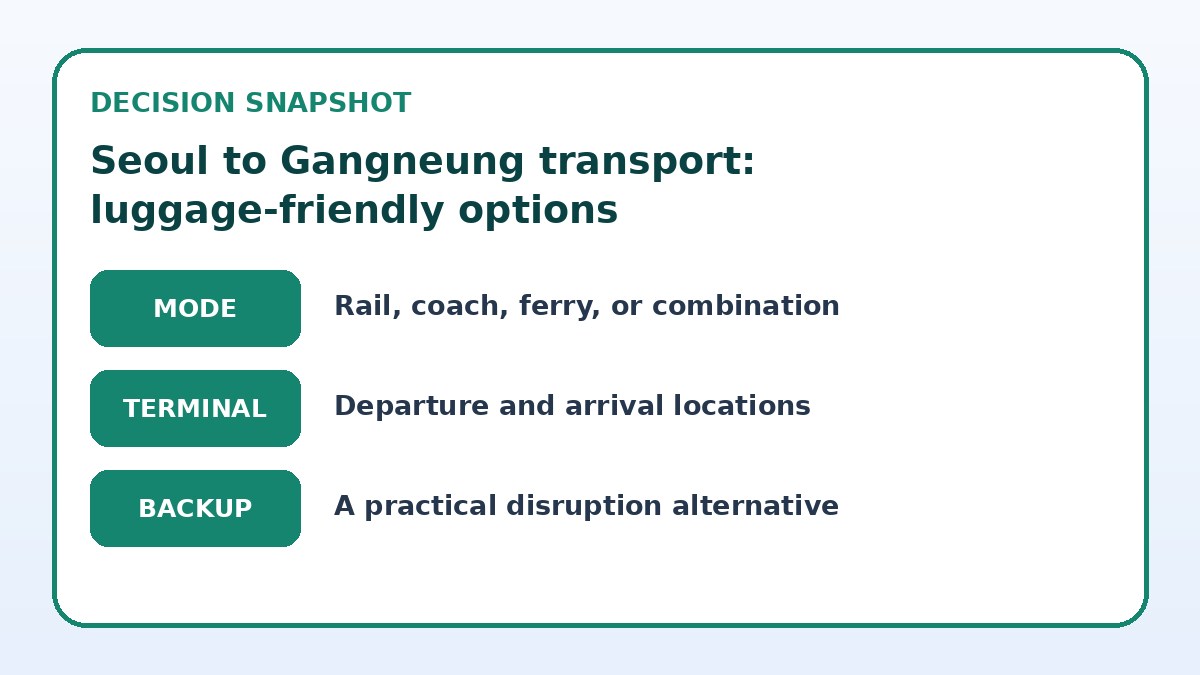
See current options before you compare the details
Availability and final conditions change. Open Trip.com now or keep reading for the practical comparison.
Direct trains: ease of riding with bags
Direct intercity trains typically offer stable seats, a flat place to stow smaller bags at your feet, and overhead racks or designated luggage zones. For solo travelers with a single medium-sized suitcase and a daypack, this often means the least physically demanding option: you carry bags onto the platform, board once, and disembark at your destination without moving luggage between vehicles. Trains also limit the number of times you need to lift a heavy bag, which helps if you’re traveling alone.
Tradeoffs include platform access and crowding at peak times—some stations have stair-only access or long distances between concourse and platform. Verify whether the service is direct or requires a change, whether reserved seats are available, and if there are explicit size or quantity limits for luggage. On the operator’s booking page look for luggage dimensions, overhead-rack rules, and any charged excess-luggage policies before you finalize.
Express buses: simpler boarding, limited storage
Express buses often stop at central terminals or highway interchanges and can be straightforward to use: load large suitcases into the hold, ride with a single ticket, and retrieve bags at the destination. For many solo travelers, the baggage-handling step is clear—you hand your bag to the driver or staff, they place it below, and you don’t need to juggle it in crowded stations. Buses can be a practical choice if you value a single transfer and a staff-handled hold.
The tradeoff is that bus underfloor holds vary by vehicle, and you may need to wait while luggage is unloaded, or verify your bag isn’t stacked inaccessible. Buses may have tighter space for carry-on items inside the cabin, and some services limit the number or size of free hold items. Always check the operator’s terms on the final booking page for hold size limits, handling procedures, and whether staff will assist with heavy items.
| Approach | Best for | Tradeoff to check |
|---|---|---|
| Direct train | Travelers who want a single-boarding journey with seat space and fixed stops | Platform access and luggage racks vary; check reserved-seat and luggage policies |
| Express bus | Those preferring staff-handled hold storage and central terminal boarding | Hold size and access timing can be restrictive; confirm hold rules and unloading process |
| Taxi/private transfer | Door-to-door convenience and minimal handling for multiple or oversized bags | Higher cost and variable trunk size; request and confirm vehicle class and trunk capacity |
| Mixed modes | Travelers balancing cost, schedule flexibility, and access to out-of-center addresses | More coordination and lifts between modes; verify each segment’s luggage rules |
Ready to check the option that fits your plan?
Use your exact dates and traveler details so the provider page can show the current total and conditions.
Taxis and private transfers: door-to-door with caveats
A taxi or private transfer offers door-to-door convenience and removes the need to lift and carry luggage between modes. For a solo traveler with multiple or oversized bags, a private car means you control loading and stops, and you’re not sharing hold space with strangers. If accessibility, late arrivals, or travel with delicate gear is a concern, confirm that the vehicle type you request has sufficient trunk or cargo capacity.
The tradeoff is cost and verification: trunk sizes differ widely between sedans, compact cars, and larger SUVs or vans. Always request the vehicle class you need and confirm the provider will send a vehicle with the required trunk dimensions. If you book through a platform, check the final booking page for vehicle photos, trunk dimensions, and cancellation terms. For ad-hoc street taxis, inspect trunk space before you load heavy items.
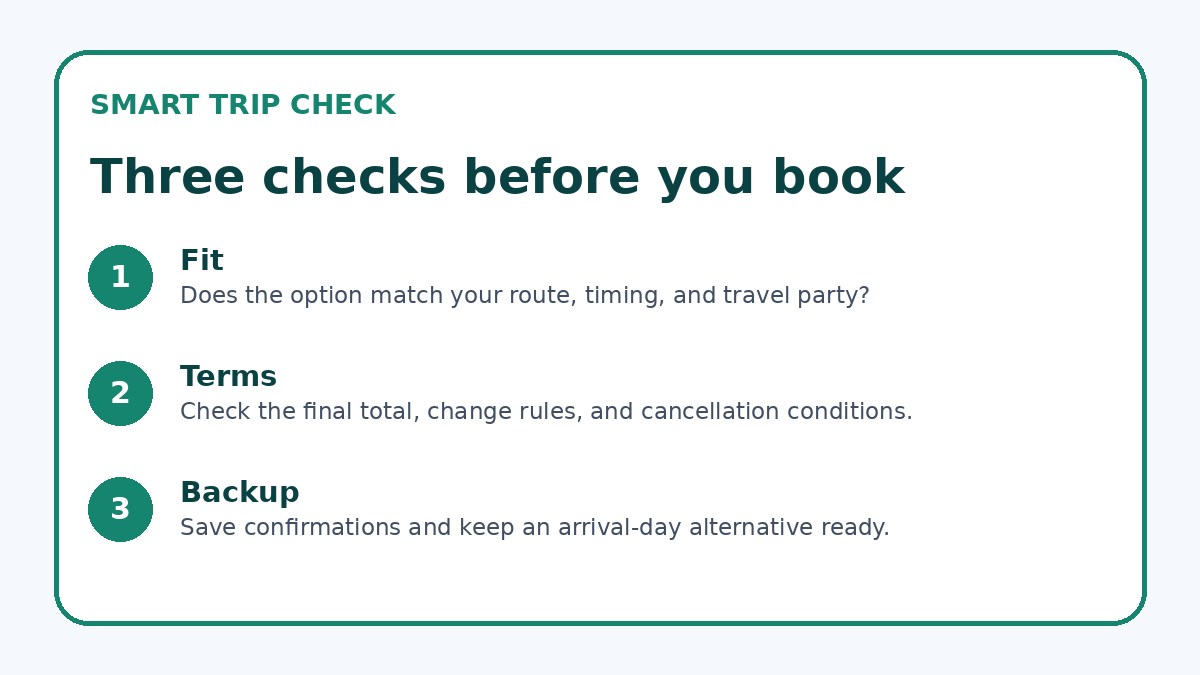
Before you book
- Measure suitcase dimensions and weigh your bag to compare with operator luggage limits on the booking page.
- Confirm whether your chosen train or bus is direct or requires a transfer; plan extra time if changing platforms.
- If booking a taxi or private transfer, request the vehicle class and ask for trunk dimensions or photos before confirming.
- Check station access details—elevators, long stairs, or platform distance—to plan how you’ll move luggage.
- Pack a compact lock and a brightly colored tag so staff can quickly identify your hold luggage at arrival.
- Buy refundable or changeable tickets when possible so you can adjust if luggage rules change or connections are missed.
Mix-and-match: when transfers or mid-route stops matter
Sometimes the best choice combines modes—train to an interchange, then a short taxi—especially if your station access is cumbersome or your accommodation is outside the town center. When planning a mixed route, prioritize minimizing the number of lifts: choose a transfer point with elevators or short walking distances and allow extra time to move luggage between vehicles. A smooth mix reduces physical strain and the chance of leaving items behind.
The downside is increased coordination: separate tickets can have different luggage rules, and missed connections add stress when you’re solo. Compare total door-to-door time, number of platform changes, and the effort of carrying bags between modes before you buy. Verify each segment’s luggage policy on the carrier’s final confirmation pages, and leave slack in your schedule for baggage handling or unexpected delays.
Frequently asked questions
Can I bring a large suitcase on trains between Seoul and Gangneung?
Many intercity trains accept standard suitcases but operators set their own rules on size, number, and placement. Some trains have overhead racks and a designated luggage area near the doors; others expect smaller items in the cabin and larger pieces in a luggage space. Before you book, check the operator’s final booking page for specifics: permitted dimensions, whether you need a reservation for oversized luggage, and any fees or restrictions that might apply.
Are buses better than trains for handling heavy bags?
Buses can be convenient because staff usually load large suitcases into underfloor holds, which reduces the amount you personally lift. However, hold sizes vary and unloading can take time at busy terminals. Trains may let you keep smaller bags with you, which reduces handling but requires lifting onto racks or placing at your feet. Compare the bus company’s hold rules and the train operator’s luggage guidance on their booking pages to see which suits your needs.
How should a solo traveler choose between a taxi and public transport with luggage?
Decide by weighing convenience, cost, and vehicle capacity. If minimizing transfers and physical effort matters most, a taxi or private transfer that matches your luggage volume is preferable. If you’re budget-conscious and comfortable lifting your bags once or twice, trains or buses may work fine. Whatever you choose, confirm trunk or hold capacity, pickup/drop-off logistics, and any extra baggage charges on the supplier’s final booking page before you commit.
Final planning note
Choosing how to travel from Seoul to Gangneung with luggage comes down to the effort you want to expend and how much control you need over your bags. Direct trains and express buses reduce the number of times you lift luggage, while taxis and private transfers reduce handling altogether at the expense of higher cost and the need to verify vehicle capacity. Mixed itineraries can balance price and convenience but require careful coordination and checking each carrier’s luggage rules. Before you book, measure your bags, review operator luggage policies on the final booking pages, and leave buffer time for transfers or unloading so your solo journey is smooth and stress-free.
Continue planning
Check current options and final conditions
Use the provider page to confirm live availability, the final total, cancellation terms, and every condition that matters to your trip.
This evergreen planning guide was created with AI-assisted drafting and a structured quality review. It does not display live prices, schedules, availability, visa guidance, or provider rankings. Verify current details before booking. Some links are affiliate links; we may earn a commission at no additional cost to you.