If you need to travel solo from Sydney to Canberra and flexibility matters, start by deciding whether you want fewer changes, loose timing, or the ability to cancel or rebook easily. Rail and coach are the main door-to-door public options; some trips mix a train to a regional hub plus a coach shuttle or rideshare for the final leg. The practical choice depends on where you start in Sydney, where you need to arrive in Canberra, how much luggage you carry and how much schedule certainty you require. This article compares ticket flexibility across common approaches, highlights terminal fit and luggage handling, explains how to evaluate transfer friction, and gives a simple disruption backup plan so you can book with confidence rather than guesswork.
Choosing between rail, coach, or a mixed approach
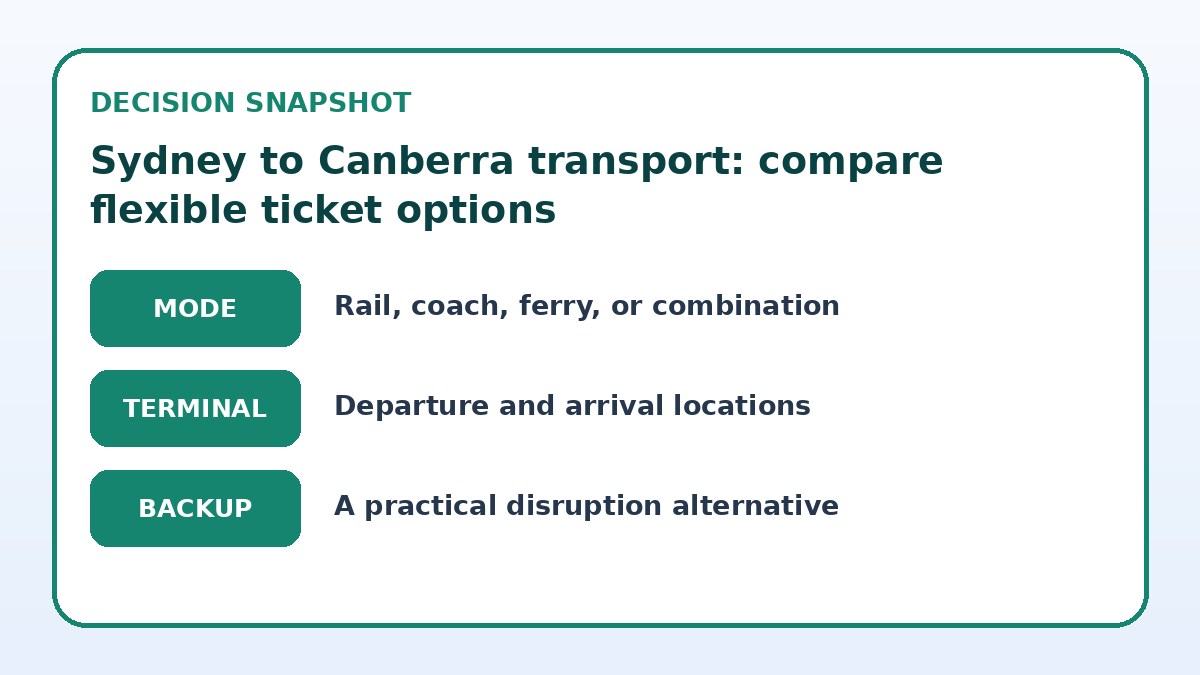
Start by mapping how each mode fits your origin and final address. Rail often serves central urban terminals which can be convenient if you are staying near Sydney’s stations and Canberra’s central stops; coaches may offer more stops closer to suburban pickup points or Canberra neighbourhoods. A mixed approach — for example rail for the main intercity leg then an onward coach, local bus, or rideshare — can reduce travel time on narrow roads and give more flexible arrival points, but it increases the number of tickets and potential transfer friction to manage.
When assessing ticket flexibility, compare the ease of changing each leg independently versus a through-ticket. Separate tickets can allow last-minute swaps on one leg without affecting the other, but they may expose you to missing a connection without recourse. A single through-ticket might include protections for missed connections but could have stricter change rules. If you need flexibility, look for options that let you rebook or cancel with minimal fees and clear online self-service options; always confirm the exact change and refund policy on the provider’s final booking page.
Choose the end-to-end journey plan
| Journey approach | Best for | Friction to check |
|---|---|---|
| Book a single through-ticket covering the whole trip | Travellers who want a single booking confirmation and protection for missed connections | Often involves stricter change rules and higher fees for flexibility compared with separate tickets |
| Buy separate tickets for each leg (train + coach or local transfer) | Solo travellers prioritising low-risk scheduling and the ability to change one leg independently | You assume responsibility for missed connections and may need to buy a new ticket if delayed |
| Choose fully flexible/refundable fares on your preferred mode | Those who need last-minute freedom to change plans or expect uncertain schedules | Flexible fares usually cost more and require checking exact refund and exchange windows before purchase |
| Mix budget tickets with a paid backup (rideshare/taxi) plan | Solo travellers aiming to save on fares while keeping a practical fallback for disruptions | You pay extra for the fallback if needed and must manage separate arrangements quickly during disruptions |
Check live intercity options
Look beyond the ride itself and compare terminals, transfers, luggage, and arrival fit.
Terminal fit, luggage, and transfer friction
Terminal fit matters more for door-to-door practicality than ride comfort. Check where services pick up and drop off in both cities: central coach stations, suburban depots, or train stations may be multiple kilometres from your accommodation. Consider the walking distance, public-transport connections, and the availability of a short rideshare or taxi hop. Luggage handling varies: some coaches have checked-bag service, trains may have luggage racks but limited staff assistance, and mixed routes force you to manage carry-on transfers between vehicles.
Transfer friction increases with the number of ticketed legs. Evaluate realistic connection times — not just scheduled minutes — allowing for potential delays, ticket queues, and luggage retrieval. If you travel light and can move quickly from platform to platform, separate legs can be practical and flexible. If you carry more bags or value a single confirmation for the whole journey, seek through-tickets or services that explicitly protect connections; verify luggage allowances, carriage rules, and where to collect or store bags on the provider pages before completing a purchase.
Timing flexibility and how to interpret ticket rules
Timing flexibility covers three things: how late or early you can travel, how easily you can change times, and whether you can get a refund. Ticket classes and fare types often encode these tradeoffs: refundable or flexible fares allow same-day changes or cancellations with modest fees, whereas the cheapest fares may be non-refundable and fixed to a specific departure. On some services, open or flexible returns exist allowing travel on any service within a date range; on others only fixed reservations are possible. Read the provider’s terms that describe change windows, required fees, and whether changes can be made online without calling customer support.
When comparing options, simulate changes on the provider’s booking interface so you can see real rules and any displayed fees before you commit. Note cut-off times for changes (for example, whether changes are allowed within 24 hours of departure), and whether ticket credits or vouchers replace cash refunds. Also check whether tickets are name-specific and whether you need to present original payment details to process a refund. If the final booking page is unclear, contact the provider’s support and keep screenshots of policy pages and confirmation emails as proof in case of disputes.
Compare the practical alternatives
Use the final page to confirm what is actually offered on your dates and save a workable fallback.
Intercity travel checklist
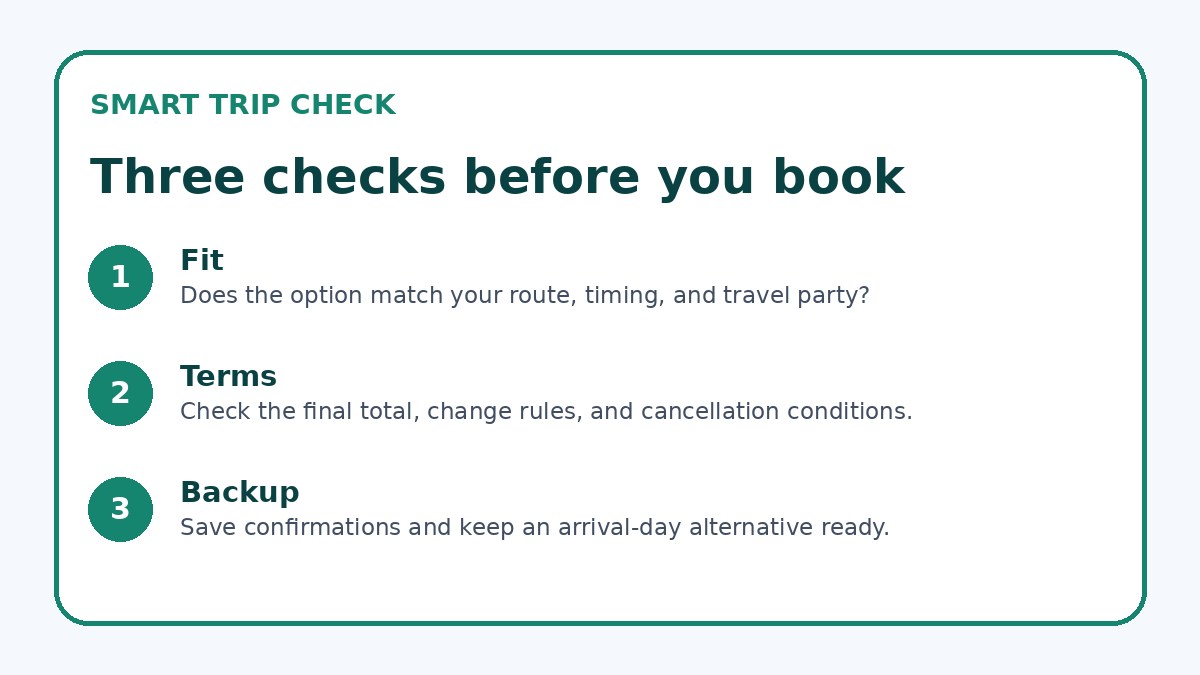
- Confirm pick-up and drop-off locations in both Sydney and Canberra and map the final short transit to your accommodation.
- Read the exact change, cancellation, and refund rules shown on the provider’s final booking page before you pay.
- Compare whether a through-ticket or separate tickets gives you the protection you want for missed connections.
- Check luggage allowances and whether assistance or checked baggage service is available for each leg.
- Save screenshots of booking terms, confirmation emails, and the provider’s customer-service contact details on your phone.
- Note the next two alternative departures and local rideshare/taxi options from your arrival terminal as a disruption backup.
Disruption backup: practical steps for solo travellers
Plan a short disruption playbook before you travel. Identify the next two or three alternative departures on each mode and note the typical transfer options (local buses, rideshare, or a short taxi) from the arrival terminal to your final address. If you have separate tickets, understand that a missed train or coach connection can mean buying a new fare; if you have a through-ticket, find out how the operator handles missed connections and whether they will rebook you on the next service. Save contact numbers, and keep the booking confirmation and policy screenshots readily available on your phone.
If disruption happens, remain calm and use the provider’s official channels first: live chat, customer service counters, or social media can sometimes rebook you faster than email. For immediate onward travel, compare the cost and time of taking the next public service versus a direct rideshare to keep to your schedule. Use travel insurance for high-value trips: confirm in advance what kinds of delays or cancellations the policy covers. Finally, document unusual delays and any communications; photographic evidence and time-stamped screenshots can help with refund or reimbursement claims later.
Rail & Intercity Transport questions travelers ask
Can I change a Sydney to Canberra ticket on the day of travel?
It depends on the fare type and provider. Some flexible or refundable fares allow same-day exchanges or rebooking; the cheapest tickets often restrict changes or impose fees. Before purchasing, look for specific cut-off times and whether changes can be completed online or require calling customer service. If same-day flexibility is essential, choose a fare that explicitly states day-of-travel changes are permitted and keep the provider’s change policy screenshot with your confirmation.
Is it safer to buy one through-ticket or separate legs when travelling alone?
Safest depends on your priorities. A through-ticket centralises responsibility with one provider, which can help if you miss a connection, but through fares may limit flexibility and be more expensive. Separate tickets give you flexibility to change a single leg without modifying the whole itinerary, but you then bear the risk if a delay causes you to miss a subsequent independent connection. Consider how much buffer time you can allow, your comfort handling transfers, and whether you prefer a single point of contact for disruptions.
What should I check about luggage rules before booking?
Confirm permitted luggage size, weight limits, and whether a bag is carried in a checked hold or must be stowed by you. Some coaches offer checked-baggage handling; some trains rely entirely on passenger-managed luggage. If you plan a mixed journey, verify transfers: will you need to collect and re‑check bags, and does the next leg accept the same type of luggage? Also check any fees for oversized items and whether assistance is available at terminals in case you need help lifting or storing baggage.
Final decision note
For solo travellers on the Sydney to Canberra corridor, the right ticket is the one that matches your tolerance for schedule risk, your luggage needs, and how much time you want to spend managing transfers. If you prefer simplicity and a single contact for disruptions, a through-ticket makes sense; if you need the freedom to change one segment without affecting the rest, separate tickets may be better. Always verify the provider’s final booking page for exact change, cancellation, and luggage rules before you complete payment. Finally, build a quick disruption backup — alternative departures and local rideshare options — so you can adapt without panic if plans change.
Continue planning
Check current options and final conditions
Use the provider page to confirm live availability, the final total, cancellation terms, and every condition that matters to your trip.
This evergreen planning guide was created with AI-assisted drafting and a structured quality review. It does not display live prices, schedules, availability, visa guidance, or provider rankings. Verify current details before booking. Some links are affiliate links; we may earn a commission at no additional cost to you.