Your first hour after touching down in Seoul usually sets the tone for the whole trip. As a solo traveler, the immediate decision is straightforward: head for public transit if you prioritize cost and flexibility and are comfortable navigating trains or buses with luggage; choose a private transfer if you value door-to-door convenience, a single meeting point, and a predictable indoor drop-off. Think about how many bags you have, whether your arrival time is late or disrupted, and how well your accommodation matches transport stations or road access. This guide gives a clear practical answer up front, then unpacks tradeoffs so you can match a transfer choice to your energy level, budget, and itinerary for those first crucial hours in Seoul.
Check options for your arrival details
Use your flight, luggage, party size, and accommodation address to compare current choices.
Luggage and party size: match your bags to the mode
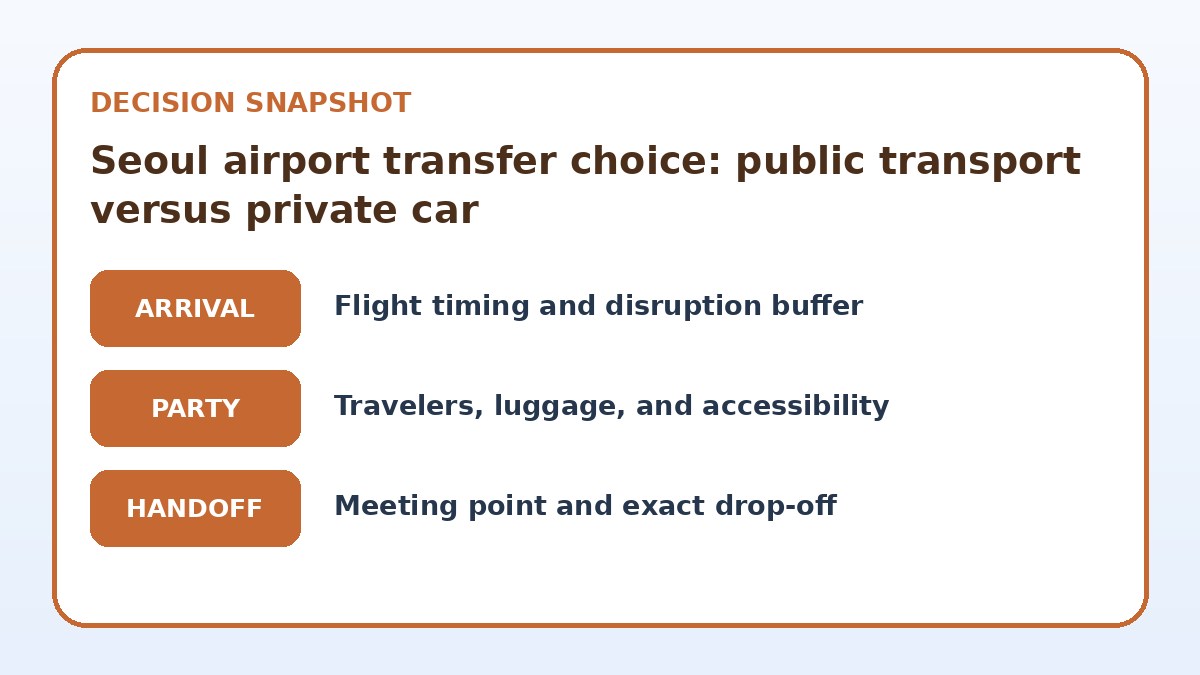
Count and assess your bags before committing. One carry-on and a personal bag is easy to manage on Seoul’s subway and airport express services; stairs, escalators, and station transfers can still be quick if you pack compactly. If you have multiple large suitcases, camera gear, or bulky items, a private car removes the physical strain of dragging bags through ticket gates, transfers, and crowded platforms. Consider how you handle luggage on your own: are you comfortable lifting a heavy bag onto a train rack or standing with it in a carriage for 30–60 minutes?
Party size changes the math too. Solo travelers rarely need a full private vehicle unless they want privacy, door-to-door drop-off, or have unusual schedules or mobility needs. Shared shuttle services exist but can extend travel time with multiple stops, so compare whether a private door-to-door ride saves time enough to justify the cost. Also factor in the return journey: if you have fewer bags and a daytime departure, public transit may be the same sensible choice both ways.
Arrival details to have ready
- Check your landing terminal and note the arrivals hall number or a clear indoor landmark before you disembark.
- Count bags and photograph them so you can confirm your baggage with a driver or recall which suitcase is yours after transfer.
- Save screenshots of the exact hotel address, nearest subway station, and the recommended exit number on your phone.
- If booking a private transfer, confirm the driver’s meeting point, phone number, vehicle model, and a reasonable wait-time policy.
- If using public transit, screenshot route options including transfers and operating hours; mark fallback taxi ranks near the station.
- Keep a local payment method and a ride-app with a working phone number ready in case you need to change plans on arrival.
Late or disrupted arrival: safety and stress considerations
Late-night or significantly delayed arrivals change priorities. Seoul’s subway network has operating hours and buses may reduce frequency late at night, so confirm public transit schedules before deciding to rely on them after midnight. A private transfer or pre-booked ride provides a scheduled meeting point and often softens the stress of an unexpected late arrival. If you prefer to minimize unknowns and arrive at a lit, staffed hotel entrance, a private pickup offers reassurance when you’re tired or when signage is confusing.
That said, not every late arrival necessitates a private car. If you land within subway hours and feel alert enough to make connections, public transit remains a safe option with frequent trains, staffed stations, and clear English signage at major stops. Always have a backup plan: identify a reliable indoor meeting point in the airport, save a hotel contact number, and keep a payment method for a taxi or ride app available in case your original choice becomes impractical.
Match the transfer to your arrival
| Arrival approach | Best for | Detail to verify |
|---|---|---|
| Airport subway/train (including express) | Budget-minded solo travelers with light luggage and daytime arrivals. | Lower cost and frequent service but requires gate transfers, luggage handling, and adherence to operating hours. |
| Airport bus or shared shuttle | Travelers who want fewer platform changes and a direct route to a general neighborhood. | Easier on luggage than trains but can be slower with stops and less predictable door-to-door service. |
| Private pre-booked transfer (car or van) | Solo travelers arriving late, with heavy luggage, or wanting a stress-free door-to-door arrival. | Offers convenience and direct drop-off but is costlier and requires confirming precise meeting details with the provider. |
| Taxi or ride-hailing on arrival | Flexible travelers who need on-demand transport without the lead time of a pre-booking. | Immediate availability in many cases, but fares and pickup points vary; verify the driver’s pickup instructions and any local surcharges. |
Make the meeting plan clear
Check the final pickup instructions, waiting conditions, and exact drop-off coverage.
Meeting-point clarity: reduce wait time and confusion
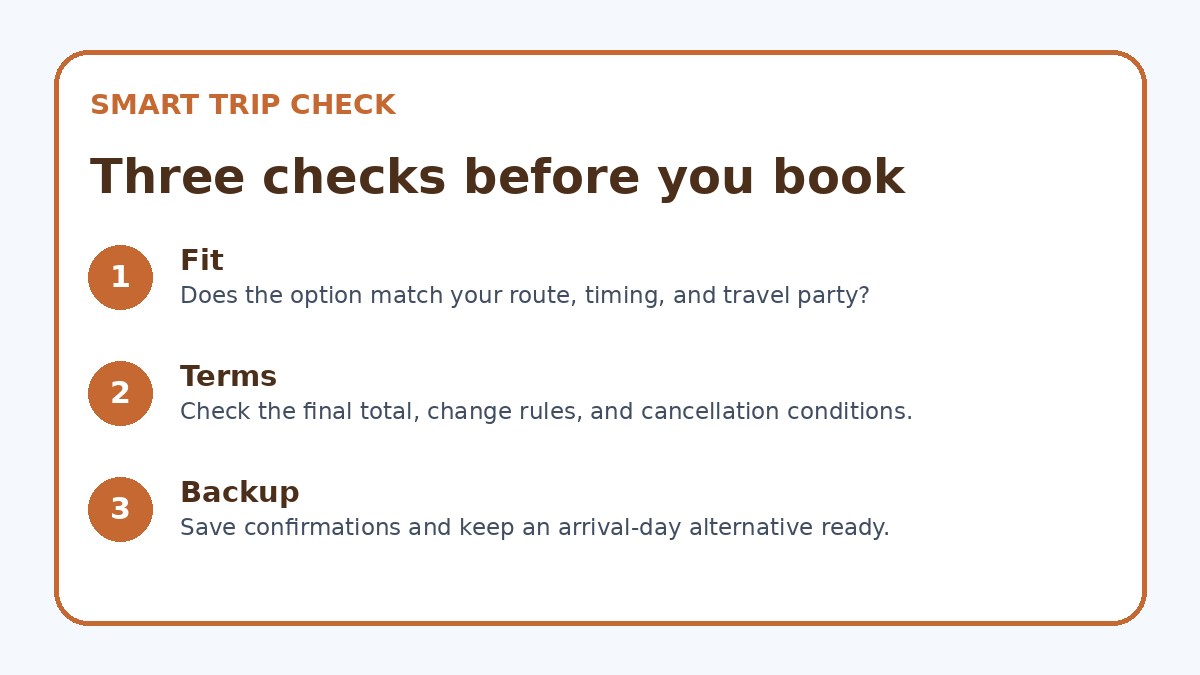
Whatever transfer mode you choose, clarify the meeting point before you land. Airports have multiple exits, terminals, and indoor meeting spots; state the terminal, gate or arrival hall, and a vivid landmark such as a café, an information desk, or a numbered exit. For private transfers, confirm whether the driver meets you inside customs, in the arrivals hall, or outside the terminal curb; some services wait at a standardized meeting point while others charge for extended waits outside. Clear instructions keep you from wandering through crowds while the driver searches for you.
For public transit, meeting-point clarity means mapping the exact subway station exit closest to your accommodation and noting transfer directions. Use screenshots of station maps and the number or name of the exit to avoid last-minute navigation under pressure. If you plan to meet a host or a local contact, agree on a specific landmark and a time buffer to allow for baggage collection and immigration. Save the contact number for the driver or host in both local and international formats.
Destination-side drop-off fit: door, curb, or station access
Consider how accessible your lodging is by road versus rail or foot. Many Seoul accommodations are a short walk from subway exits but may face narrow streets or pedestrian-only alleys that complicate car drop-offs. If your hotel has a formal entrance on a busy street, a private vehicle may pull in close; if it is on an inner lane, you may still need to walk a block with luggage. Verify your accommodation’s recommended arrival instructions and whether they expect guests to approach by subway or car.
If your plan is to start exploring immediately after arrival, prioritize being dropped near a major station with clear onward connections. A privately arranged drop-off near a station combines convenience with mobility. Conversely, if you value arriving directly at the property to check in or rest, a private transfer may better match that desire. Before booking, check whether your accommodation offers luggage storage for early arrivals and whether the door or main desk is staffed at your arrival time.
Airport Transfer & Local Mobility questions travelers ask
How much time should I allow between landing and leaving the airport for public transit?
Allow extra time for immigration, baggage claim, and walking to the station; this can easily add 45–90 minutes depending on queues and terminal layout. When planning, factor in train or bus departure times and transfer walking distances, and check the operating hours of the service you intend to use. If your itinerary has tight onward connections or you feel tired after a long flight, a private transfer can reduce the stress of rushing between underground platforms and street-level exits.
What should I verify on a private transfer provider’s page before booking?
Verify the exact pickup location (inside arrivals, curbside, or information desk), the driver’s contact method, the vehicle type and luggage allowance, and the provider’s cancellation and wait-time policies. Check whether the price covers tolls, parking, or additional stops, and whether they provide a local emergency contact. If possible, confirm the driver will wait inside the terminal if customs take longer, and save screenshots of the booking confirmation and contact details in case you lose mobile data on arrival.
Is it safe to use ride-hailing apps in Seoul as a solo traveler?
Ride-hailing and taxi apps operate widely in Seoul and can be safe and convenient for solo travelers, but it’s sensible to verify the pickup point the app shows and confirm the vehicle details before getting in. Keep your phone charged, share your ride status with someone you trust, and use well-known app providers or local taxi companies with clear reviews. If you have mobility or accessibility needs, check vehicle suitability in advance and confirm the driver understands any special requirements.
Final decision note
For solo travelers in Seoul, the practical decision in the first hour is to match energy, luggage, and arrival time to the transport mode: take public transit if you’re traveling light and arrive during daytime, or choose a private transfer when you want minimal fuss, door-to-door service, or are arriving late. Use the checklist to lock in meeting points, confirm luggage allowances, and prepare fallback taxi or ride-app options. Before you finalize any booking, check the provider’s pickup instructions and wait policies on their page, and consider Trip.com as one option to compare current availability. A small bit of preparation before deplaning keeps the first hour in Seoul calm and efficient.
Continue planning
Check current options and final conditions
Use the provider page to confirm live availability, the final total, cancellation terms, and every condition that matters to your trip.
This evergreen planning guide was created with AI-assisted drafting and a structured quality review. It does not display live prices, schedules, availability, visa guidance, or provider rankings. Verify current details before booking. Some links are affiliate links; we may earn a commission at no additional cost to you.