If you’re traveling from Singapore to Bangkok with extra suitcases or unusually sized gear, start your booking process by collecting exact trip details: travel dates, traveler ages, total piece count, individual weights and dimensions, and whether items are fragile or need special handling. The practical answer: prioritize fare rules that include the baggage allowance you need or allow low-cost add-ons with predictable fees, then compare routing and connection risk for transfers that could force you to reclaim and recheck luggage. This approach keeps surprises at check-in and avoids missed connections or costly last-minute baggage purchases. Below you’ll find a step-by-step decision framework — covering routing choices, baggage and connection risk, schedule fit, and fare condition checks — plus a concise pre-booking checklist you can use right now to prepare for live searches and bookings.
See live routes for your exact travel day
Compare direct and connecting choices with the same baggage and traveler details.
Routing: direct vs connecting and what it means for luggage
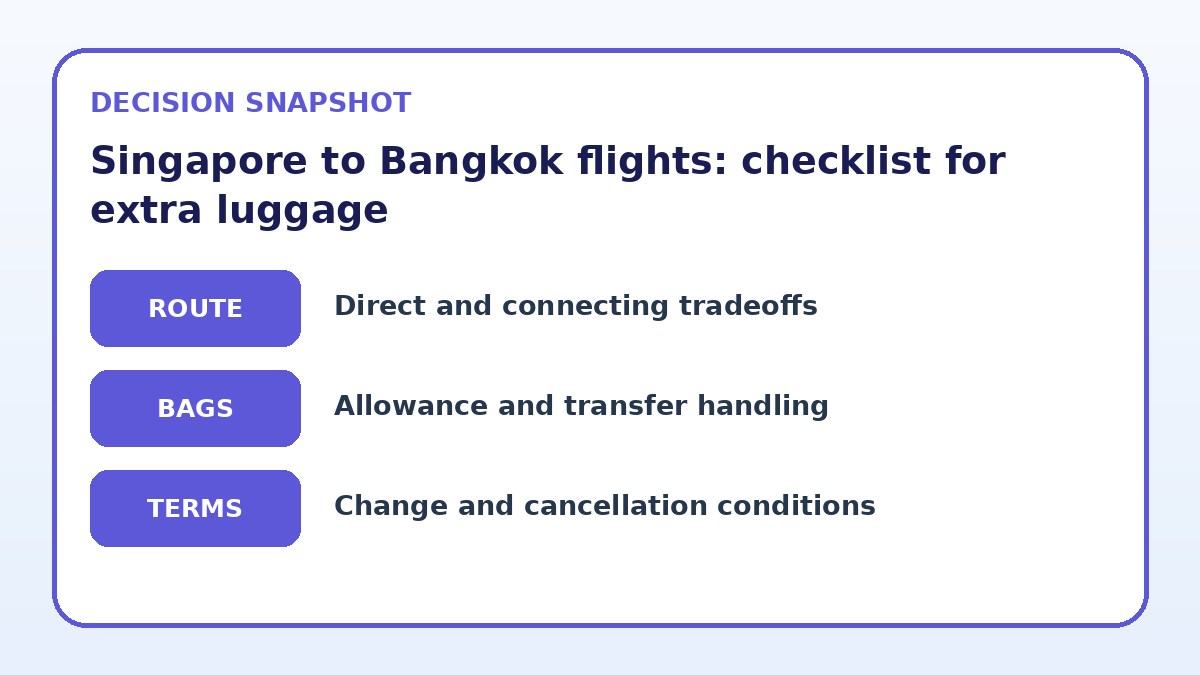
When choosing between direct and connecting Singapore to Bangkok flights, start by listing all routing options available for your travel dates. Direct flights remove the baggage transfer step, so checked bags typically go from origin to final destination without passenger intervention; this reduces the chance of missed bags. Connecting itineraries can be attractive for lower fares or better schedules, but they introduce points of failure: baggage transfer between aircraft and different ground handling procedures at intermediate airports. For travelers with extra luggage, a direct flight or a single-ticket itinerary that guarantees through-checking of bags is generally simpler and less risky.
If direct flights are limited or more expensive, scrutinize connecting options for three details: whether both legs are on the same ticket, whether the connection airport requires customs and baggage re-clearance, and how much buffer time you’ll have. A single-ticket connection handled by partner carriers often ensures your luggage is tagged to the final destination. By contrast, separate tickets can mean you must collect and recheck luggage, which is time-consuming and heightens the chance of missed onward flights. Before booking, verify the final booking page to confirm baggage transfer policies for each routing option.
Baggage and connection risk: what to verify before booking
Before you select a fare, gather exact details about each piece of luggage: weights, dimensions, and whether any items are oversized, fragile, or considered sporting equipment. Different fare classes across carriers have different inclusions; low-cost fares frequently exclude checked bags, while full-service fares may include one or more pieces. Even when baggage is allowed, rules for weight versus piece concept differ: some carriers allow limited number of pieces up to a weight per piece, others allow higher weight totals. On the airline’s final booking page verify allowance specifics, permitted dimensions, and overweight/oversize fee schedules rather than relying on third-party summaries.
Connection risk compounds baggage uncertainty. If your itinerary requires switching airlines or reclaiming baggage through immigration, allocate ample transfer time and plan for manual recheck procedures. Confirm whether the booking platform or airline will tag bags to Bangkok at check-in in Singapore, and read the carrier’s transfer handling notes. If you rely on partner interlining, check both carriers’ policies on damaged or delayed bags and the process to file a claim. For peace of mind, note customer service contacts for each carrier and have record-keeping methods for baggage tags and receipts.
Compare flight-selection strategies
| Flight strategy | Best for | Risk to check |
|---|---|---|
| Direct full-service fare with included checked bags | Travelers who want simple baggage handling and minimal transfer risk | Usually higher base fare but reduces chance of manual recheck or lost luggage |
| Low-cost direct fare plus prepaid add-on for checked bags | Cost-conscious travelers willing to manage baggage fees in advance | Lower initial price but careful checking of size/weight limits and add-on rules required |
| Connecting itinerary on a single ticket with baggage through-checked | Those balancing lower fares with some transfer complexity while keeping luggage checked through | Cheaper routing but requires reliable connection time and trust in interline handling |
| Separate tickets or mixed carriers requiring self-transfer | Flexible itineraries or complex multi-city trips where cost savings outweigh convenience | Highest baggage risk: you will likely need to collect and recheck bags, so allow long transfer times |
Recheck the complete itinerary
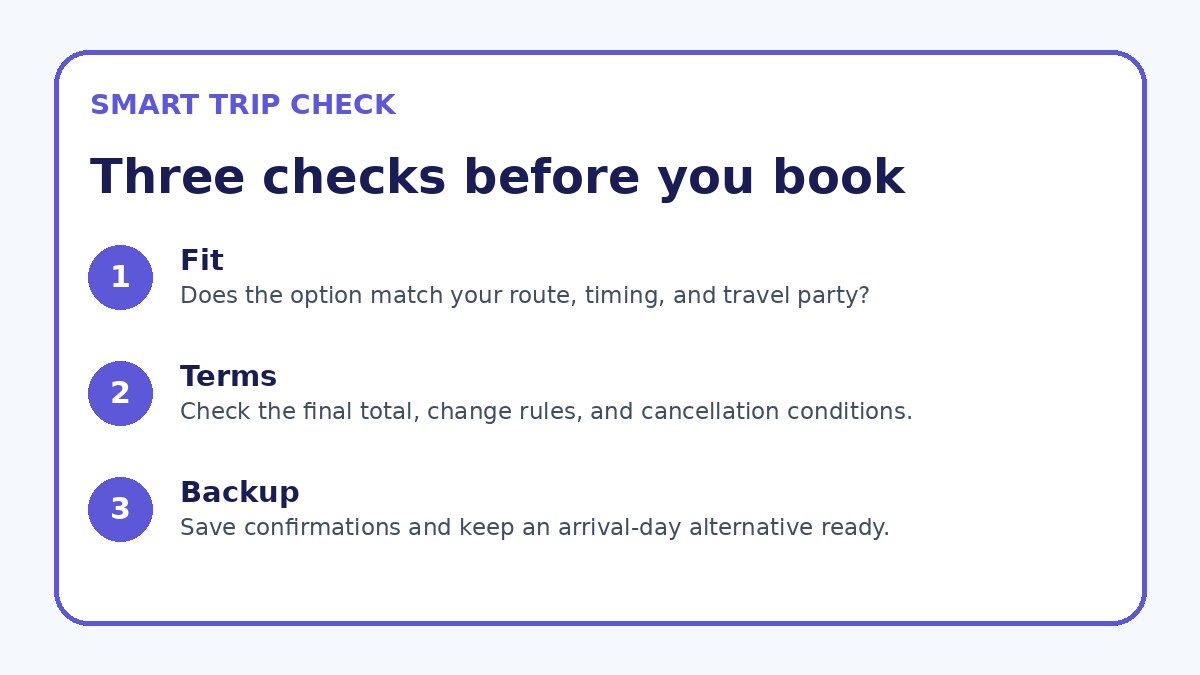
Confirm airports, connection handling, baggage, and change conditions before deciding.
Schedule fit: picking times that work with heavy luggage
Travelers with extra luggage should prioritize realistic schedules over the smallest time savings. Early morning flights can mean quieter airports and more efficient check-in counters, but they may also require earlier departures from your accommodation. Late flights can give you more packing time but might mean fewer ground services and staff to handle oversized items. Look at realistic door-to-door transfer times from your accommodation to Singapore’s departure airport and from Bangkok’s arrival airport to your final destination; allow extra buffer if you expect heavy or slow-moving luggage handling.
When evaluating connection windows, aim for longer minimums than online systems suggest, especially if you must recheck luggage or pass through immigration. Consider the logistical side: will you need a porter, special handling, or a ramp vehicle for bulky items? If so, confirm availability and potential lead times with the airline or airport services. If your schedule includes early checkouts or late arrivals, pre-arrange baggage handling services at hotels where possible to ease transfers between ground transport and the terminal.
Flight details to verify
- Record exact travel dates, passenger names as on passports, ages of all travelers, and contact details before searching fares.
- Measure and weigh every piece of luggage; note dimensions and whether any item is oversized, fragile, or hazardous.
- Decide whether you need a checked-piece allowance or can manage with carry-on plus prebooked add-ons; compare fees on the carrier’s final booking page.
- When comparing itineraries, confirm if baggage will be tagged to Bangkok on a single ticket or if you must reclaim and recheck at any connection.
- Choose flight times with extra transfer buffer if you expect manual baggage handling; allow more time than the minimum connection suggested.
- Save screenshots or PDFs of the airline’s baggage allowance, fees, and fare conditions from the final booking page for documentation at check-in.
Fare conditions: what to confirm on the booking page
Fare conditions determine whether the price you see will cover the baggage needs you’ll actually have. On the carrier’s booking page, verify included baggage allowance by pieces and weight, the fee schedule for additional pieces or overweight items, and whether those fees can be paid online in advance — often cheaper and more predictable than at the airport. Also confirm change and cancellation rules, as carrying extra luggage sometimes prompts itinerary adjustments; flexible change terms can reduce stress if you must swap dates to avoid weather or transit disruption.
Read the fine print for special handling charges and check-in deadlines; oversized and special items often require advance notice or separate booking. If you plan to combine a low-cost carrier leg with a separate long-haul ticket, verify whether the low-cost carrier permits interlining for baggage — many do not. When possible, screenshot or save the final booking pages that list your exact baggage allowance and fees. If you want a quick place to compare live availability and the booking pages that matter, Trip.com can be used to view options, but always confirm the baggage details directly on the airline’s final booking page.
Flight Guide questions travelers ask
Should I always buy an included checked baggage allowance for Singapore to Bangkok flights?
If you already know you will travel with multiple heavy bags, buying an included checked allowance on a fare that covers the pieces you need usually reduces stress and the risk of unexpected gate or airport fees. However, if the included allowance is expensive and you only slightly exceed carry-on limits, prepaying add-ons on a low-cost fare may be cheaper. The critical step is to compare the carrier’s final booking page for exact piece versus weight rules and prepayment fees, not just headline fare descriptions.
How much connection time should I allow when I have to recheck luggage en route to Bangkok?
Allow significantly more time than the standard minimum connection window when rechecking luggage, because you will need to collect bags, clear any required immigration and customs, and complete a separate check-in. Practical planners often give themselves several hours for self-transfers, depending on airport layout and whether inter-terminal transport is needed. Check the airports’ transfer procedures and the airline’s baggage recheck policies on their booking pages, and consider booking later connections to provide a safety buffer.
What documents or receipts should I keep to speed up baggage issues at check-in or claim processes?
Keep your booking confirmation, baggage allowance screenshots, and pictures of baggage tag receipts issued at check-in. If you prepay add-ons, retain the payment confirmation. For oversized or special items, save any advance-handling emails. These documents streamline discussions with ground staff and claims with carriers. If problems occur, having the proof of what was promised on the airline’s final booking page and the physical baggage tags will make it faster to resolve missing, delayed, or damaged luggage claims.
Final decision note
Traveling from Singapore to Bangkok with extra luggage is manageable if you prepare specific facts before you search fares. Prioritize whether you want included checked pieces or predictably prepaid add-ons, then compare routing and connection risk to minimize manual baggage handling. Verify the carrier’s baggage rules, fees, and transfer procedures on the airline’s final booking page and save those details. Use realistic connection buffers and know which itineraries are single-ticket through-checked versus those requiring self-transfer. With the checklist above, you can approach live booking searches confidently and reduce last-minute surprises at the airport.
Continue planning
Check current options and final conditions
Use the provider page to confirm live availability, the final total, cancellation terms, and every condition that matters to your trip.
This evergreen planning guide was created with AI-assisted drafting and a structured quality review. It does not display live prices, schedules, availability, visa guidance, or provider rankings. Verify current details before booking. Some links are affiliate links; we may earn a commission at no additional cost to you.