If you’re carrying extra suitcases, bulky gear, or more than one bag, the practical answer is to pick the approach that minimizes handling and unwanted walking: choose a route with the fewest transfers and clear door-to-door options. For many travelers that means a single-transfer or direct rail itinerary with advance confirmation of luggage allowances and station access, or a private transfer for full door-to-door convenience when budget and street access allow. Coaches can save money but often mean more lifting and constrained storage; multi-modal combinations (train plus taxi or luggage delivery) balance cost and comfort. Before you book, decide which friction you most want to avoid — stairs, crowded platforms, trunk loading, or timed connections — and then verify luggage rules, station transfer distances, and pickup/dropoff points on the provider’s booking page.
Choosing between rail, coach, and mixed door-to-door plans
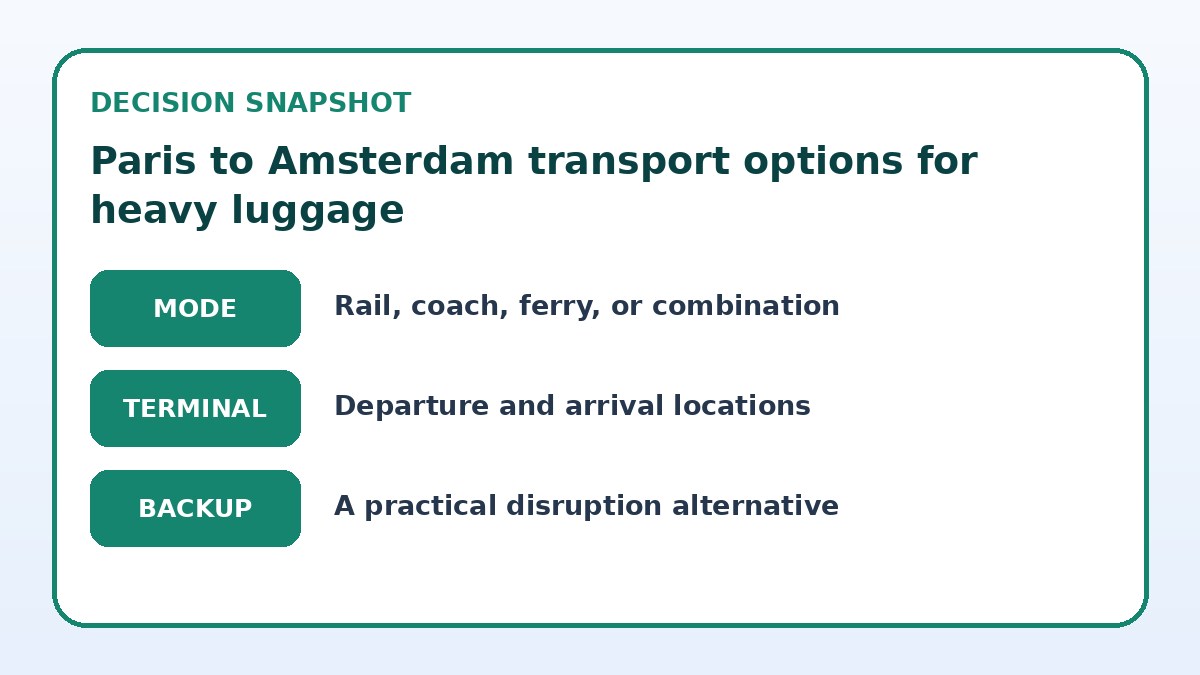
Start by deciding which type of friction you want to avoid: repeated carrying up and down stairs, rolling cases over cobbles, or lifting into vehicle bays. High-speed and intercity trains usually provide level boarding and generous open aisles, which makes them attractive with heavy luggage if you can store bags near your seats or on designated racks. Coaches often have larger external storage compartments but require lifting into low bays and sometimes long walks between bay and vehicle; that’s manageable but increases handling steps.
When budget, schedule, and comfort conflict, consider a mixed plan. For example, take the fastest rail segment for the long distance and arrange a booked taxi or private transfer at each end to bridge stations and lodging. Luggage delivery services are another option when you want to avoid carrying bulky items through stations, but always confirm pickup/dropoff windows and insurance limits on the provider booking page.
Choose the end-to-end journey plan
| Journey approach | Best for | Friction to check |
|---|---|---|
| Direct or single-transfer train with booked taxis at ends | Travelers prioritizing minimal handling and reliable station access | Higher total cost than coach but far fewer manual lifts and simpler platform navigation |
| Long-distance coach with large external bays | Those looking to minimize walking with steady loading by drivers | Requires lifting into bay and may add waiting time; less flexibility for last-mile door-to-door drops |
| Multi-modal split: fast train plus local public transport or ride-hailing | Budget-conscious travelers who want balance between speed and convenience | More moving stages can increase handling unless taxis are used for the last mile |
| Private door-to-door transfer (car or van) for whole route | Groups with many large items or travelers who must avoid lifts and stairs entirely | Most direct and convenient but usually the most expensive and subject to street access limitations |
Check live intercity options
Look beyond the ride itself and compare terminals, transfers, luggage, and arrival fit.
Terminal fit: stations, curb access and transfer distances
Stations in Paris and Amsterdam vary: some have multiple entrances, lifts, escalators, and long platform walks; others are compact but busy. Before you commit, map the exact arrival and departure terminals to your accommodation and note whether there are elevators, ramps, or significant platform gaps you’ll need to negotiate. If your itinerary includes a connection, estimate the route between platforms and add extra time to account for slow-moving luggage, ticket checks, or crowded corridors.
Curb access is key for door-to-door practicality. If you plan taxis or private cars, confirm designated pickup zones and whether they’re adjacent to the platform level or require an additional stair or elevator. For coach terminals, find out where luggage is loaded and whether you can remain by the vehicle during loading. Always check provider booking pages for specific pickup instructions and allowable lead times to avoid last-minute surprises.
Luggage and transfer friction: what to pack and how to handle it
Think about how often and how far you want to move your bags during the trip. Use sturdy wheeled suitcases with reliable handles, protective corners, and a well-fitting carry strap or sling for odd-sized items. If you have fragile gear, use hard-shell cases or padded bags and clearly mark them; consider a secondary small backpack for essentials so you can leave heavier items in storage or the vehicle during short stops.
Plan for contingencies: bring a luggage scale to avoid unexpected handling due to weight limits, use ID tags and a mobile photo of your bags, and pack a compact moving strap to help two-person lifts. If you have several large items, pre-book assistance at stations when available so staff can help you with stairs, elevators, or platform transfers. Verify luggage policies and help services on the operator’s final booking page before payment.
Compare the practical alternatives
Use the final page to confirm what is actually offered on your dates and save a workable fallback.
Intercity travel checklist
- Measure and weigh all bags and photograph them; record dimensions and weight for operator verification and to avoid last-minute rejections.
- Map exact station entrances, platform transfer routes, and curbside pickup points for both origin and destination before booking.
- If you need help, pre-book station assistance or porter services and confirm arrival time windows on the booking page.
- Reserve taxis or private transfers for the first and last mile when station access is difficult or you have many heavy items.
- Pack essentials (documents, medication, a change of clothes) in a small daypack kept on you during transfers.
- Save contact numbers for station information, booked transfer providers, and your accommodation to coordinate pickups and resolve delays quickly.
Timing flexibility and building a disruption backup
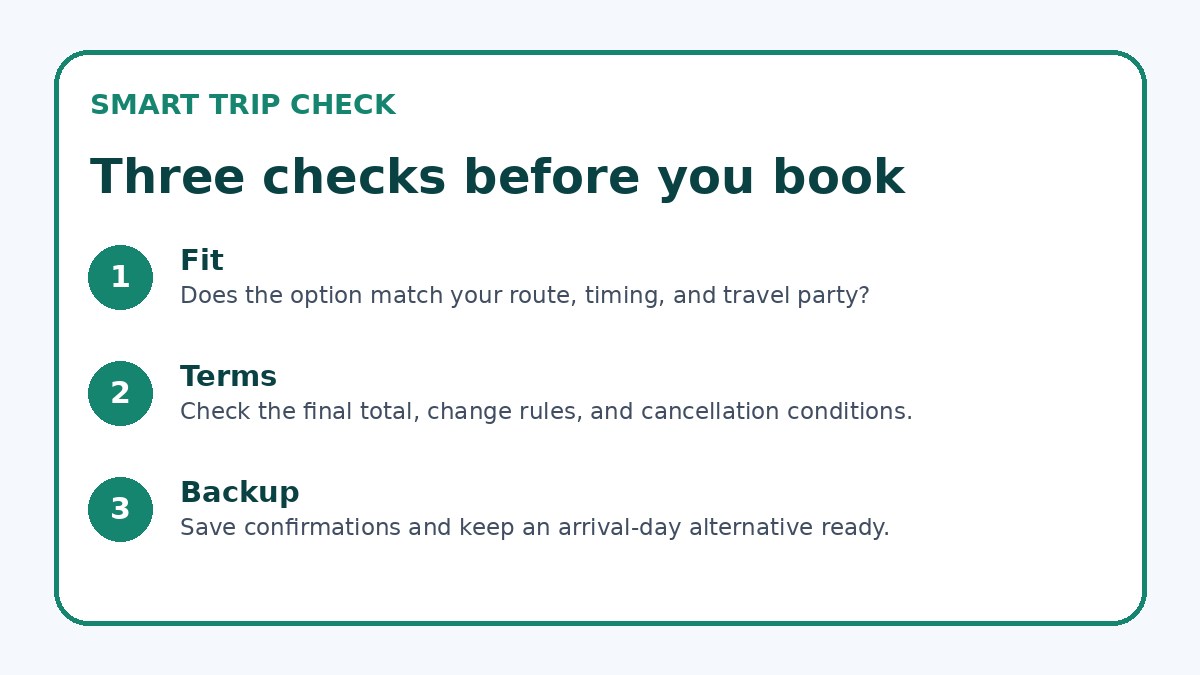
When traveling with extra luggage, build extra transfer buffer into your schedule. Allow more time for connections and pick-ups than you would with just hand luggage; even a single missed train becomes much harder when several suitcases must be re-routed. If you’re traveling during peak periods or on a complex itinerary, choose longer connections or earlier services to reduce stress and allow time to secure your luggage in lockers or left-luggage facilities when necessary.
Create a simple backup plan before you leave: identify an alternate later service, a nearby station or coach stop with easier street access, and local taxi companies that accept larger items. If you rely on a multi-step plan, buy flexible tickets or refundable options when possible and save the contact details for station assistance and luggage services. Always verify the providers’ transfer points, luggage rules, and refund/cancellation policies on the operator’s booking pages so you can act quickly if plans change.
Rail & Intercity Transport questions travelers ask
How do I decide between taking a train or a coach from Paris to Amsterdam with bulky luggage?
Decide by comparing total handling steps, not just travel time. Trains often mean fewer lifts and easier aisle storage, which reduces physical strain when you have bulky luggage. Coaches provide large external bays but add a lifting step into the compartment and sometimes a longer walk between pick-up points and city centers. Assess your ability to lift, the number of pieces you have, and whether you need direct door-to-door drops; then verify luggage allowances and loading procedures on each provider’s booking page before you buy.
Can I rely on taxis or ride-hailing for the station-to-hotel legs if I have oversized bags?
Yes, taxis and many ride-hailing vehicles are practical for station-to-hotel transfers with oversized or multiple bags, because they eliminate extra lifts and long walks. However, check vehicle size options and communicate in advance if you need a larger van—some apps let you select vehicle types or request assistance. Also confirm pickup/dropoff curb points and any additional charges for oversized luggage on the provider’s booking page to avoid surprises at the curb.
Should I use a luggage shipping service to avoid carrying heavy bags between Paris and Amsterdam?
Luggage shipping can be a useful way to avoid physical handling, but it introduces timing, pickup windows, and insurance considerations. If you use such a service, confirm guaranteed delivery windows, how items are handled at both ends, and liability limits on the provider’s booking page. Consider parcel tracking and whether you can be present for pickup and delivery; for fragile or valuable items, evaluate whether a private transfer might be simpler and safer despite higher cost.
Final decision note
Travelers with extra luggage should prioritize route choices that reduce the number of manual moves and the distance between vehicle doors and their accommodation. For many, that means favoring rail with a single transfer and pre-booked taxis for the first and last mile, or choosing a private transfer when door-to-door simplicity outweighs cost. Coaches may work for large, non-fragile items but accept additional lifting and timing constraints. Whatever you choose, verify luggage policies, curbside pickup locations, and assistance availability on the provider’s final booking page. Planning in detail—measuring bags, mapping transfers, and reserving help when needed—turns a potentially stressful intercity leg into a manageable part of your trip.
Continue planning
Check current options and final conditions
Use the provider page to confirm live availability, the final total, cancellation terms, and every condition that matters to your trip.
This evergreen planning guide was created with AI-assisted drafting and a structured quality review. It does not display live prices, schedules, availability, visa guidance, or provider rankings. Verify current details before booking. Some links are affiliate links; we may earn a commission at no additional cost to you.