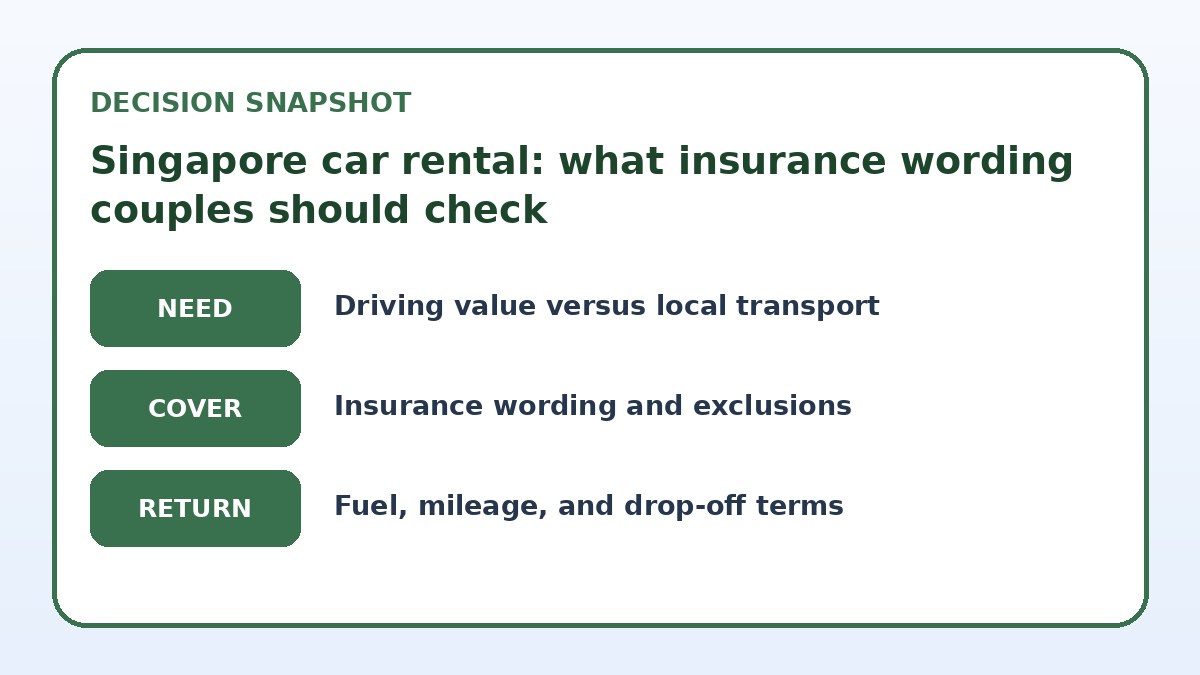
If you're a couple planning to rent a car in Singapore, the most practical step is to read the insurer and rental-agreement wording before you commit. Start by confirming whether both partners are listed as additional drivers and whether that status is included in the quoted rate or appears only at pickup. Look for exact language about 'full insurance', 'collision damage waiver (CDW)', 'loss damage waiver (LDW)', third-party liability, and any caps, excess (deductible), or exclusions for drivers under a certain age or with certain license histories. Also check how roadside assistance, theft, and windshield or tyre damage are handled—some waivers exclude these. Finally, note whether a provider accepts a third-party insurance supplement (often called a super CDW) and what documentation you must present to validate cover on collection.
Which insurance words actually matter for two drivers
Not every phrase in a rental contract is equally important for couples sharing driving duties. Key terms to focus on are collision damage waiver (CDW) or loss damage waiver (LDW), third-party liability, personal accident coverage, and supplementary options such as excess reduction or super CDW. CDW/LDW usually limit your financial responsibility for damage to the rental vehicle, but they rarely remove it entirely; look for explicit statements about the excess amount. Third-party liability covers damage to other people or property and is critical in Singapore because local rules and dense traffic mean small incidents can escalate quickly.
Also pay attention to who counts as an authorized driver. Some rentals automatically cover a spouse or partner, while others charge extra or require both drivers to be present at pick-up to show valid licenses. If only one driver is named but both will really be driving, the insurer or company might deny a claim. Finally, note any age, license-country, or driving-history exclusions—these can invalidate cover for one partner and leave the other liable even when sharing driving.
Understanding excess, holds, and payment wording
Excess (sometimes called deductible) is the amount you're liable for if the car is damaged or stolen. Wording may say 'excess up to SGD X' or 'unlimited liability with super CDW'—phrases that have real consequences. For couples, the practical detail is how excess reduction products change your exposure and whether they apply to all authorized drivers. Many companies offer a reduced-excess option that lowers or removes your financial responsibility, but the rental contract will explain if it only applies when paid at booking or if it needs to be added on at counter and paid in cash or by card.
Payment wording also matters when the company requires a security hold on your credit or debit card. Look for explicit language about the maximum hold amount, how long the hold remains after return, and whether hold amounts differ when excess reduction is purchased. If one partner uses a different card to pay while the other is listed as primary driver, make sure the policy wording supports that arrangement. Always verify on the final booking page how much will be authorized or charged and what documentation the company requires at pickup.
| Approach | Best for | Tradeoff to check |
|---|---|---|
| Buy rental company's excess-reduction product | Couples who want minimal out-of-pocket exposure at the counter | Higher upfront cost but usually less administrative hassle if damage occurs |
| Use credit-card rental coverage | Couples where the primary cardholder has strong rental insurance terms | May leave the non-cardholder partner uninsured or create a slow reimbursement process |
| Rely on home-country personal auto insurance | Couples with policies that explicitly extend to Singapore rentals | Policy wording can be complex and the rental company may still require local waivers |
| Buy a third-party super CDW from an insurer/marketplace | Couples seeking lower excess without incremental rental-company charges | Some providers need pre-approval and you must verify acceptance on the rental booking page |
Exclusions and negligent-use clauses couples must check
Exclusions often contain the phrases that catch couples by surprise. Common exclusions include driving outside permitted areas, off-road use, unauthorised drivers, driving under the influence, and use on restricted roads. For example, a contract may exclude windscreen, tyre, or undercarriage damage—items often struck on Singapore’s urban roads or when using certain car types. Couples should read the full list and pay attention to how terms like 'negligent use', 'intentional damage', or 'unauthorised driver' are defined, because a claim can be denied on those grounds.
If you plan to swap drivers while driving across borders (for example, short day trips near Singapore’s checkpoints), verify whether cross-border driving is allowed and how the insurance wording treats it. Some policies require prior notification or a special endorsement for international travel. Also confirm how roadside assistance is worded: whether it’s included, limited to certain hours or areas, or provided by a third-party contractor whose response time and service levels you should verify on the booking page.
Before you book
- Confirm both partners are named as additional drivers in the reservation and on the rental agreement.
- Check the exact excess (deductible) wording and whether an excess-reduction product is available and what it covers.
- Verify which damages are excluded (windscreen, tyres, undercarriage) and whether add-ons cover those items.
- Read the payment terms for security holds—amount, card type required, and release timing after return.
- Compare the rental company's cover to your credit-card and personal auto insurance wording for driver and territory limits.
- On the provider’s final booking page, confirm how to present proof of coverage or documentation required at pickup.
How to compare what to buy and what to skip
When deciding whether to add options, compare the rental firm’s CDW/LDW and excess reduction against any coverage you already have. Many credit cards offer primary or secondary rental coverage—read the card manufacturer’s insurance wording to identify coverage limits, exclusions, and whether both drivers are covered. If a card covers only the cardholder, the partner may not be protected. Personal auto insurance from your home country may extend abroad; confirm exactly what it covers in Singapore and whether the rental company accepts it in lieu of their own waivers.
Think about the practical trade-offs: paying for the rental company's excess reduction may increase upfront cost but reduces your immediate exposure and simplifies claims; relying on a credit card or personal policy might save money but could mean a longer reimbursement process or a larger hold at pickup. Decide what matters most—lower upfront cost, minimized risk at the counter, or simpler claims handling—and let that guide whether you add the additional driver fee, excess reduction, or third-party supplemental cover.
Frequently asked questions
If both partners drive, do we always need to pay an extra driver fee?
Not always—some rental companies include a spouse or domestic partner as a free additional driver, while others charge. The insurance wording in the rental contract will state whether additional drivers are covered automatically and whether an extra fee applies. Some companies require both drivers to be present with valid licences at pickup to activate the cover. Always check the booking page and rental agreement for the specific wording about 'additional driver' or 'partner driver' before you assume cover exists without an extra charge.
Can my credit card’s rental insurance cover my partner as driver in Singapore?
It depends on the card's policy language. Many cards cover only the cardholder or provide primary coverage when the card pays for the rental. If the partner is not the cardholder, they may be excluded or covered only as a secondary insured. Carefully read the card issuer’s insurance wording for named driver rules, territory limits, and exclusions. Also confirm whether the rental company accepts credit-card coverage instead of its own waivers and whether a hold or proof of coverage will still be required at pickup.
What wording indicates our claim might be denied after a collision?
Watch for terms that list exclusions or conditions that void cover, such as 'unauthorised driver', 'driving while intoxicated', 'reckless or negligent use', driving on unpaved roads, or using the vehicle for commercial activities. Phrases like 'coverage void if', 'not covered when', or long lists of excluded events are red flags. Also check for procedural requirements—failure to report an incident to the police or to the rental company within specified timeframes can lead to denial. Keep copies of the exact language and ask the rental agent to clarify any unclear clauses.
Final planning note
For couples renting a car in Singapore, the decisive step is reading and comparing the exact insurance wording before booking. Confirm both partners are authorised drivers, understand what the CDW/LDW and third-party liability actually cover, and pay attention to excess amounts, holds, and exclusions. Weigh the convenience of the rental company’s excess-reduction product against potential coverage from credit cards or personal auto policies, and verify acceptance and documentation requirements on the provider’s final booking page. Doing this homework keeps decision-making practical: you’ll know whether to accept a higher upfront cost for peace of mind or rely on external coverage and handle additional paperwork if necessary.
Continue planning
Check current options and final conditions
Use the provider page to confirm live availability, the final total, cancellation terms, and every condition that matters to your trip.
This evergreen planning guide was created with AI-assisted drafting and a structured quality review. It does not display live prices, schedules, availability, visa guidance, or provider rankings. Verify current details before booking. Some links are affiliate links; we may earn a commission at no additional cost to you.