Practical answer first: for most first-time visitors to Seoul who want low planning stress and straightforward logistics, a well-reviewed package that bundles flights, a hotel, and airport transfer can be the simplest path. If you value flexibility, hotel or neighborhood choice, or plan side trips (to Busan or Jeju) and personalized pacing, booking flights, accommodation, and transport separately usually gives better control. The right option depends on how much time you want to spend researching, your comfort with comparing multiple providers, and whether your dates are fixed. This article compares the tradeoffs, shows what to check on provider pages, and gives a simple checklist to use while you compare Seoul travel deals so you can choose the approach that fits your style and budget.
Convenience and support: how packages simplify logistics
Packages centralize bookings so you contact a single company for questions, changes, or rebookings. For first-time visitors, this can be a major relief: the package operator often handles airport transfers, initial orientation services, and can advise on visas or entry formalities in one call. That reduces the number of separate confirmations, arrival instructions, and receipts you must track before departure.
However, convenience has limits. Ask the provider exactly what is included and what happens if one element changes—flight delays, missed connections, or hotel overbooking. Check the provider’s policy language on their final booking page for who is responsible for rebooking or compensation. If you need flexible arrival times or like to explore different neighborhoods, a full package might feel restrictive despite the support it provides.
Flexibility and customization with separate bookings
Booking components separately gives you control to pick flight times, seat options, and specific hotels in Seoul neighborhoods that match your interests—Insadong for culture, Myeongdong for shopping, Hongdae for nightlife. It’s easier to add domestic legs or day trips later without being tied to a package itinerary, and you can upgrade individual elements selectively, for example choosing a boutique hotel while keeping flights on a budget carrier.
That flexibility requires time to compare conditions across suppliers: baggage allowances, change fees, and whether a cheap flight is refundable. You’ll also need to coordinate transfers and know how to manage problem resolution with multiple providers—airline customer service for flights and separate property policies for hotels. Always confirm the exact cancellation and change terms on each provider’s booking page before paying.
| Approach | Best for | Tradeoff to check |
|---|---|---|
| Package deals | Travelers wanting minimal planning and a single point of contact. | Less neighborhood choice and possible bundled fees shown at checkout. |
| Separate bookings | Travelers wanting full control over flights, hotels, and side trips. | Requires more time to compare policies and coordinate logistics. |
| Hybrid approach (package + a-la-carte) | Travelers who want a base package but plan custom add-ons. | Can complicate refunds and change handling across different suppliers. |
| Flexible self-book with travel insurance | Travelers who value flexibility and can manage bookings independently. | Insurance adds cost and requires careful policy match to trip risks. |
Price transparency and where extra costs appear
Packages often advertise a single headline price that hides per-person room supplements, single-occupancy surcharges, optional excursions, or local taxes that appear during checkout. They can still be economical because of bulk buying, but compare the full breakdown: base price, fees, transfers, and optional add-ons. Ask for a detailed invoice or review the booking summary page to see all components that affect the door-to-door cost.
When booking separately, the tradeoff is seeing all line items up front—airfare, seat fees, baggage, hotel taxes, and transport cards—so you can add them to a spreadsheet to compare apples to apples. Don’t forget practical costs like airport transfer, T-money (transport card) top-ups, and SIM or eSIM data plans. The most useful comparison uses total trip cost, not just headline fares, and verifies fees at checkout on each provider’s final booking page.
Before you book
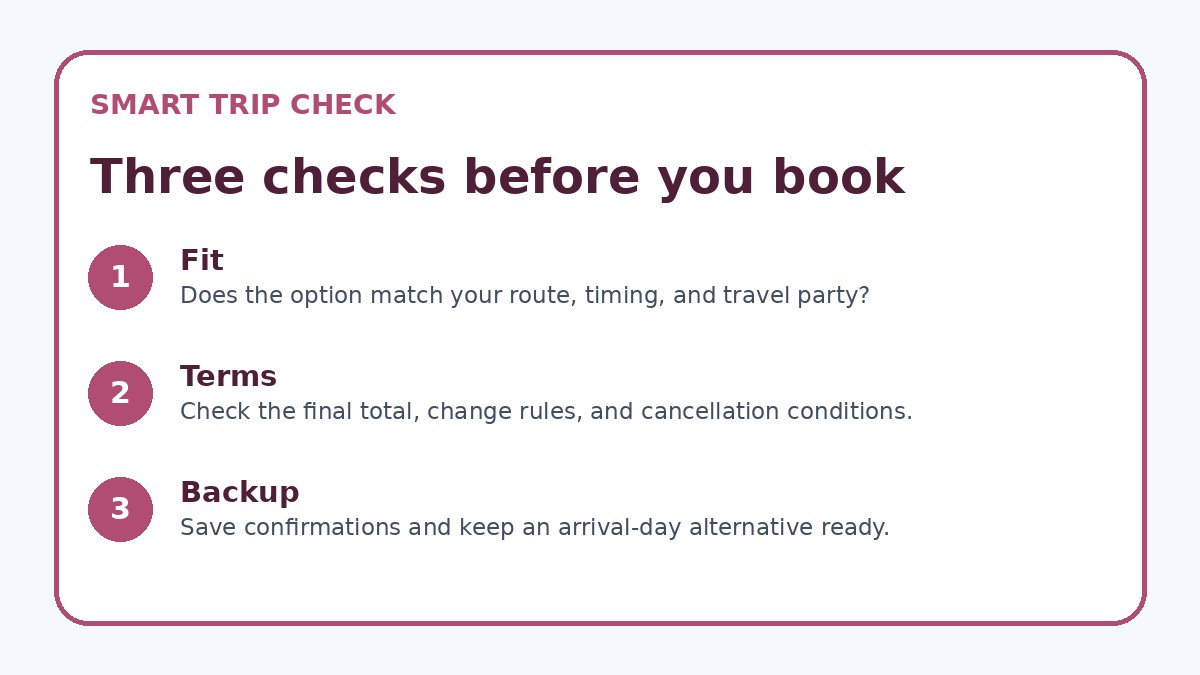
- Compare the total door-to-door cost for packages versus separate bookings, including transfers, taxes, baggage, and local transport.
- Open the provider’s final booking page and copy or screenshot cancellation, change, and refund rules for flights and hotels.
- Confirm what airport transfer or first-night options are included and whether arrival windows are flexible.
- List preferred Seoul neighborhoods and check hotel availability and transport links separately before committing to a package.
- If mixing low-cost carriers with hotels, verify baggage and check-in rules to avoid unexpected fees at the airport.
- Consider travel insurance that covers cancellations and missed connections, and confirm it accepts independently booked components if you go separate.
Risk, cancellations, and how to verify policies
Risk exposure differs: with a package, one provider typically manages force majeure, itinerary disruptions, and substitution arrangements. That can reduce stress but also concentrate risk—if the operator goes poorly, you may face more effort to recover funds. With separate bookings, you deal with each supplier independently; that can mean faster resolution in some cases but requires more work juggling refunds or rebookings.
Regardless of approach, read the cancellation, change, and refund terms before booking. Don’t accept generic summaries—open the provider’s final booking page to confirm what’s refundable, how cancellations are processed, and where customer support is reached. If you’re comparing online marketplaces, note that platform policies may differ from the airline or hotel’s own policy. Checking these specifics avoids surprises if plans change.
Frequently asked questions
Will a package save me money compared with booking flights and hotels separately for Seoul?
A package can sometimes bundle components at lower combined cost, but savings aren’t guaranteed. The only reliable method is to compare the package invoice to a separate booking tally that includes flights, hotel taxes, transfers, baggage fees, and optional extras. Make sure you compare the exact same dates, room type, and flight conditions. Always verify the breakdown on the package provider’s final checkout page and on each supplier’s booking page for the separate option before deciding.
How do I choose the right Seoul neighborhood if I use a package?
Packages often offer a limited set of hotels in a few neighborhoods; request the full hotel list before buying. If neighborhood choice is critical, ask the provider whether you can pick hotels in areas like Myeongdong, Hongdae, or Jongno and whether switching hotels is possible. If they can’t guarantee the location you want, consider booking your hotel separately so you control proximity to subway lines, attractions, and evening activities. Verify any promised neighborhood or hotel name on the provider’s final booking page.
What should I verify about transfers and arrivals when comparing Seoul travel deals?
Check whether transfers are private or shared, included in the headline price, or optional at extra cost. Verify pickup points, allowed arrival windows, and how late or early pickups are handled. If you arrive on a delayed flight, confirm who covers rebooking or extra transfer charges. For separate bookings, compare public transport options, airport express trains, taxis, and ride apps in terms of convenience and cost. Always confirm transfer details and conditions on the booking confirmation or final provider page.
Final planning note
Choosing between a package and separate bookings for your first trip to Seoul comes down to how much planning you want to do and how much flexibility you need. Packages simplify logistics and give you a single contact but can restrict hotel or flight choices and introduce bundled fees. Booking components separately offers control over neighborhoods, carriers, and upgrades, but requires time to compare policies and coordinate transfers. Use the checklist above, verify all cancellation and inclusion details on providers’ final booking pages, and consider a hybrid path if you want convenience for arrival and control for the rest of the stay. For one-stop availability checks, you can optionally compare offerings on platforms such as Trip.com, but always rely on the provider’s own terms when confirming a booking.
Continue planning
Check current options and final conditions
Use the provider page to confirm live availability, the final total, cancellation terms, and every condition that matters to your trip.
This evergreen planning guide was created with AI-assisted drafting and a structured quality review. It does not display live prices, schedules, availability, visa guidance, or provider rankings. Verify current details before booking. Some links are affiliate links; we may earn a commission at no additional cost to you.