Practical answer up front: if you prioritize the lowest cost and want a local experience, use Seoul’s public transport (subway, buses and trains). If you value door-to-door convenience, easy luggage handling, or you arrive at night or as a group, choose a private transfer or taxi. Both options are reliable and widely used by locals and visitors, but they serve different needs. This article explains when each option makes sense, what tradeoffs to expect, and the specific decision points—time of day, luggage, mobility, language comfort, and schedule flexibility—to help you pick the best transfer approach for your arrival and onward travel in Seoul.
Understanding Seoul’s public transport for arrivals
Seoul’s public transport network is extensive and generally straightforward for travelers willing to learn a few basics. Subways and airport trains connect major terminals to central neighborhoods; buses fill gaps and reach suburbs. To use public transport efficiently, familiarize yourself with the main airport rail links, how to buy and top up a reloadable transit card, and the basic layout of lines serving your hotel or first destination. Expect clear signage in English at major stations, but allow extra time if you need to transfer between modes or carry heavy luggage.
Public transit shines if you travel solo or on a budget, enjoy moving like a local, and are comfortable with walking short distances to or from stations. It’s also the best option during daytime when trains run frequently and traffic congestion is unlikely to affect your schedule. However, consider how well you can handle stairs, escalators, and platform navigation with bags; if mobility or carrying capacity is an issue, public transit may add stress that offsets the cost savings.
When private transfers make sense
Private transfers and pre-booked airport shuttles are valuable for travelers who want minimal fuss from curb to hotel door. They remove the guesswork of finding the correct exit, navigating luggage, or speaking enough Korean to confirm a destination. These services typically meet you at the arrivals area or curb, help with baggage, and drive directly to your accommodation, which is especially convenient for late-night arrivals, early departures, or itineraries with tight connections between flights and ground activities.
Choose private transport if you travel in a group, have oversized or multiple pieces of luggage, are traveling with children or people with limited mobility, or need to reach a specific address that is awkward to access by public lines. When booking, verify vehicle size, luggage allowances, pickup point instructions, driver contact methods, and cancellation or change policies on the provider’s final booking page—these operational details change frequently and can affect service suitability.
| Approach | Best for | Tradeoff to check |
|---|---|---|
| Public Transit (subway, trains, buses) | Solo travelers, budget-conscious visitors, those comfortable navigating stations | Lower cost but requires transfers, luggage handling and possible walking to final address |
| Private Transfer (pre-booked vehicle) | Families, groups, travelers with lots of luggage or mobility needs | Higher cost but provides door-to-door service and reduced arrival-day stress |
| Taxi or Ride-Hailing | Travelers seeking convenience without prior booking, short trips in city | Variable cost and time due to traffic; less predictable than rail schedules |
| Hybrid (public + short taxi) | Those balancing cost and convenience, or staying near but not next to stations | Saves time and money in balance but requires coordination and local route knowledge |
Comparing convenience, cost and time
Convenience often conflicts with cost. Public transit usually costs less per person but can take longer and require transfers; private transfers cost more overall but save door-to-door time and hassle. If you arrive during peak city traffic or late at night, a private vehicle may reach your destination in a comparable time to public transit without carrying bags through stations. Evaluate your personal priorities: are you trading money for time and comfort, or do you prefer the local experience and savings of public options?
Also factor in variability: taxi or ride-hailing travel times can swing widely with traffic, while subway or airport rail services operate on consistent schedules. If your arrival is timed to a train service, public options are predictable; if you value absolute flexibility—stopping for a supermarket run, making extra pickups, or adjusting the route mid-journey—private transport offers that freedom. Always compare door-to-door route logistics rather than just distance when judging travel time between airport and accommodation.
Before you book
- List the number of travelers, total bags including carry-ons and oversized items to assess vehicle or transit suitability.
- Note your arrival time at the airport and check whether it coincides with peak commuting hours or late-night service gaps.
- Search for the closest airport rail or bus lines to your hotel and map the door-to-door route, including transfers and walking distance.
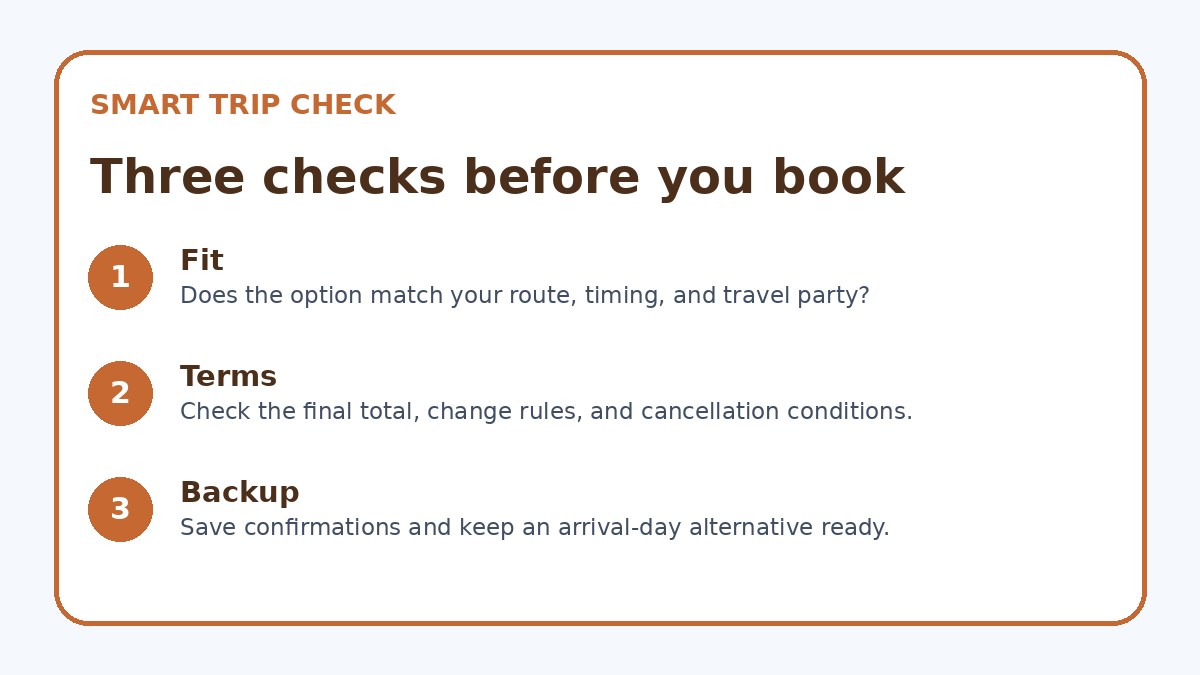
- If considering a private transfer, verify vehicle size, luggage policy, pickup point details, driver contact phone, and cancellation rules on the provider’s booking page.
- Ensure you have a payment method accepted locally for taxis or transit cards and download a reliable map and translation app for on-the-ground navigation.
- Save clear arrival meeting instructions (terminal, exit number, meeting landmark) and keep confirmation screenshots accessible in case of connectivity loss.
Practical steps to choose the right transfer
Start by listing constraints: number of people, total luggage, mobility needs, time of arrival, and tolerance for walking and transfers. Next, estimate convenience value: how much do you value direct pickup and drop-off compared with a short walk to a station? Check real-time providers for availability on your travel dates; if you use a booking site like Trip.com, confirm the provider’s final pickup instructions, vehicle size, and any boarding or luggage policies on the operator’s own page before finalizing.
Finally, plan a backup: if you opt for public transport but arrive much later than planned, know the nearby taxi stands and how to request a ride, or ensure you have cash or a card usable for rides. Conversely, if you reserve a private transfer, confirm how the driver handles delays and what proof of booking you must show at arrival. These small confirmations prevent common arrival-day stress and help your first hours in Seoul run smoothly.
Frequently asked questions
Is the subway in Seoul easy to use for visitors who don’t speak Korean?
Yes—Seoul’s subway system is designed with international users in mind. Major stations have signage in English and Korean, and route maps are usually bilingual. Ticket machines often offer English menus, and station staff at busy hubs can assist with basic directions. For transfers, check the line colors and terminal names rather than relying solely on announcements. Carry a screenshot of your destination in Korean and use a map app to guide walking between station exits and your hotel; that reduces the chance of confusion when moving between modes.
What should I check on the provider’s booking page before choosing a private transfer?
Before confirming a private transfer, verify the exact pickup location and how the driver will identify you, the vehicle type and passenger capacity, luggage allowances and any extra charges for oversized bags, and the operator’s policy for delays and flight changes. Also confirm payment methods accepted, cancellation and refund terms, and whether the price quoted is total or subject to local taxes or tolls. If the provider links to terms of service or driver contact details, save those; they are your reference if a schedule or pickup point changes on arrival.
How do I decide between taking a taxi and pre-booking a private car?
Decide based on arrival certainty and comfort with uncertainty. If you value choosing on the spot and may change plans, a metered taxi or app-based ride can be flexible and quick to access at designated taxi stands. If you prefer a guaranteed vehicle waiting for you with known inclusions—for example, a child seat or fixed price—you’ll want to pre-book a private car. Consider traffic risk: taxis are subject to the same congestion as private vehicles, so if your schedule is tight, account for potential delays in either case and confirm driver contact details when pre-booking.
Final planning note
There’s no single right answer for first-time visitors to Seoul—your ideal transfer depends on how you prioritize cost, convenience, luggage handling and flexibility. Public transport offers economical, reliable access to most neighborhoods and is a good fit for travellers comfortable with moderate walking and transfers. Private transfers reduce stress at the airport and are sensible for groups, late arrivals, or those needing door-to-door service. Whatever you choose, verify pickup details, vehicle and luggage policies, and cancellation terms on the provider’s final booking page before you travel; Trip.com can be a convenient place to compare current availability, but always confirm operational details with the operator listed on any booking.
Continue planning
Check current options and final conditions
Use the provider page to confirm live availability, the final total, cancellation terms, and every condition that matters to your trip.
This evergreen planning guide was created with AI-assisted drafting and a structured quality review. It does not display live prices, schedules, availability, visa guidance, or provider rankings. Verify current details before booking. Some links are affiliate links; we may earn a commission at no additional cost to you.