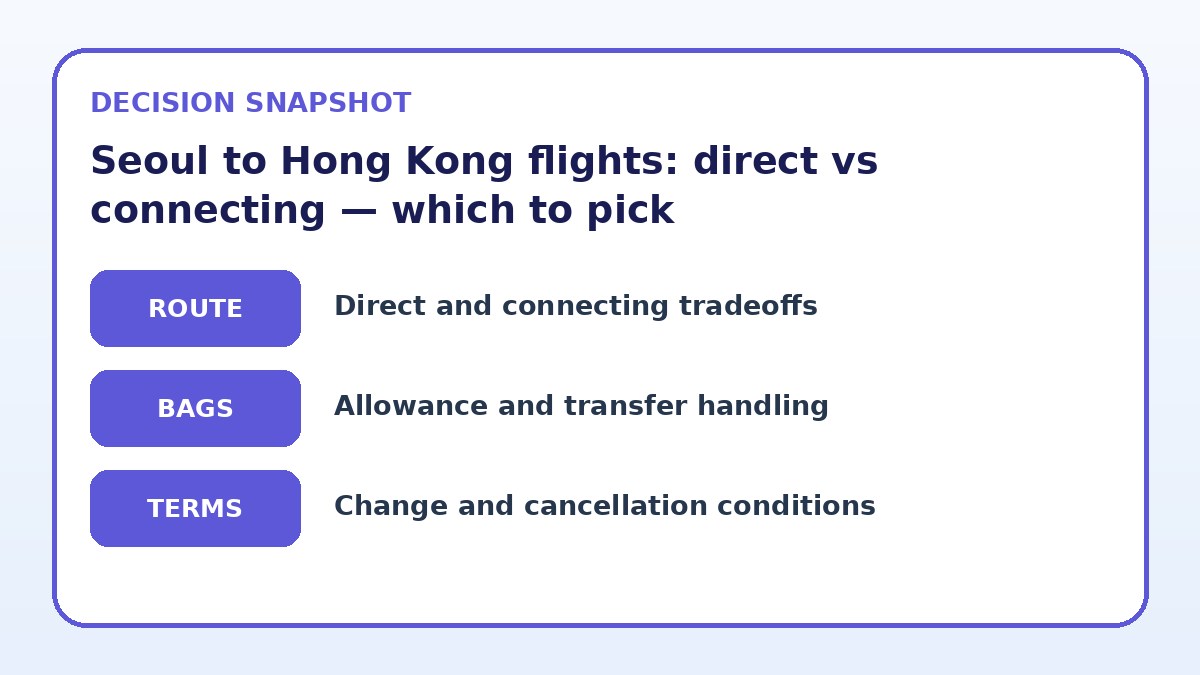
Practical answer first: if you value speed, simplicity, and minimizing hassle on a first trip, choose a direct Seoul to Hong Kong flight when available; if you want a lower base fare, more schedule options, or a stopover to break up the journey, consider a connecting itinerary. Both choices are reasonable for first-time visitors: direct flights cut total travel time and reduce transfer stress, while connections may save money or allow you to land at different times of day. When comparing options, treat total door-to-door time and the likelihood of tight connections as primary factors. Also verify baggage transfer rules, minimum connection times, and whether you need to clear immigration at the connecting airport. Use the airline or booking platform pages to confirm final schedules, baggage allowances, and change/cancellation policies before you buy.
How to weigh time, cost, and convenience
For first-time travelers, time and convenience often matter more than a marginal price difference. A direct flight reduces touchpoints: fewer airport transits, no transfer buses or shuttle trains, and lower risk of lost baggage when the journey is single-segment. Consider your tolerance for jet lag, arrival time at your Hong Kong accommodation, and how quickly you want to begin exploring. If arriving early in the day is important, prioritize schedules that get you into the city at a convenient hour even if they cost slightly more.
Cost remains key for many travelers, and connecting flights sometimes provide savings or access to different departure or arrival airports. However, factor in layover costs like food, transit to a different terminal, or possible overnight stays if connections are long. Also account for the value of your time: longer total travel hours can reduce the time you have to enjoy Hong Kong. Balance the sticker price against total travel time and the likelihood of delays or missed connections when making your decision.
Safety and stress: what changes with connections
Connections add procedures: deplaning, re-clearing security or immigration at some airports, and moving between terminals. For a first trip, unfamiliar transfer layouts and language barriers can increase stress, especially if you have limited time between flights. Choosing longer layovers reduces risk but lengthens the journey. When comparing options, look at the minimum connection time suggested by the operating airline and add a buffer for potential delays; if you book separate tickets, leave even more time and understand baggage re-check rules.
Direct flights remove those transfer steps, which lowers the chance of missing onward travel and simplifies arrival logistics in Hong Kong. That can be particularly valuable if you’re traveling with family, carrying fragile equipment, or arriving late at night. Still, direct service may have fewer daily departures, so flexibility on travel dates could be limited. For peace of mind, weigh how confident you feel navigating unfamiliar airports and whether you want to avoid the additional coordination that comes with connections.
| Approach | Best for | Tradeoff to check |
|---|---|---|
| Direct flights | Travelers seeking simplicity, shorter door-to-door time, and lower transfer risk | Often fewer schedule choices and sometimes higher base fares |
| Single connecting flights | Travelers wanting lower fares or specific arrival times not covered by direct service | Adds one transfer step and depends on connection reliability |
| Multiple-stop connections | Those building a stopover or seeking the lowest possible fare with flexible time | Significantly longer travel time and more chance for disruption |
| Separate tickets and mixed carriers | Flexible planners who want tailored timing or price opportunities across carriers | You assume responsibility for tight connections, luggage re-check, and missed-connection risk |

Practical booking comparisons and what to verify
When you pull up search results, compare total travel time, number of segments, and layover duration side-by-side rather than focusing only on fare. Check baggage rules carefully: some connecting itineraries on different carriers require you to collect and re-check bags at the transfer airport, while interline or codeshare tickets usually transfer baggage automatically. Verify whether meals, seat selection, and carry-on allowances differ between the options you’re considering; these features can affect comfort and value even when two fares look similar.
Before you click purchase, confirm the final details on the airline’s booking page: exact schedule, cancellation and change fees, seat policy, and whether the ticket qualifies for frequent flier credit. If you use a third-party platform, follow through to the carrier’s site to confirm the same items. Trip.com is an example of a place to compare availability and routing, but always cross-check with the operating airline for the definitive information on baggage transfer and minimum connection times.
Before you book
- Confirm whether your chosen itinerary is a single-ticket booking or separate tickets and understand the implications for baggage transfer.
- Compare total door-to-door travel time, not just flying hours, and factor in layover buffer time you’re comfortable with.
- Check the operating airline’s baggage allowance, seat selection cost, and what’s included versus add-on fees on the booking page.
- Verify minimum connection times and whether immigration or terminal changes are required at the connecting airport.
- Plan ground transportation from Hong Kong Airport to your first accommodation based on your estimated arrival time.
- Review change and cancellation terms and consider buying flexible fares or travel protection if your plans might change.
Special circumstances: luggage, visas, and arrival timing
Luggage rules and transfer procedures matter more on connecting itineraries. If you bring checked bags, confirm whether they’ll be tagged through to Hong Kong or if you must reclaim and re-drop them at the transfer airport. That requirement often depends on whether flights are on the same ticket and whether the transfer country allows transit without immigration. If a transit visa is needed at the connecting airport, a direct flight avoids that complication—verify visa needs with official government sites or the airline before booking.
Arrival timing in Hong Kong also affects ground transportation options and your first-day plans. Arriving late at night may limit public transit or hotel check-in options; arriving early gives you more of the day to explore. Consider when you’ll clear immigration and how long it typically takes at Hong Kong’s airport at different times of day. Plan onward travel from the airport—MTR, buses, taxis, or hotel shuttles—and check whether your arrival time aligns with those services to avoid unexpected waits or extra transfers.
Frequently asked questions
Are direct flights from Seoul to Hong Kong always the best choice for first-time visitors?
Not always. Direct flights are typically best when you want less complexity and faster travel, but they may be more expensive or less available on your preferred dates. If you value cost savings or need an arrival time that direct service doesn’t offer, a connecting flight can be a good alternative. For first-time visitors, prioritize how comfortable you feel with transfers, whether your luggage will be checked through, and the total travel time. Confirm those specifics on the airline’s official booking page before you finalize any ticket.
How much layover time should I allow when choosing a connecting flight?
Allow more time than the airline’s stated minimum, especially if you must change terminals, pass through immigration, or re-check bags. A conservative approach for international-to-international connections is to add an extra 60–90 minutes beyond the airline’s minimum if everything is on one ticket; if you have separate tickets or need a transit visa, plan several hours or an overnight. Consider airport size, whether you need to switch terminals by shuttle, and peak-time congestion. Always check the carrier’s guidance for minimum connection times before booking.
What should I verify about baggage and transfers when booking a multi-leg trip?
Check whether checked luggage is tagged through to your final destination or if you must collect and re-check it at the transfer airport. This depends on whether segments are on a single ticket and whether airlines have interline agreements. If you must re-check bags, verify arrival and next-departure terminals, the time needed to move between them, and whether you need to clear immigration. Confirm these rules on the operating airline’s booking page and consider adding extra layover time if baggage re-check is required.
Final planning note
For first-time visitors deciding between direct and connecting Seoul to Hong Kong flights, prioritize what matters most to your trip: simplicity and shorter travel time (direct) or wider scheduling and potential fare savings (connecting). Don’t let a lower headline fare blind you to longer travel time, added transfers, or baggage and visa complications. Compare total door-to-door time, connection procedures, and baggage transfer rules on the airline’s booking page, and leave yourself enough buffer at connections. If you want a single place to compare current options, you can look at Trip.com for listings, but always confirm final schedules and policies with the operating carrier before booking.
Continue planning
Check current options and final conditions
Use the provider page to confirm live availability, the final total, cancellation terms, and every condition that matters to your trip.
This evergreen planning guide was created with AI-assisted drafting and a structured quality review. It does not display live prices, schedules, availability, visa guidance, or provider rankings. Verify current details before booking. Some links are affiliate links; we may earn a commission at no additional cost to you.