Practical answer first: choose by balance of luggage, arrival airport, budget, and time. If you arrive at Kansai International Airport (KIX) and want a fast, cost‑efficient link to central Osaka, rail and express airport buses are the common choices; taxis and private transfers offer door‑to‑door simplicity for groups or late arrivals. If you land at Osaka’s closer domestic airport (Itami/ITM), shuttle buses and taxis usually work best. Before you book, verify current schedules, platform assignments, and any luggage or advance‑booking requirements on the provider’s official page. Trip.com can be one place to compare live availability, but confirm final terms with the operator you select. Below you’ll find the practical pros and cons, decision criteria, and a checklist to help you choose the right airport transfer for your itinerary and comfort level.
How to pick between train, bus, and car
Start by mapping your hotel or first stop in Osaka against the transport options available from your arrival airport. Trains typically require fewer road‑condition variables and can be faster across predictable corridors, but they also mean carrying luggage up or down stairs, along platforms, or between lines. Buses run direct routes to major hotels and hubs and are easier if you prefer to stay seated with your baggage. Taxis and private transfers remove transfers and walking, which is valuable at night or with small children, but you should weigh this convenience against the potential for traffic delays and the need to book a licensed operator for peace of mind.
Decide using four criteria: total door‑to‑door time, ease of luggage handling, cost relative to your travel budget, and how early or late you arrive. For short layovers or tight itineraries, prioritize the fastest door‑to‑door option; if your schedule is flexible, pick the option that reduces stress with luggage. If you travel with a lot of gear, young children, or mobility constraints, a bus or door‑to‑door transfer will likely save effort even if it costs more. Always confirm schedules and pickup points on the operator’s official site before relying on a transfer, especially for early‑morning or late‑night flights.
Arriving at Kansai International (KIX): routes and choices
Kansai International serves many international arrivals and has multiple rail and road links into central Osaka. Decide whether you prefer a one‑seat ride that deposits you near a major hotel or a rail option that may require a short transfer but avoids traffic. If you prioritize fewer changes with luggage, an airport bus or a private transfer gives a simpler experience. If you want consistent travel time and lower per‑person cost for solo travelers or two people, rail can be attractive — but pay attention to which Osaka station you need to reach: Namba, Umeda, or Tennoji, since each changes which train or bus makes the most sense.
When comparing specific services, check whether the bus stops at your hotel or a convenient landmark, and confirm the rail transfer connections and platform location at KIX. Also verify any luggage restrictions or seat reservations required by express services. If a connecting train leg is offered as an alternative to a single‑seat bus or car, estimate the time for walking between platforms and transferring with luggage. For late arrivals, book a transfer that guarantees a waiting driver or aligns with the last scheduled bus; if you must rely on public transit, know the last train times and have a backup plan.
| Approach | Best for | Tradeoff to check |
|---|---|---|
| Train (express/local) | Solo or light‑luggage travelers prioritizing speed and low per‑person cost | Requires walking and possible transfers; not ideal with bulky baggage or small children |
| Airport bus / limousine bus | Travelers with moderate to heavy luggage or groups wanting fewer changes | May be slower in traffic and less frequent late at night |
| Taxi or rideshare | Door‑to‑door convenience, group travelers, late arrivals or tight schedules | Higher cost and travel time can vary with traffic conditions |
| Prebooked private transfer | Travelers who value guaranteed pickup, fixed meeting points, and minimal walking | More expensive; verify operator’s waiting policy and cancellation terms |
If you land at Itami (Osaka International): quick local options
Itami Airport handles many domestic flights and is closer to central Osaka than KIX, making surface options more practical. Shuttle buses and airport limousine services usually connect Itami with central districts, reducing transfers and heavy walking. Trains require a short bus or taxi ride to the nearest rail stations, so if minimizing steps is important, an airport bus or direct taxi is often the most convenient. For travellers staying in neighborhoods not served by major bus routes, a short taxi ride from the airport bus stop or station to your hotel may be the most comfortable solution.
Because Itami is used mainly for domestic flights, consider how your onward itinerary fits with local transit: a taxi may cost more but shorten the time and simplify travel with children or bulky luggage. If you plan to continue by train to another city, factor in the extra step of reaching a mainline station. Confirm pick‑up points and any necessary vouchers for shuttle buses; if a private transfer sounds appealing, check the operator’s cancellation and waiting policies on their booking page to avoid surprises on arrival.
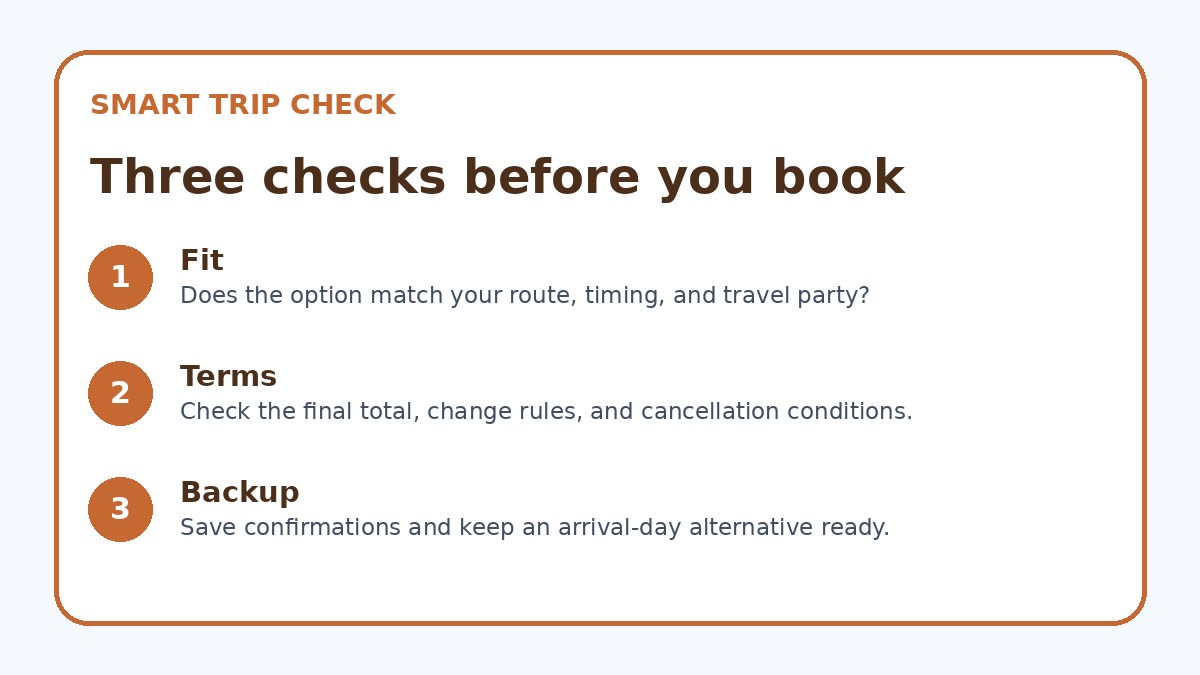
Before you book
- Confirm which Osaka station or hotel stop is closest to your final destination before choosing the transfer mode.
- Check the operator’s official page for real‑time schedules, platform or boarding point details, and luggage policies.
- If arriving late or early, verify the last service times or book a transfer that guarantees a waiting driver.
- Have your hotel address in Japanese and the nearest station name saved on your phone or printed for taxi drivers.
- Compare door‑to‑door time, total number of transfers, and walking distance — not just headline travel time.
- If using a rail pass or discount ticket, confirm whether it covers the airport connection you plan to use.
Practical tips for a smooth arrival and transfer
Before travel day, photograph or screenshot your hotel address in Japanese, the nearest station name, and the exact bus stop or hotel entrance you want to be dropped at. For trains, note which Osaka station you need and the line that serves it; for buses, confirm the stop closest to your hotel and whether the service needs reservations. Keep a small amount of local currency for small purchases or taxis in case card acceptance is limited on some routes. If you plan to use a tourist rail pass, check whether it covers the specific airport‑to‑city services you intend to use.
On arrival, allow extra time for immigration or baggage delays when comparing onward options: a service with frequent departures will tolerate waiting longer than a single scheduled ride. If you prebook a private transfer, send your flight details and update the operator about delays so waiting arrangements remain accurate. For late arrivals, prioritize services that explicitly operate at your hour or have guaranteed driver waiting; if you are traveling overnight, confirm lighting at pickup points and have a backup contact number. Finally, verify final booking pages for seat reservation rules, boarding points, and any luggage size policies.
Frequently asked questions
Should I prebook an airport transfer to central Osaka or decide on arrival?
Prebooking gives certainty about pickup, especially for late arrivals, large groups, or when you have heavy luggage; it also helps avoid language friction. If you’re comfortable using local transit and arrive during daytime with manageable luggage, you can wait and choose based on real‑time conditions. When providers require seat reservations on buses or express trains, prebooking eliminates the risk of sold‑out departures. Always check the operator’s final booking page for cancellation and change rules before deciding to prebook.
How do I choose between arriving at Umeda, Namba, or Tennoji from the airport?
Choose the station that is closest to your hotel or first destination to minimize transfers and walking with luggage. Umeda (Osaka Station area) is central for business and many hotels, Namba serves southern shopping and dining districts, and Tennoji is convenient for southern lines and some sightseeing. Look at a map and public transit connections from each station to your accommodation; a slightly longer ride to the best station can save time and effort once you’re in the city.
What should I verify on a provider’s booking page before confirming an airport transfer?
Confirm exact pickup and drop‑off points, required arrival or check‑in times, any seat reservation or voucher requirements, luggage limits, and the operator’s policy for flight delays or waiting time. Also review payment methods, cancellation or change fees, and contact details for day‑of arrival coordination. If you rely on a third‑party site to compare options, follow through to the operator’s final page to confirm those details before you complete your booking.
Final planning note
Choosing the right Osaka airport transfer is about matching arrival details, luggage, and energy level to the mode of transport. Trains are efficient for lighter travelers heading to stations with direct connections; buses simplify the journey for those with more baggage or for groups; taxis and private transfers remove stress when time or mobility is a concern. Before you commit, map your hotel against station and stop locations, verify schedules and boarding points on the operator’s official page, and consider prebooking if you arrive at night or with a lot of luggage. Use Trip.com if you like to compare options quickly, but always confirm final terms with the provider you plan to use.
Continue planning
Check current options and final conditions
Use the provider page to confirm live availability, the final total, cancellation terms, and every condition that matters to your trip.
This evergreen planning guide was created with AI-assisted drafting and a structured quality review. It does not display live prices, schedules, availability, visa guidance, or provider rankings. Verify current details before booking. Some links are affiliate links; we may earn a commission at no additional cost to you.