Practical answer first: choose the option that minimizes transfers and door-to-door handling with your luggage. If you have bulky bags, prioritize a single coach or private-transfer routing that drops you close to your Puebla accommodation, or plan rail-plus-transfer only if the train station has easy, dedicated baggage access and short onward transfer distances. Weigh transfer count, walking distances, stair or elevator availability at terminals, and how many times you must lift or load luggage into vehicles. This article explains how to compare coach, rail, private shuttle, and mixed approaches for the Mexico City to Puebla corridor, focusing on terminal fit, luggage friction, schedule flexibility, and what to do if a connection fails. Use these criteria to decide before booking, and verify the final operator pages for up-to-date boarding points, luggage rules, and exact terminal addresses.
Choosing between coach, rail, private transfer, or mixed routes
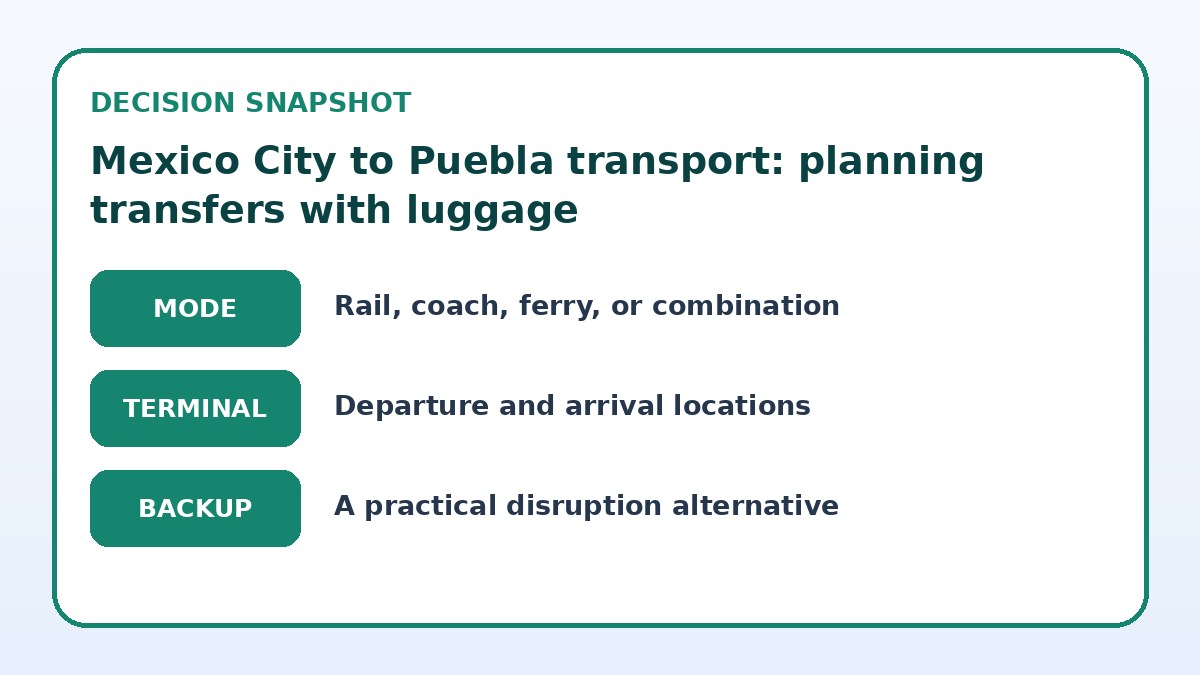
Start by comparing how each mode handles door-to-door flow for extra luggage. Long-distance bus services often load luggage into a hold and offer curbside boarding that can be faster because you hand bags to staff once. Trains can be comfortable but may require walking between disparate terminals or platforms, carrying bags up and down ramps or stairs if elevators are limited. Private transfers or shuttle vans offer the simplest door-to-door experience, but check vehicle size and whether the driver will help with loading. Mixed routes—train or bus to a hub then taxi—can work if the transfer point has short, level connections and guaranteed luggage assistance.
Deciding factors should include the number of times you must move your luggage, whether you need to negotiate stairs, and how far the final drop-off is from your destination in Puebla. If minimizing lifts is the priority, a single-vehicle option that parks near your hotel is usually best. If you prefer scheduled public transport for cost or frequency, choose services with clear luggage handling policies and plan transfers with buffer time. Always verify terminal entry points and whether the operator offers assistance or accessible access at both ends.
Choose the end-to-end journey plan
| Journey approach | Best for | Friction to check |
|---|---|---|
| Single coach direct or minimal-stop service | Travelers who want minimal handling and curbside drop-off close to a hotel | May require travel to a bus terminal rather than a convenient train station; verify luggage hold policies |
| Train plus short taxi/rideshare | Those preferring rail comfort with a short, paid last-mile taxi to avoid long walks | Potentially multiple transfers and platform walking; check elevator availability at stations |
| Private door-to-door transfer | Groups or travelers with oversized items who need direct curb-to-door service | Higher cost and dependence on vehicle size; confirm vehicle can accommodate all luggage |
| Mixed public options with planned staggered transfers | Budget-minded travelers comfortable with more hands-on luggage moves and flexible timing | More handling and walking; ensure each transfer point has accessible routes and luggage assistance |
Check live intercity options
Look beyond the ride itself and compare terminals, transfers, luggage, and arrival fit.
Terminal fit and luggage friction: what to inspect before booking
Look up exact boarding and arrival points for each operator and plug them into a maps app to inspect walking routes. Check if a bus terminal, train station, or pickup point uses underground platforms, elevated concourses, or street-level loading bays. Measure or estimate the walking distance from the stop to a taxi rank, rideshare pickup, or your lodging. If luggage must pass through crowded concourses, escalators, or narrow sidewalks, those are friction points to avoid when carrying large suitcases or odd-sized items.
Ask directly about luggage allowances and handling: will staff load and unload bags into a hold or trunk, or do you need to carry them to the platform? For mixed transfers, confirm whether the connection point has elevators or ramps and whether there’s covered, short-distance transfer between services. If you rely on elevators or ramps, verify their working status on the operator’s final booking page or by phone. Plan routes that keep baggage moves to a minimum and favor curbside and level boarding whenever possible.
Timing flexibility and practical scheduling with extra baggage
When you’re managing heavy or oversized luggage, build extra time into every step—arrival at the first terminal, transfer windows, and final drop-off. Choose departure times that avoid rush-hour congestion in Mexico City and Puebla neighborhoods where possible. Morning departures can reduce traffic unpredictability, but also consider whether terminals are busy at those times; quieter boarding makes handling luggage easier. If you must change modes, select connections with generous gaps so you’re not sprinting across platforms with suitcases.
Also weigh frequency versus reliability. A high-frequency coach line can reduce the need to commit to a tight schedule because there’s usually another departure soon. Scheduled train services may be less frequent but predictable; if you pick a train, ensure the onward connection in Puebla is feasible given the train’s arrival time and actual proximity to your final address. For private transfers, allow buffer time for pickup windows and confirm pickup location details so drivers can find you quickly without added handling or waiting.
Compare the practical alternatives
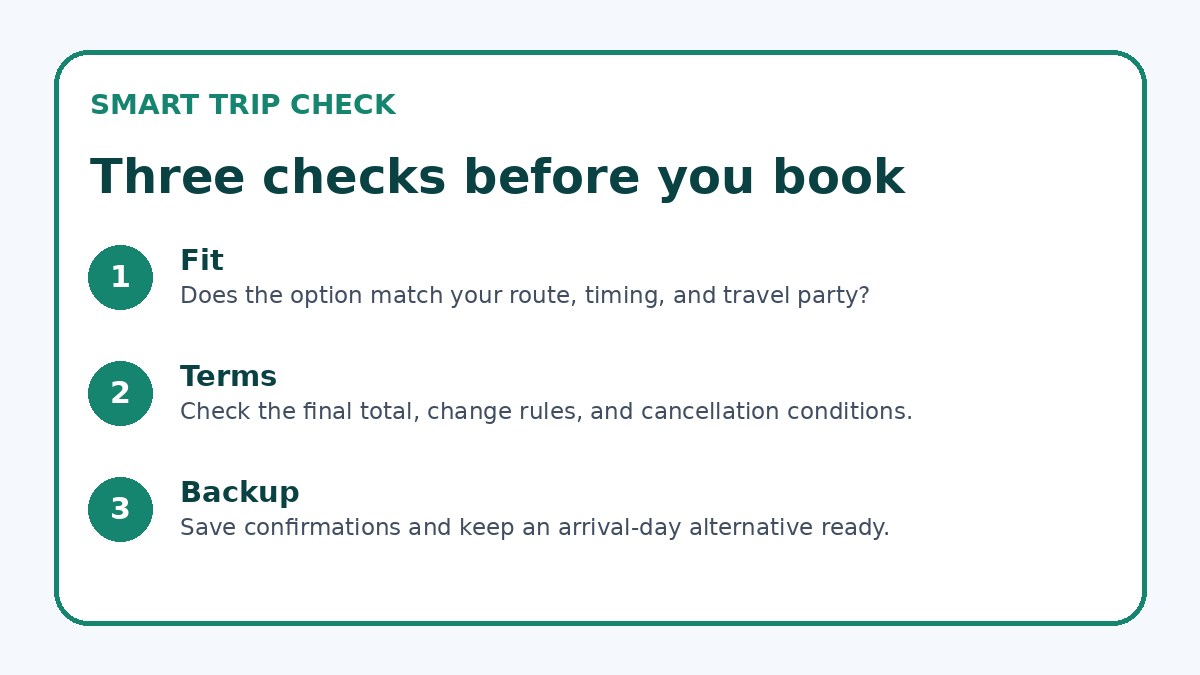
Use the final page to confirm what is actually offered on your dates and save a workable fallback.
Intercity travel checklist
- Pin exact boarding and arrival addresses in your maps app and screenshot them for offline use.
- Confirm luggage allowances and whether staff will load/unload your bags on the operator’s final booking page or by phone.
- Measure walking distance and stairs/elevator needs between platforms, terminals, and taxi/rideshare areas.
- Book a private transfer if minimizing transfers and door-to-door drop-off is more important than cost.
- Keep contact numbers for your operator, a local taxi company, and your accommodation handy in case plans change.
- Allow at least 45–90 minutes extra for transfers when moving between modes with heavy or oversized luggage.
Disruption backup: quick alternatives when plans change
Prepare two realistic fallbacks: a ready taxi/rideshare pickup and an alternative public departure within an hour. Save the addresses and map pins of major terminals and a reliable meeting spot that is easy for drivers to find. If a coach or train is delayed, a short-notice taxi can get you to Puebla with fewer transfers, though this may cost more. If you rely on scheduled public transport, know the next three possible departures and their pickup points so you can move to the nearest option without dragging luggage long distances.
Also consider local luggage storage and short-term lockers near central stations if you need hands-free mobility for a transfer or town stop. Confirm whether a chosen operator will allow rebooking or standby on a later service and what that process requires. Keep digital copies of booking confirmations and terminal contact numbers, and have enough local currency or a payment method accepted by drivers and smaller shuttle operators in case you switch to a private transfer at short notice.
Rail & Intercity Transport questions travelers ask
Can I take large suitcases on buses and trains between Mexico City and Puebla?
Policies vary by operator—some coaches have underfloor luggage holds and allow larger suitcases, while trains may have stricter carry-on rules and limited luggage spaces onboard. Before booking, check the operator’s published luggage size and weight allowances on their official booking page, and ask whether staff will load and unload hold luggage. If you have oversize pieces or many bags, consider a private transfer or coach service that explicitly advertises luggage handling to avoid unexpected refusals or extra handling at stations.
What’s the easiest way to plan the final mile from the station to my Puebla accommodation?
Map the walking route and measured distance from the station exit to your hotel and note if stairs, steep sidewalks, or pedestrian-only streets are involved. If the walk is longer than a comfortable carry with heavy bags, pre-book a taxi or rideshare for immediate pickup at the station curb—confirm the recommended pickup point on the operator’s page. For narrow streets or historic areas with limited vehicle access, ask the hotel if they offer porter service or a nearby drop-off that reduces distance.
How much transfer time should I allow when connecting between coach, train and taxi?
Factor in time for disembarking, locating your luggage, possible queuing for elevators or escalators, and walking to the next service. A practical buffer for a single transfer is often 45–90 minutes when luggage is heavy or terminals are complex; for multiple transfers, add additional time. Also consider local traffic variability—allow extra time for road travel in or out of Mexico City and Puebla. Check operator guidance for recommended arrival times before departure and verify current terminal layouts where possible.
Final decision note
When traveling between Mexico City and Puebla with extra luggage, prioritize routes that reduce the number of transfers and the physical handling of bags. Use the criteria here—terminal fit, luggage handling policies, timing flexibility, and a clear disruption backup—to compare coaches, trains, private transfers, and mixed approaches. Map exact boarding and drop-off points, confirm luggage rules on the operator’s final booking page, and plan realistic buffers for walking and traffic. Preparing a fallback taxi or shuttle and keeping contact details accessible will keep your trip practical and lower stress, letting you focus on arrival rather than logistics.
Continue planning
Check current options and final conditions
Use the provider page to confirm live availability, the final total, cancellation terms, and every condition that matters to your trip.
This evergreen planning guide was created with AI-assisted drafting and a structured quality review. It does not display live prices, schedules, availability, visa guidance, or provider rankings. Verify current details before booking. Some links are affiliate links; we may earn a commission at no additional cost to you.