Practical answer first: for most families, choosing between high-speed rail and an intercity coach comes down to tradeoffs in terminal convenience, luggage hassle, travel-time predictability, and how flexible you need to be if plans change. Rail often wins for predictability and fewer roadside transfers; coaches can be simpler if your hotel is close to an expressway interchange or coach terminal. The travel day should be planned door-to-door: factor in getting to the departure terminal, moving luggage, bathroom and snack breaks, seats and child needs, and how you’ll reach your Gyeongju accommodation from the arrival point. Below you’ll find clear decision criteria, a comparison of four planning approaches, checklists for the travel day, and answers to typical family questions. Verify schedules, seat types, luggage rules, and transfer options on the operator’s booking page (or a comparison site such as Trip.com) before you buy.
Choose the right mode for your family
Start by matching the mode to your family’s priorities. If your children need predictable travel time and minimal road motion, rail often provides a smoother schedule and fewer intermediate stops. Coaches can be cheaper in some cases and may offer direct routing to termini closer to your final Gyeongju neighborhood, which reduces urban transfers. Consider whether you prefer a single seamless transfer from your Seoul door to the arrival station or whether you’re willing to accept an extra taxi or subway ride in exchange for a lower fare or different departure times.
Think about seat layout and onboard facilities: families with toddlers or infants will value easy access to toilets, room to spread a changing mat, and seats that allow an adult to sit beside a small child without blocking an aisle. For larger groups, splitting across multiple reserved seats can be awkward, so check whether you can reserve a block of seats together. If you need to transport strollers, car seats, or many bags, confirm luggage allowances and how items are stored—under-seat, overhead, or in a separate luggage hold—before you commit.
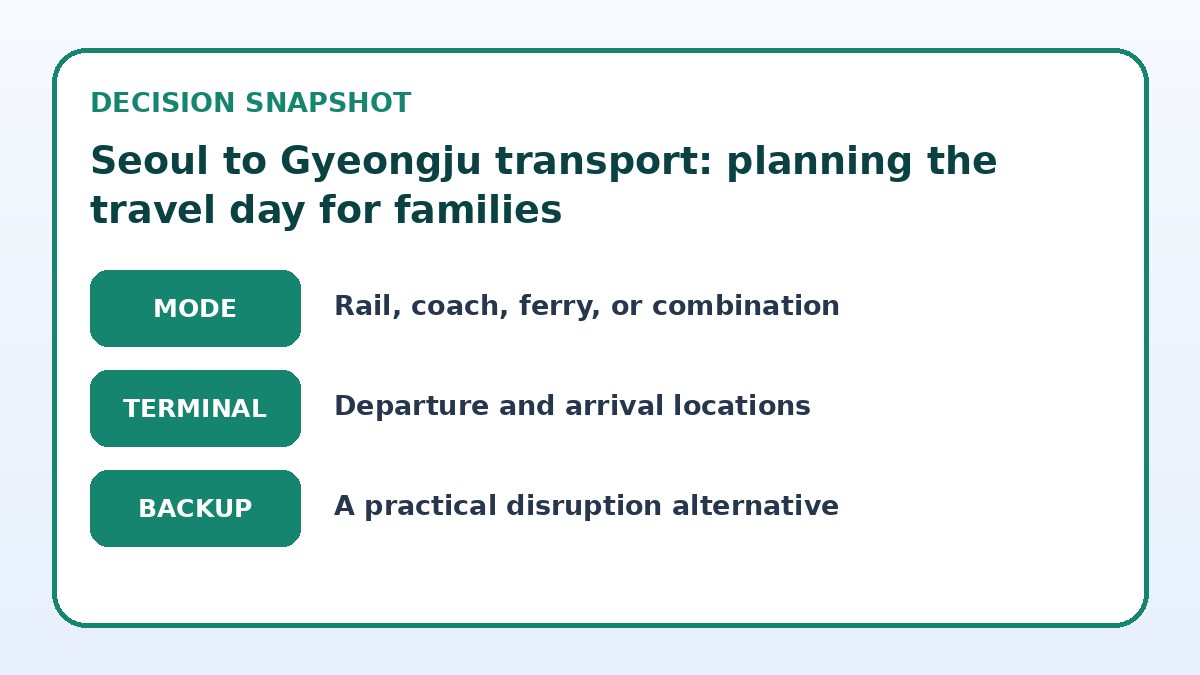
Choose the end-to-end journey plan
| Journey approach | Best for | Friction to check |
|---|---|---|
| High-speed rail (single-booking) | Families valuing speed, timetable reliability, and predictable in-vehicle travel time. | May require longer transfer to/from stations and rules for bulky luggage or strollers can vary. |
| Intercity coach (direct routing) | Families seeking simpler routing if the coach terminal is close to your Seoul or Gyeongju accommodation. | Ride comfort and timing are more subject to road traffic; onboard space for large items varies. |
| Mixed-mode (train + local coach/taxi) | Families needing a balance between long-distance predictability and last-mile flexibility. | More handoffs increase transfer friction and require careful timing and baggage handling planning. |
| Drive or private transfer | Families with lots of luggage, young children needing car seats, or those who want door-to-door control. | Higher cost and potential for longer journey times in traffic; you must plan parking and rest stops. |
Check live intercity options
Look beyond the ride itself and compare terminals, transfers, luggage, and arrival fit.
Terminal fit, luggage and transfer friction
Terminal location in each city changes the practical trip time. A centrally located Seoul station or bus terminal may look quick on a timetable, but heavy traffic or long subway connections add minutes and stress. Pick departures from stations you can reach without a risky tight connection—allow generous buffer time for family bathroom breaks and security lines. At the arrival end in Gyeongju, check whether the terminal is near your hotel, whether a short taxi ride is required, and how easy it is to collect large luggage or fold strollers.
Luggage rules differ by mode and operator. Coaches sometimes handle large suitcases in an undercarriage compartment; trains often allow one or two large items plus a carry-on but may have limited space for oversized items. If you plan to bring a car seat or stroller, verify whether it can be stored on board or must be checked at a counter. Consider splitting items into one large suitcase and a lightweight day bag for each adult so essentials are immediately accessible during transfers and unexpected delays.
Timing flexibility and scheduling the travel day
Build the day with realistic windows rather than tight connections. For morning departures decide whether an early start is worth an entire travel day in Gyeongju or whether arriving late gives you a more relaxed morning in Seoul. Midday departures suit families who want a calm morning and a flexible buffer for small delays; evening departures can be tiring for young children. Evaluate the frequency of services on your chosen mode—more frequent departures reduce the cost of an unexpected missed connection, while infrequent schedules require stricter on-time performance and a firmer backup plan.
Factor in check-in or ticket collection time. Some operators require you to arrive 15–30 minutes before departure to collect reserved tickets or check luggage; others allow e-tickets and faster boarding. If you are staying near a subway line or using a taxi, plan extra time for potential traffic or weekend crowding. If you choose to combine modes—train to a regional hub then coach to a final stop—double-check connecting windows and whether baggage transfer is seamless or needs manual handling by you.
Compare the practical alternatives
Use the final page to confirm what is actually offered on your dates and save a workable fallback.
Intercity travel checklist
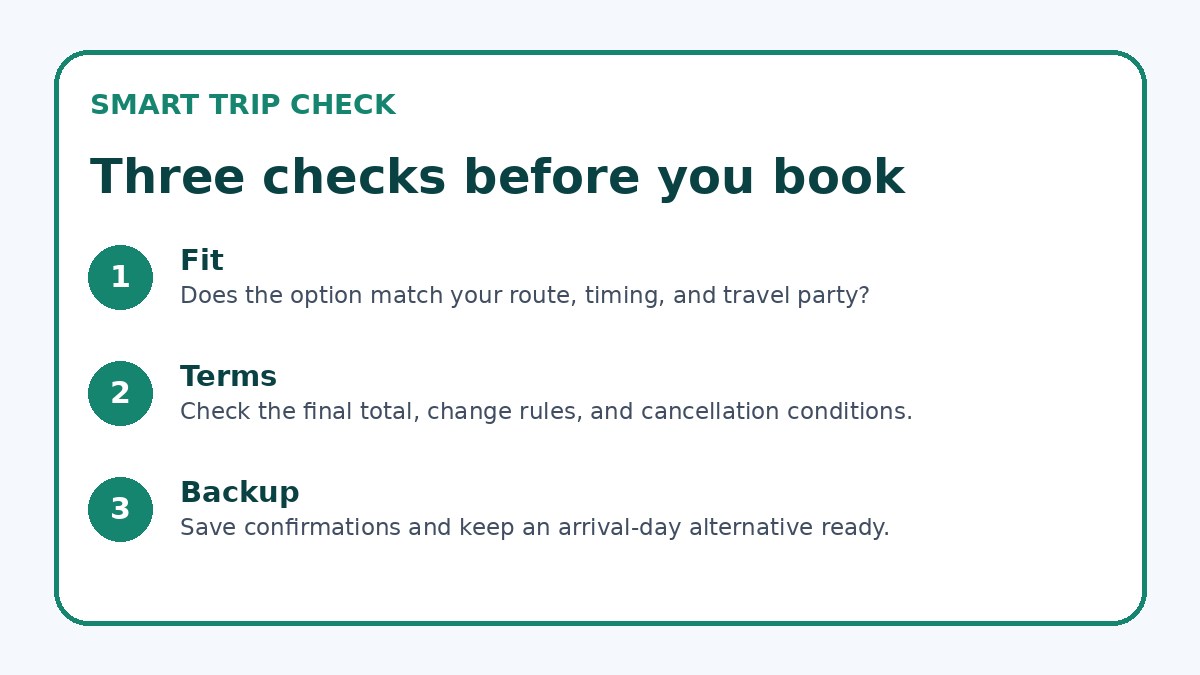
- Confirm departure and arrival terminal addresses and how you will travel between each terminal and your accommodation.
- Pack a family carry bag per adult with snacks, basic medicines, chargers, passports, wet wipes, and a change of clothes for kids.
- Reserve seats together where possible and screenshot booking confirmations and the operator’s luggage and change/refund rules.
- Plan two realistic alternate departures and note their terminals; memorize or save taxi and ride-hailing contact details for both cities.
- Measure and test-fit strollers/car seats into your vehicle or luggage spaces and check whether operators accept them onboard or require check-in.
- Set phone alarms for departure-time buffers: when to leave the hotel, when to be at the terminal, and when to recheck travel updates.
Disruption backup and what to confirm before booking
Have a clear backup plan: a later train or coach you can shift to, a nearby dayroom or hotel in case of cancellations, or a pre-identified rental car or private transfer option if public services are suspended. Families should avoid relying on last-minute seat availability; instead, identify the first and second reasonable alternate departures and note their departure points. Keep contacts and apps for taxis, ride-hailing, or the local cab company in your phone and make sure charging cables and power banks are accessible during interruptions.
Before you book, verify four things on the operator’s final page: exact terminal addresses, luggage allowance and how oversized items are handled, seat reservation and change/refund policies, and where your service ends within Gyeongju and how to continue to your accommodation. If you need to compare current availability or conditions, services like Trip.com can show options, but always confirm policy details directly with the provider you choose. Save screenshots or PDFs of your booking and the operator’s terms so you can reference them quickly on the travel day.
Rail & Intercity Transport questions travelers ask
Should we choose train or coach if we’re traveling with a toddler and stroller?
With a toddler and stroller, prioritize a plan that minimizes repeated lifting and long walks. Trains generally offer more predictable schedules and easier onboard movement, but check whether the station has elevators and whether the train operator allows strollers onboard without a separate fee. Coaches may have generous undercarriage storage but require lifting the stroller into a hold and longer roadside transfers in some terminals. Verify each operator’s stroller policy and terminal accessibility before booking, and keep a lightweight, quick-fold stroller as a backup for transfers.
How much extra time should we allow for transfers and unexpected delays on the travel day?
Allow generous buffers: plan at least 45–75 minutes from your door to the departure terminal for urban transfers, depending on distance and traffic risk, and add 30–60 minutes for potential wait or ticket collection at the terminal. For connections between modes, aim for a 60–90 minute window to account for baggage retrieval and taxi or local transfer time. If you have very young children or peak-hour travel, err toward the higher end of these windows. Check operator rebooking rules in case you miss a scheduled departure despite your buffer.
What is the simplest backup if our planned service is cancelled on travel day?
The simplest backup is a clearly identified alternate public service within a couple of hours of your original departure that you can move to quickly, plus a taxi option if public services are suspended. Before travel day, note the next two trains or coaches and confirm whether they allow same-day rebooking. If family comfort is the priority and public rebookings are uncertain, a pre-identified private transfer or short stay in a nearby hotel are viable fallbacks. Keep payment methods ready for a last-minute taxi or booking change and store operator contact details for faster assistance.
Final decision note
Planning your Seoul to Gyeongju transport day as a family means thinking beyond in-vehicle minutes: factor in terminal access, luggage handling, seat arrangements, and a clear backup. Choose the mode that fits your tolerance for transfers and disruption—rail for predictability, coach for direct terminal routing, mixed modes for balance, or private transfer for door-to-door control. Build realistic time buffers, prepare a small accessible family bag for the journey, and confirm luggage, seat, and change policies on the operator’s booking page before you purchase. With a focused travel-day plan and two alternate options, you’ll reduce stress and keep the trip enjoyable for everyone.
Continue planning
Check current options and final conditions
Use the provider page to confirm live availability, the final total, cancellation terms, and every condition that matters to your trip.
This evergreen planning guide was created with AI-assisted drafting and a structured quality review. It does not display live prices, schedules, availability, visa guidance, or provider rankings. Verify current details before booking. Some links are affiliate links; we may earn a commission at no additional cost to you.