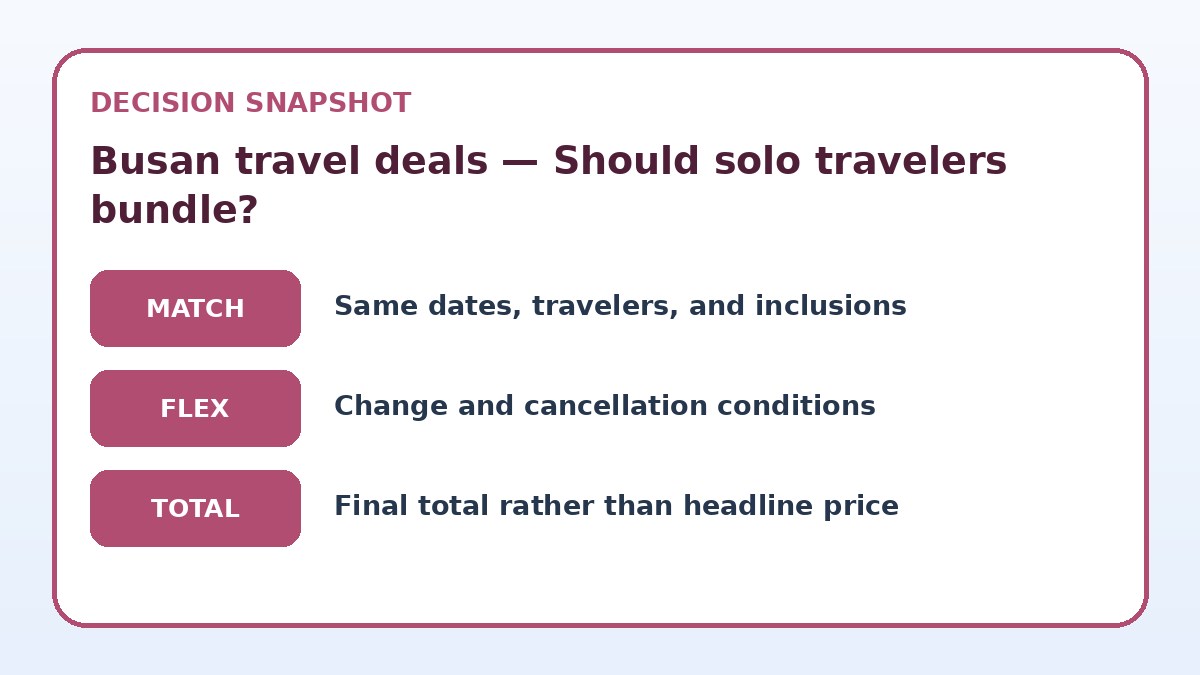
Before you can judge whether a bundled tour is a good deal for a solo trip to Busan, compare the exact scope: the same dates, the same number of travelers, identical inclusions (flight baggage, transfers, taxes), and the cancellation or change terms. Practically: if you want fewer logistics and a set itinerary, a package may save time; if you value flexibility and want to mix independent days with targeted experiences, separate bookings usually win. For most solo travelers the answer hinges on three things—how fixed your travel dates are, how comfortable you are arranging connections and local transport alone, and whether the package’s included services match what you’d otherwise buy individually. Use those criteria to test any advertised “deal” and check the provider’s final booking page for exact rules on refunds, name changes, and included services.

Test package value fairly
| Booking approach | Best for | Tradeoff to check |
|---|---|---|
| Full tour package (flight + hotel + tours) | Solo travelers who want low planning effort and guided arrangements | Less flexibility, likely single-room surcharges, and rules tied to a single contract |
| Flight + hotel package (no tours) | Travelers seeking simpler logistics with freedom for independent days | May still include single supplements and limited change options for bundled fares |
| Separate bookings for flight, hotel, and tours | Those who want maximum flexibility, neighborhood choice, and control over refunds | More time spent comparing suppliers and handling multiple policies if plans change |
| Hybrid approach (book flight or hotel in package, buy other parts separately) | Solo travelers balancing convenience for one component and flexibility for others | Can be administratively trickier and requires careful matching of dates and conditions |
Check current package and separate options
Use identical dates, travelers, room needs, baggage, and flexibility so the comparison stays meaningful.
Inclusions: what’s actually bundled
A package’s headline price can feel attractive, but its real value depends on precise inclusions. Inspect whether the package lists flights, checked baggage, airport transfers, hotel nights, daily breakfast, guided tours, entrance fees, and local taxes. If the package includes a tour or meals you wouldn’t choose, that inflates perceived savings. For solo travelers, check if single supplements apply; some packages add a surcharge for one-person occupancy, which can erase any discount compared with separate bookings.
When comparing to separate arrangements, price each element on the same dates and with the same cancellation conditions. For flights, note fare rules like baggage and change fees. For hotels, check location and room type rather than star ratings alone. For tours and transfers, confirm the pickup/drop-off points and group sizes. If a package omits transfers or has limited baggage, factor those costs in before deciding whether the bundle is truly advantageous.
Flexibility: changing plans and risk tolerance
Packages often lock in dates and suppliers to secure group rates. That can be convenient—one contract, one customer-service phone number—but it reduces flexibility. Solo travelers who might extend their stay, change arrival times, or add spontaneous side trips will usually find separate bookings more forgiving. Also check how a package handles itinerary changes: some operators allow substitutions for a fee, others treat any date change as a cancellation, which could be costly if your plans shift.
Separate bookings let you swap hotels, change flights, or skip a prearranged tour without unpicking a multi-component contract. However, managing more bookings means handling multiple supplier policies and possibly more stress during disruptions. Consider your tolerance for juggling customer service interactions and whether you prefer to have a single vendor handle refunds and rebookings in case of delays or cancellations.
Look past the headline total
Compare inclusions and change conditions before deciding whether a package is genuinely useful for this trip.
Deal comparison checklist
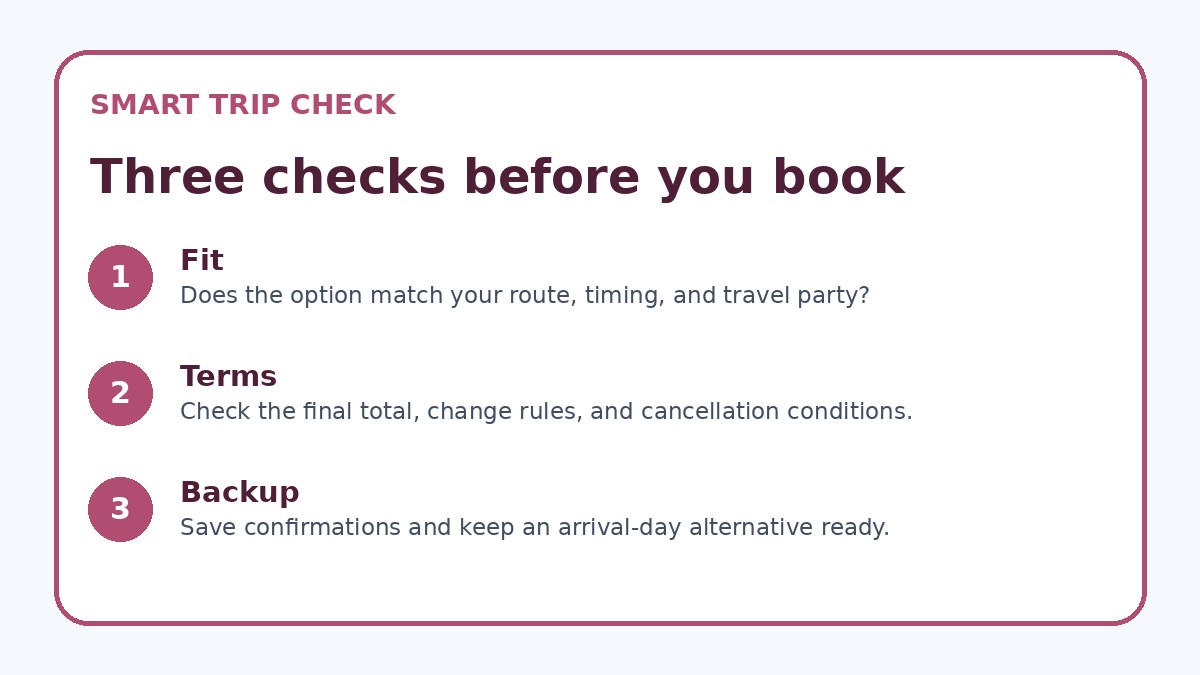
- Match the same travel dates, number of travelers, and room type when comparing package and separate totals.
- Confirm single-room supplement rules and calculate the per-person cost for solo occupancy.
- Read the cancellation and change policy on the provider’s final booking page before you pay.
- Verify what transfers include: meeting points, luggage handling, and whether wait times are covered.
- Price individual inclusions (baggage, breakfast, entrance fees) and add them to the separate-booking total.
- Save screenshots of final confirmations and supplier contact details for faster problem resolution.
Traveler-specific value: what solo travelers need
Solo travelers often prioritize location, safety, social opportunities, and cost fairness. Packages sometimes add a single-person surcharge; ask whether the package price assumes shared accommodation or charges an extra for single rooms. If you value social experiences, look for small-group departures or included social activities—but again, confirm group size and the prospect of solo mingling. If your priority is staying in a specific Busan neighborhood—Haeundae, Seomyeon, or Gwangalli—independent hotel booking typically offers better neighborhood choice.
If language support or guided navigation through Busan’s transport system matters to you, a package that includes English-speaking guides and transfers can be high value. Weigh that against the freedom to explore local markets and independent eateries at your own pace. Also consider mobility and luggage handling: if moving between hotels or attractions would be difficult alone, a package with included transfers may justify itself despite a higher headline price.
Final terms: the contract, not the brochure
Always read the final contract or booking confirmation—this is where the real terms live. Verify cancellation deadlines, refund formulas, change fees, and how the provider handles force majeure events. For flights included in packages, confirm whether the fare is changeable and who handles rebooking: the package operator or the airline. For hotels, check who bears responsibility if the property overbooks or misrepresents room features.
If you plan to book separately, screenshot and save each supplier’s final booking page and policy. For packaged offers, ask for a sample itinerary and the exact supplier names for flights and hotels; some operators sub-contract components, which affects who you call when something goes wrong. When in doubt, test the customer support contact before you commit. Trip.com is one place you can compare availability and final conditions, but always confirm details on the seller’s own booking pages.
Travel Deals & Booking Strategy questions travelers ask
How can I be sure a Busan package’s price is comparable to booking separately?
Price apples-to-apples: list every included item in the package (flight fare class and baggage, hotel nights and room type, transfers, excursions, taxes) and get independent quotes for those same items on the same dates. Include any single supplements, transfer fees, and optional add-ons the package covers. Don’t forget to compare cancellation and change penalties since those affect net cost if plans change. Only after totaling the separate quotes with identical conditions will you know whether the package is cost-effective for your situation.
Are packages safer or better value for first-time solo visitors to Busan?
Packages can reduce uncertainty—pre-booked transfers, guided introductions, and a single support number are helpful if you prefer not to navigate local transportation or language barriers. That convenience can be worth the premium for first-time visitors. But safety and value depend on the specifics: check whether the package includes meet-and-greet transfers, the guide’s language, and hotel location. If you’re comfortable using public transit and reading supplier terms, separate bookings often offer better neighborhood choices and flexible timing.
What should I verify on the supplier’s booking page before finalizing a Busan deal?
On the supplier’s final booking page, confirm cancellation windows, refund amounts, change fees, included baggage allowances, pickup locations for transfers, and whether taxes or local fees are already included. Check whether the price assumes shared accommodation or adds a single supplement. Note supplier contacts for emergency changes and whether any services are provided by third-party subcontractors—if so, find their names and policies. Keep copies of confirmations and policy screenshots for disputes or rapid rebooking needs.
Final decision note
For solo travelers planning a trip to Busan, the practical choice between a package and separate bookings comes down to matching the deal to your priorities: simplicity and consolidated support, or flexibility and neighborhood choice. Start by comparing identical dates, traveler counts, and inclusions; then weigh single-room surcharges and the package’s change and cancellation rules. If you value easy logistics and a guided introduction, a well-detailed package can be a good fit. If you expect to change plans, choose neighborhoods deliberately, or prefer different daytime activities, assembling your own trip usually offers superior control. Always verify exact terms on the supplier’s final booking page before you commit.
Continue planning
Check current options and final conditions
Use the provider page to confirm live availability, the final total, cancellation terms, and every condition that matters to your trip.
This evergreen planning guide was created with AI-assisted drafting and a structured quality review. It does not display live prices, schedules, availability, visa guidance, or provider rankings. Verify current details before booking. Some links are affiliate links; we may earn a commission at no additional cost to you.