If you're booking Seoul to Da Nang flights for business travel, the practical question is not just price but how easily you can change plans without losing time or money. For a typical short business trip you’ll balance a faster routing and reliable arrival against stricter fare rules that may penalize changes or refunds. Before you open a booking page, gather exact travel dates, passport details, a preferred connection window, and firm or flexible meeting times. That preparation lets you compare fare classes and ancillary policies efficiently. This guide focuses on the decision drivers: routing and connections, baggage and missed-connection risk, schedule fit for meetings, and the fine print on change and cancellation fees—plus what to verify on the airline or reseller final page.
See live routes for your exact travel day
Compare direct and connecting choices with the same baggage and traveler details.
Routing: direct versus connecting options
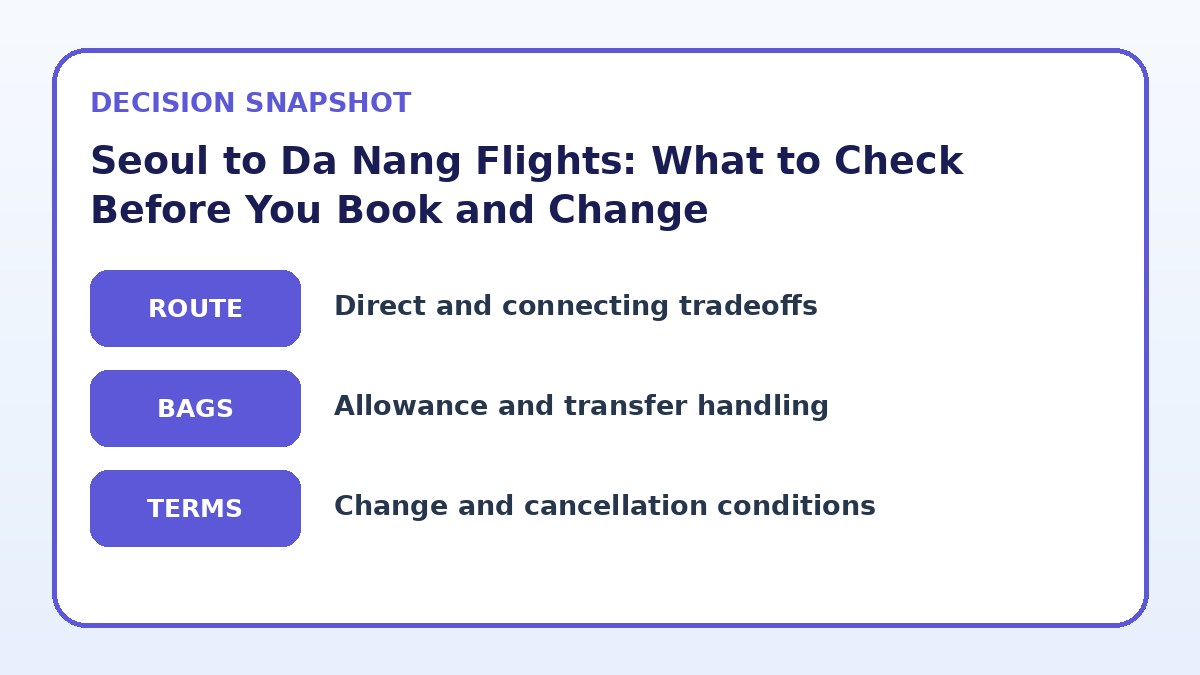
On the Seoul to Da Nang route you’ll typically compare flights with zero or one connection. Direct services (if offered) minimize connection risk and save time but often come in fewer fare buckets with limited flexibility. Connecting itineraries can be cheaper or offer later rebooking options through multiple carriers, yet they increase the chance of missed connections, schedule complexity, and disparate change rules across carriers on a single ticket. For business trips where schedule reliability matters, prioritize fewer connections and check how the ticket treats disruptions.
When evaluating a connecting itinerary, verify where the layover is, the minimum connection time at that airport, and whether the carriers have an interline agreement that covers missed connections and luggage transfer. Confirm whether the carrier issues a single ticket with through-checked baggage and unified change policy, or separate tickets requiring you to rebook each leg. On the airline’s final booking page, check the transfer and misconnection assistance language and whether the ticket includes protected connections or simply publishes flight times.
Baggage and connection risk for business travelers
Business travelers often travel with a carry-on and a checked bag; fare class determines whether checked baggage is included. Low-fare options may look attractive but require added baggage fees, which change the total cost and complicate refunds or reissuance. If the itinerary has a tight connection and baggage must be rechecked, you face higher misconnection risk. Confirm whether checked baggage is through-checked to Da Nang or must be collected and rechecked during transit, and factor potential recheck times into your schedule.
If you rely on hand luggage only, confirm airline size and weight limits to avoid last-minute gate fees or forced check-in that alters change/refund eligibility. For itineraries booked via multiple carriers on one PNR, baggage rules could follow the most restrictive carrier. Always read the carrier’s baggage allowance displayed on the final booking screen; if booking via an agent or Trip.com, open the airline’s official fare rules afterwards and verify checked-baggage inclusion, fees, and how baggage affects refunds and rebooking options.
Compare flight-selection strategies
| Flight strategy | Best for | Risk to check |
|---|---|---|
| Buy a flexible business fare (higher base fare) | Travelers prioritizing schedule certainty and easy, low-cost changes | Higher upfront cost but simpler rebooking and clearer refund rules |
| Purchase the lowest nonrefundable fare and add baggage | Travelers with fixed dates who want minimal base cost | Lower price but higher change penalties and added baggage expenses |
| Book a connecting itinerary to save fare | Those willing to accept longer travel time for a cheaper ticket | Increased missed-connection risk and potential mixed-carrier rule complexity |
| Use a corporate travel agency or managed travel platform | Companies that want policy compliance and centralized support | May have less price flexibility but faster assistance for changes and disruptions |
Recheck the complete itinerary
Confirm airports, connection handling, baggage, and change conditions before deciding.
Schedule fit: arrival windows and business constraints
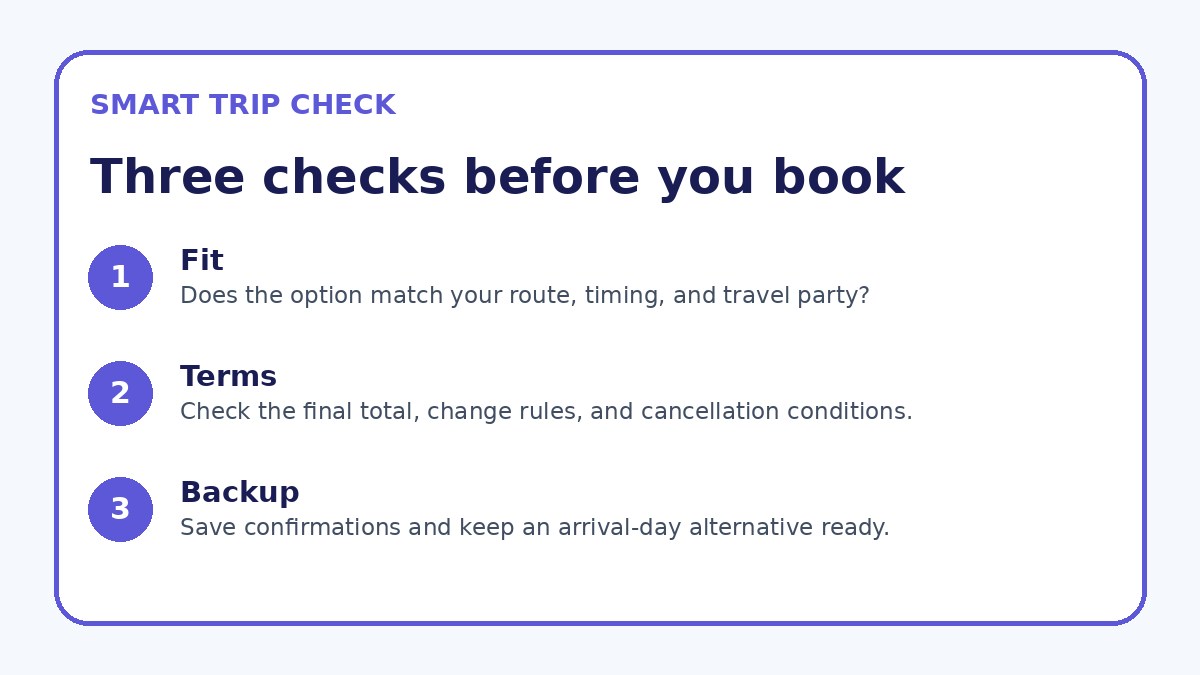
For meetings, arrival window is often the decisive factor. Late arrivals that require same-day transfers to clients or venues increase stress and risk. Choose flights that arrive with enough buffer for customs, ground transfer, and a margin for delays—typically a couple of hours for in-city meetings. If your trip includes an onward domestic connection inside Vietnam, add additional buffer to clear immigration and collect luggage. When comparing options, align departure times from Seoul with the earliest realistic meeting start time in Da Nang, then eliminate itineraries that compress margins below your acceptable risk threshold.
Also consider outbound flexibility: do you need a guaranteed evening return in Seoul or can you accept a ticket that requires paying a change fee to rebook? If meetings are tentative, favor fares that allow fee-free date changes or at least lower reissue penalties. On the final airline or reseller page, check the exact rebooking windows and any blackout dates that could affect using a credit or voucher. If you rely on a corporate travel policy, confirm whether your company reimburses change fees or prefers a specific fare family.
Flight details to verify
- Collect exact traveler names as on passport, passport numbers, and contact phone and email before starting any booking.
- Decide your acceptable arrival window in Da Nang and minimum layover time for any connecting options.
- Compare fare rules on the airline’s official page: change fees, refund types, blackout dates, and credit expiry.
- Confirm whether checked baggage is included; if not, calculate baggage fees and how they affect refunds or reissues.
- If booking connecting flights, verify whether baggage is through-checked and if the itinerary is on a single ticket.
- Save screenshots or PDFs of the final fare rules and booking confirmation, and note any customer service reference numbers.
Fare conditions: change fees, refunds, and credits
Fare rules differ by fare class, channel, and whether you booked directly with an airline or through an agent. Key items to check: fixed change fees, whether you pay only the fare difference plus a fee, if refunds are allowed and in what form (cash refund, credit, or voucher), and any time limits or blackout periods for rebooking. For business travel, a fare that allows free date changes or credits toward future travel can be more valuable than a marginally lower fare with steep penalties.
When you reach the final booking page, expand the fare rules or terms and conditions link and verify: exact change fee amount, whether taxes and surcharges are refundable, how long credits remain valid, and whether the carrier charges a reissue fee if routing changes. If booking via a consolidator or Trip.com, use the airline’s official site to confirm those terms because third-party sites sometimes display summary rules that omit exceptions. If in doubt, contact the airline’s customer service and save the representative’s reference number for your records.
Flight Guide questions travelers ask
Should I always buy a refundable or flexible fare for a short business trip to Da Nang?
Not always. Refundable or flexible fares are best when your meeting schedule is uncertain and last-minute changes are likely because they reduce reissue costs and administrative hassle. If your dates are firm and the trip is short, a lower nonrefundable fare plus a paid change option or corporate travel policy backup might be more cost-effective. Evaluate the likelihood and cost of changes: multiply probable rebooking fees by change probability. Also verify the exact refund and rebooking language on the airline’s booking page before purchasing.
If I book with a third-party site, how can I be sure of the change and cancellation terms?
Third-party sites sometimes summarize fare rules; always click through to the airline’s official fare conditions linked on the booking confirmation or open a new browser tab to the carrier’s site and locate the same fare class. Verify change fees, refund type (cash, voucher, or credit), and any reissue or service charges the reseller may add. If the reseller applies separate penalties, confirm those fees in writing. Keep the airline and reseller contact details handy and save screenshots of the fare rules for reference when you need to change or cancel.
How do I reduce the risk of missing a connection on a multi-leg Seoul to Da Nang itinerary?
Choose connections with longer minimum layovers that account for arrival immigration, potential delays, and baggage transfer times. Prefer single-ticket itineraries because carriers are likelier to protect connections and rebook you on the next flight at no extra fare difference beyond any published policy. If you must book separate tickets, allow substantial buffer time, and be prepared to handle a missed connection yourself—this often means additional cost. Check the airline’s wording on protected connections and the conditions for rebooking due to delays on the carrier’s final booking page.
Final decision note
For business travelers on Seoul to Da Nang flights, the right choice balances arrival reliability with fare flexibility. Prioritize fewer connections and fare classes that match your change-risk tolerance: pay up front for flexible business fares when meetings are uncertain, or choose lower fares and purchase protections where dates are fixed. Always gather exact traveler and schedule details before you search, and verify the full fare rules on the airline’s official booking page—checking change fees, refund type, baggage inclusion, and credit expiry. If you use an agent or Trip.com, follow up with the carrier’s terms to confirm any third-party differences. Doing this research before booking prevents costly surprises and preserves time for what matters: the meeting.
Continue planning
Check current options and final conditions
Use the provider page to confirm live availability, the final total, cancellation terms, and every condition that matters to your trip.
This evergreen planning guide was created with AI-assisted drafting and a structured quality review. It does not display live prices, schedules, availability, visa guidance, or provider rankings. Verify current details before booking. Some links are affiliate links; we may earn a commission at no additional cost to you.